
You’ll need one light per 200 300 square feet of pool surface, though your actual requirements depend on several factors. Your pool’s shape, finish color, and depth all influence fixture placement and quantity. Dark finishes absorb more light, so they’ll require 1.5 times more fixtures than light finishes. LED technology offers superior energy efficiency and longevity compared to halogen or HID options. Proper transformer sizing and safety compliance are essential for ideal performance. Understanding how these elements interact reveals the complete picture for your specific pool.
Calculating Light Requirements by Pool Size
To determine how many lights your pool needs, you’ll want to start with a straightforward calculation based on surface area. A simple rule of thumb divides your pool’s square footage by 200 300 to estimate the number of fixtures required. For example, a 384 sq ft pool needs approximately three lights, while larger pools scaling beyond 800 sq ft demand at least three or more fixtures.
However, surface area alone doesn’t tell the complete story. You’ll also need to take into account lighting intensity requirements and fixture beam spread. These factors directly impact how effectively each light covers your pool’s dimensions. High-output fixtures with broader beam spreads can cover more area than smaller ones. Narrow beam angles create stronger visual effects but require more precise positioning to avoid dark spots in your pool. LED lights typically last up to 100,000 hours, providing long-term reliability for your pool lighting system. Before purchasing replacement fixtures, you should measure the diameter of your light fixture front face to ensure compatibility with your existing niche. Always consult manufacturer specifications for lumen output and perfect spacing to guarantee uniform illumination across your entire pool surface.
Accounting for Pool Shape and Layout
While surface area provides a useful baseline for light quantity, your pool’s actual shape and layout demand far more nuanced consideration. Complex geometries require sectional zoning to guarantee individualized light coverage across varied surfaces.
Your pool’s design features significantly impact fixture placement:
- Curved walls need strategic positioning concave curves allow wider spacing, while convex curves require additional fixtures to prevent shadowed areas
- Architectural elements like entry steps, tanning ledges, and swim-outs necessitate dedicated lighting to maintain visibility and accentuating design features
- Dark pool finishes demand higher wattage or increased fixture count regardless of shape to achieve adequate illumination
Rectangular pools benefit from uniform 8-foot spacing, while L-shaped and kidney-shaped designs require individualized placement at each section. Angular pools particularly benefit from corner fixtures that highlight modern aesthetics while preventing shadow pooling. Lights positioned a minimum of 18 inches underwater ensure optimal visibility while maintaining aesthetic appeal. Staggered, overlapping beam spreads eliminate both hot spots and cold spots effectively. Multi-color LED lighting enhances the emotional experience while maintaining energy efficiency across all fixture types. As a general rule, aim for minimum 1 light per 200-300 square feet to ensure comprehensive coverage across your entire pool surface.
Optimal Light Placement and Spacing
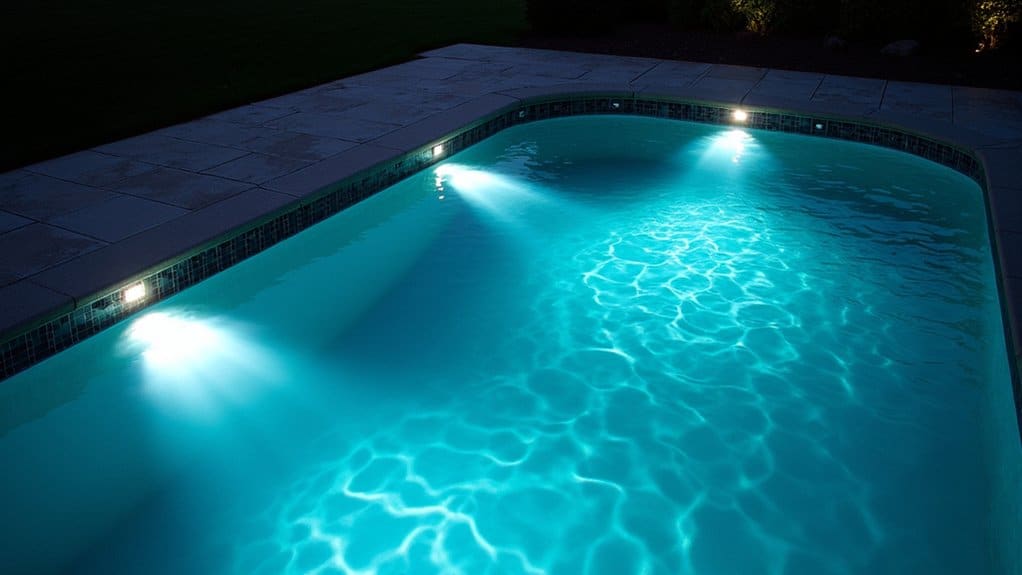
Proper fixture positioning builds on the foundational principle that you’ll need approximately 1 light per 200 250 square feet of pool surface, though larger pools exceeding 500 square feet typically demand at least 2 3 fixtures to achieve even illumination. Space in-wall lights 6 to 8 feet apart, positioning them 9 12 inches below the waterline for ideal coverage. Position your first light 4 feet from pool ends to eliminate shadowing. Select wide-angle beam fixtures with 60° focused light beam angles, enabling effective spread and overlap. Stagger lights on both sides of rectangular pools rather than placing them opposite each other, ensuring uniform light distribution without gaps or hot spots. This strategic spacing prevents dark areas while maintaining balanced brightness throughout your entire pool. Using dimmable LED models allows you to adjust brightness as needed to create the perfect ambiance for any occasion.
Impact of Pool Finish on Lighting Needs
Because your pool’s finish color directly influences how much light you’ll need, understanding reflectivity differences is essential for determining your fixture requirements. Light-colored finishes reflect illumination efficiently, while dark finishes absorb up to 50% more light to achieve equivalent brightness.
Pool finish color directly influences lighting needs light finishes reflect efficiently while dark finishes absorb up to 50% more light.
Reflectivity factors directly impact your lighting plan:
- Light finishes require fewer fixtures and lower-wattage options, reducing energy consumption
- Dark finishes necessitate approximately 1.5 fixtures per single light-finish fixture, substantially increasing operational costs
- Pool depth impacts fixture placement and brightness distribution across varied water volumes
Your finish choice also affects safety and visibility. Enhanced reflectivity from lighter surfaces improves underwater visibility and supports safer swimming conditions. Dark finishes create low-visibility zones requiring targeted, strategic lighting placement to eliminate hazards and maintain uniform coverage throughout your pool. LED lights offer the highest energy efficiency for pools with darker finishes, helping offset the increased fixture requirements. Consider surface-mounted underwater lights for easier installation in pools with dark finishes where visibility optimization is critical. Smart color-changing systems can further optimize energy usage while allowing you to adjust brightness and ambiance based on your pool’s specific reflectivity characteristics.
Choosing the Right Lighting Technology
When selecting pool lighting technology, you’ll want to weigh LED efficiency and longevity against the power and transformer requirements of older halogen or HID systems, as LEDs can reduce energy consumption by 80 90% while operating for 30,000 50,000 hours compared to traditional bulbs’ limited lifespans. While halogen and HID fixtures may deliver higher brightness initially, they demand substantially greater electrical capacity and generate excessive heat, making them costlier to operate and maintain. Fiber optic lighting offers an enhanced safety alternative by eliminating electricity in the pool while allowing remote bulb replacement without draining water. Consulting a pool professional can help determine the ideal lighting configuration for your specific pool size and shape. Solar-powered lights provide an eco-friendly option that eliminates ongoing electricity costs while reducing your pool’s environmental footprint. Your choice ultimately hinges on balancing upfront installation costs, ongoing electricity expenses, and maintenance frequency against your pool’s size, desired brightness levels, and available electrical infrastructure.
LED Efficiency and Longevity
You’ll find that LED pool lights stand out as the superior choice when you weigh energy consumption against performance. They’ll consume 25 80% less power than incandescent alternatives, delivering substantial energy savings that accumulate over time. Operating costs typically run just pennies daily, offsetting initial purchase prices through long-term efficiency.
Longevity defines LED advantage. You’ll benefit from extended service lives reaching 25,000 100,000 hours, translating to 10 15 years of reliable operation. This durability guarantees minimal maintenance demands and reduced replacement frequency. With up to 50,000 hours or more, modern LED pool lights significantly extend the intervals between replacements, allowing pool owners to enjoy uninterrupted enjoyment of their aquatic spaces. Additionally, LED lights produce very little heat, making them safer and more comfortable for pool users. LEDs also provide instant-on, flicker-free illumination that enhances visibility and creates a superior lighting experience.
Key benefits you’ll experience:
- Consistent output throughout most of the lifespan without brightness degradation
- Lower carbon footprint from reduced electricity consumption
- Enhanced pool safety through superior illumination and decreased outage risk
Your investment in LED technology yields measurable returns through decreased operational costs and extended equipment lifecycles.
HID and Halogen Trade-offs
While LEDs dominate modern pool lighting discussions, HID and halogen technologies remain viable alternatives each presenting distinct advantages and limitations that merit careful evaluation. Halogen offers the lowest initial cost and simplest installation, but its shorter bulb lifespan (1,000 4,000 hours) demands frequent replacements. HID lights deliver superior brightness and efficiency with extended bulb lifespan (5,000 15,000 hours), yet require specialized ballasts and complex maintenance procedures. You’ll find halogen ideal for smaller pools prioritizing warm ambiance and straightforward upkeep. HID suits larger pools needing intense, uniform illumination across expansive areas. However, both technologies generate substantial heat and lag behind LEDs in long-term cost efficiency. Your choice depends on pool size, budget constraints, and maintenance tolerance.
Power and Transformer Requirements
After weighing halogen, HID, and LED technologies against your pool’s specific needs, you’ll need to address the electrical infrastructure that powers your chosen system. Your transformer must handle the total wattage of all fixtures while maintaining proper electrical load balancing across circuits.
Size your transformer at 125 130% of your combined lighting power to accommodate voltage fluctuations and efficiency losses. For example, ten 10W lights require a 130 150W transformer. Install protective safety features including:
- IP67-rated (minimum) or IP68 waterproof transformer housings
- GFCI protection on all circuits within 10 feet of water
- Transformers positioned 120 cm from the pool wall and 10 cm above grade
Keep your transformer loaded at no more than 80% of its peak rating for longevity. Guarantee cable runs don’t exceed 30 meters to minimize voltage drop.
Power Requirements and Transformer Sizing
Proper transformer sizing is critical to your pool lighting system’s performance and safety. You’ll need to sum the wattage ratings of all fixtures typically ranging from 9W to 86W for LED lights then select a transformer rated 10 20% above that total. This safety margin prevents dimming and component failure during simultaneous operation.
For large pools, voltage drop concerns increase markedly with longer wiring runs. You’ll want to prioritize 24V systems over 12V when distances are substantial, as higher voltage minimizes performance loss. Pair this with appropriate wiring gauge selection to maintain consistent illumination across all fixtures.
Install your transformer in a dry, ventilated location away from pool water, ensuring it’s rated for outdoor, waterproof applications. Compliance with local electrical codes is mandatory.
Safety and Aesthetic Considerations
Beyond selecting the right fixtures and transformer capacity, you’ll need to balance safety requirements with visual appeal when designing your pool’s lighting scheme. Your compliance concerns mandate adequate illumination across all areas. Steps and ledges require minimum 1-2 foot candles per NEC standards, greatly reducing accident risk. Underwater lights positioned 4-18 inches below the water surface enhance visibility and safety beyond aesthetic value.
Strategic maintenance best practices guarantee ongoing compliance:
- Inspect fixtures regularly for cracks and water infiltration that compromise IP67/IP68 ratings
- Verify uniform illumination across the entire pool surface to eliminate dark spots
- Install emergency lighting with battery backup for power outages
LED technology addresses both safety and efficiency concerns, operating continuously throughout night hours with minimal energy consumption while maintaining proper illumination levels.
Frequently Asked Questions
Can I Add More Lights Later if My Current Setup Seems Insufficient?
Yes, you can add additional light fixtures later if your current setup seems inadequate. However, retrofitting typically costs more than original installation due to labor and material requirements. You’ll need to empty your pool and install surface-mounted LED lights, which simplify the process. Plan ahead for future lighting upgrade options during initial setup to lower retrofit costs and minimize pool downtime. Consider professional installation to guarantee compliance with electrical codes and waterproofing standards.
Do Colored Pool Lights Work Well With Dark Pool Finishes?
Colored pool lights work less effectively on dark finishes than light-colored pools because darker surfaces absorb colored light readily. You’ll need high-lumen LED systems to achieve visible color effects and proper lighting ambiance. By selecting advanced, high-intensity LEDs and strategically adjusting brightness and color spectrum, you’ll overcome absorption challenges. These technical adjustments guarantee your aesthetic considerations align with your desired visual impact, transforming your dark-bottomed pool into an appealing nighttime oasis.
What’s the Minimum Depth Required for Safe Pool Light Installation?
You’ll need to install your pool lights at least 4 inches below the normal water level per NEC 680.23(A)(5). However, you should position them 18 inches deep for wall-mounted fixtures to achieve appropriate lighting depth. For ideal light placement, most professionals recommend 9-12 inches below the waterline in shallow areas and 18-24 inches in deep ends. Always verify that your luminaires are listed for underwater use and comply with local electrical codes before installation.
How Often Do LED Pool Lights Need Replacement or Maintenance?
You’ll find that your LED pool lights typically last 10 20 years under average residential use, requiring full bulb replacement infrequently. However, you should establish an annual maintenance schedule to inspect fixture seals, connections, and water chemistry levels. You’ll need occasional gasket or fitting replacements every 5 10 years to prevent leaks. This proactive approach maximizes your bulb lifespan and guarantees ideal performance while minimizing costly repairs down the road.
Are Dimmer Controls Available for Adjusting Pool Light Brightness Levels?
Yes, you can install dimmer controls for most modern LED pool lights. You’ll need a dedicated LED driver or controller to enable dimming functionality. Before dimmer control installation, verify compatibility with your existing wiring, transformer, and light fixtures. Wireless RF remotes and WiFi-enabled systems offer convenient brightness adjustments. Professional installation guarantees safe, code-compliant connections for your outdoor wet-location lighting setup.