
To choose the right pool filter, you’ll need to match filtration type to your priorities. Sand filters capture particles at 20 40 microns and cost $200 $800, cartridge filters trap 10 20 microns without backwashing, and DE filters deliver the finest clarity at 2 5 microns but demand the most maintenance. Size your filter’s GPM rating above your pump’s output, and factor in long-term replacement costs. Below, you’ll find the exact specs to narrow down your best option.
Sand, DE, and Cartridge Filters: How Each Type Works

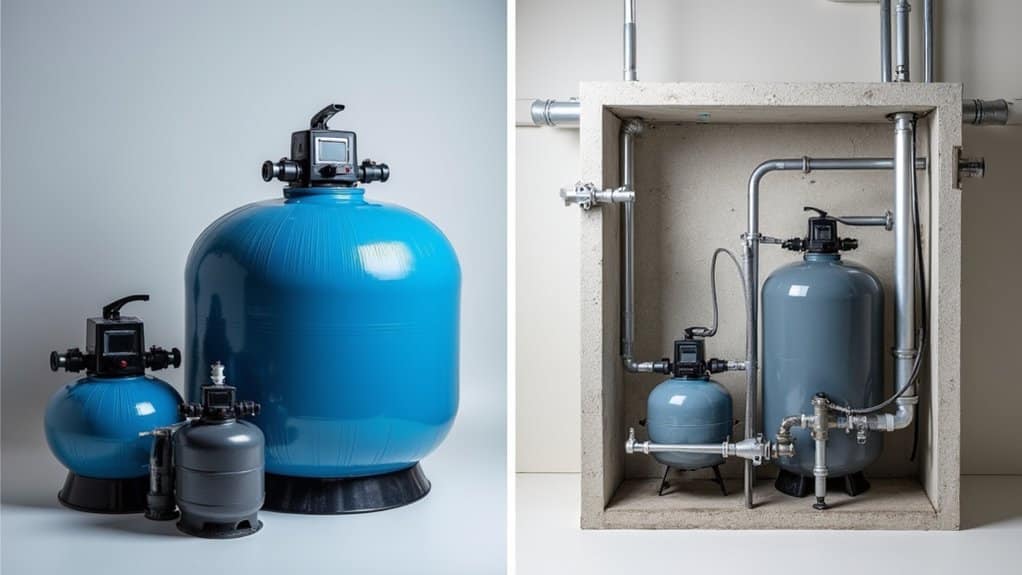
When selecting a pool filter, you’ll need to understand how each type mechanically removes contaminants from your water. Sand filters push water through #20 grade silica sand (45-55 mm), trapping particles at 20-40 microns. Cartridge filters use pleated polyester media with up to 300 sq ft of surface area, capturing particles at 10-20 microns without backwashing. DE filters coat fine grids with diatomaceous earth powder, achieving filtration down to 2-5 microns. DE filters are composed of microscopic sea creature skeletons, making them the most effective at removing fine debris from pool water.
In the sand vs cartridge vs DE filter comparison, each mechanism dictates maintenance requirements. Sand demands backwashing at 10 psi above normal pressure. Cartridges require periodic hose cleaning and replacement every 6 months to 3 years. DE filters need annual grid removal, inspection, and regular powder refills.
What Micron Ratings Mean for Your Pool’s Water Clarity
A filter’s micron rating defines the smallest particle size it can effectively capture one micron equals one-millionth of a meter, so lower numbers mean finer filtration. Understanding these ratings helps you maximize pool filter efficiency and water clarity.
Here’s how common filter types compare:
- DE filters capture particles down to 5 microns, trapping bacteria-sized contaminants.
- Cartridge filters catch particles around 10 15 microns, removing household dust and fine sediment.
- Sand filters trap particles in the 30 40 micron range, filtering pollen and larger debris.
- Sub-5-micron filters clog rapidly under high sediment loads, requiring frequent maintenance.
You should note that tighter pores increase water resistance and reduce flow rate. Using staged filtration with varying micron ratings extends filter life while maintaining precise contaminant removal.
Pool Filter Costs, Maintenance, and How Long Each Lasts
When you’re comparing pool filters, upfront costs range from $200 $800 for sand filters, $200 $1,000 for cartridge filters, and $400 $1,200 for DE filters, with installed prices pushing DE systems up to $2,500. Maintenance demands vary greatly: sand filters require backwashing and sand replacement every 3 5 years, cartridge filters need cleaning and replacement every 1 3 years at $100 $300 per cartridge, and DE filters demand the most frequent attention through regular powder refills. These differences in purchase price, maintenance frequency, and component lifespan directly affect your total cost of ownership over the filter’s service life.
Upfront Purchase Costs
Three distinct price tiers separate sand, cartridge, and DE pool filters at the point of purchase. Your upfront purchase costs depend directly on filtration capacity and pool filter sizing requirements. Here’s what you’ll pay for each type: When considering your options, you should also think about how to choose a pool vacuum that suits the specific needs of your pool. Factors like pool size, surface type, and personal maintenance preferences will play a significant role in your decision-making process.
- Sand filters $250 $600 per unit, with installed costs reaching $500 $1,200. Brands like Intex start at $80 for above-ground models.
- Cartridge filters $300 $900 per unit, with installed costs between $700 $1,600. Pentair cartridge models run $300 $1,000.
- DE filters $400 $1,200 per unit, with installed costs from $1,200 $2,500. Hayward’s Pro-Grid 36 sq. ft. model costs $1,099.
- Average installed cost $1,350 across all filter types.
DE filters carry the highest upfront investment due to complex internal grid assemblies and superior micron-level filtration components.
Maintenance Requirements Compared
Each pool filter type demands a distinct maintenance routine, though all three share one universal trigger: clean or backwash once your pressure gauge reads 8 10 psi above the system’s baseline. Sand filters require backwashing every 4 6 weeks followed by a rinse cycle the simplest pool maintenance filter routine available. Cartridge filters need hose rinsing every 2 4 weeks plus deep soaking in cleaning solution every 3 6 months, but they eliminate backwashing entirely, conserving water and chemicals. DE filters carry the heaviest demands: backwashing every 4 8 weeks, fresh DE powder replenishment after each cycle, full grid cleaning every 3 6 months, and annual grid inspections for tears. Schedule additional maintenance after storms, heavy swimmer loads, or peak season use to prevent contaminant buildup and pump strain.
Filter Lifespan Expectations
Because each filter type uses different media and construction materials, lifespan varies considerably across sand, cartridge, and DE systems though all three can support 20 30 years of total system operation with proper care.
Key lifespan benchmarks for each pool filtration system type:
- Sand filters: Media lasts 5 10 years; tanks endure 15 20 years with routine maintenance.
- Cartridge filters: Elements require replacement every 2 5 years; oversizing your filter can double cartridge life.
- DE filters: Grids last 2 5 years, with replacement costs averaging $200 per cycle; housing exceeds 10 years.
- Replacement indicators: Monitor for sustained pressure drops or persistent water cloudiness both signal degraded media performance.
Pool size, usage frequency, water chemistry balance, and environmental debris load directly accelerate or extend these intervals. When considering these factors, the choice between above ground vs in ground pool pump becomes crucial. Each type of pump has its own efficiency and maintenance requirements that can impact the overall health of your pool.
Match Your Pool Filter to Your Pool Size and Environment
When sizing a pool filter, you’ll first need to calculate your pool’s volume in gallons using the correct formula for its shape rectangular pools use Length × Width × Depth × 7.5, round pools use 3.14 × Radius² × Depth × 7.5, and irregular shapes use Length × Width × Depth × 5.9 as an approximation.
Once you’ve determined volume, divide by 8 to get gallons per hour, then by 60 for GPM. This flow rate dictates filter capacity. When learning how to choose a pool filter, always select one with a GPM rating exceeding your pump’s output. Sand filters suit pools under 15,000 gallons at 21 24″ diameter. Cartridge filters require 100 square feet per 10,000 gallons. In water-restricted areas, cartridge filters eliminate backwashing waste. Once you’ve determined your pool volume, divide by 8 to get gallons per hour, then by 60 to calculate GPM, as this flow rate defines the appropriate filter capacity. When learning how to choose a pool filter, always pick a unit with a GPM rating higher than your pump’s output for optimal efficiency. Sand filters work well for pools under 15,000 gallons with a 21 24″ diameter, while cartridge filters need about 100 square feet per 10,000 gallons and are ideal in water-restricted areas since they eliminate backwashing waste an important consideration alongside how to choose pool heater size for a properly balanced system.
Sand Filter Media Upgrades: Zeolite, Glass, and FilterBalls
Standard silica sand filters down to only 20 40 microns, but upgrading your filter media can dramatically close that gap. If you’re searching for the best pool filter type without replacing your entire system, consider these high-performance alternatives:
Upgrading your filter media can dramatically improve filtration no full system replacement required.
- Zeolite sand filters to 2 5 microns, traps ammonia, reduces chloramines, and requires 50% less media by volume than silica sand.
- Glass media achieves 3 5 micron filtration, lasts 2 3 times longer than sand, and cuts backwash water usage by approximately 23%.
- FilterBalls capture particles at 5 15 microns and hold up to 20 times more debris than silica sand.
- All three options reduce backwash frequency, lower long-term maintenance costs, and extend equipment lifespan.
When to Replace or Upgrade Your Pool Filter
How do you know it’s time to replace or upgrade your pool filter rather than simply service it? Monitor these critical indicators: pressure gauge readings consistently 8 10 psi above your clean baseline, persistent cloudy water despite proper chemical balance, and visible debris bypassing your pool water filtration system.
Inspect for physical deterioration cracked tanks, torn cartridge pleats, worn grids, or broken laterals. Listen for grinding, rattling, or hissing sounds signaling internal damage. If you’re cleaning more frequently without performance improvement, your filter’s likely past its service life. Cartridge filters typically last 3 5 years.
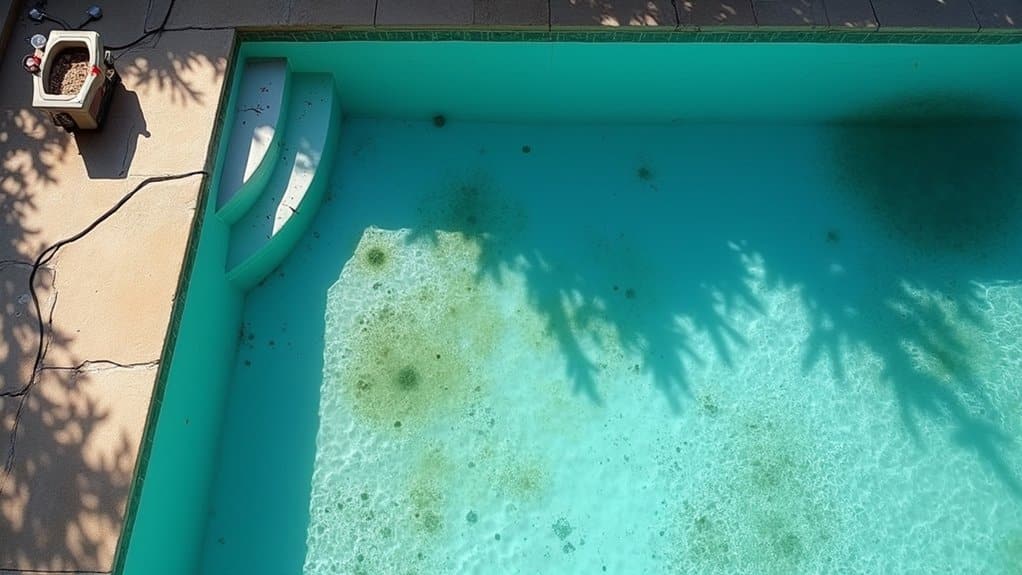
Watch for weak return jet flow, rising energy bills, and algae growth despite balanced chemistry. These signs confirm your filter can’t maintain adequate circulation or particle capture efficiency. Replacement restores system performance.
Which Pool Filter Type Is Right for You?
Ultimately, which filter type best matches your pool depends on three measurable factors: particle capture efficiency, maintenance demands, and total cost of ownership. Evaluate each filter against your specific debris load and clarity requirements.
Use these specifications to narrow your pool cleaning system selection:
- DE filters capture 1 5 microns choose these if water clarity is your top priority and you’ll commit to periodic media replacement.
- Cartridge filters handle 10 20 microns with no backwashing, making them ideal for compact equipment pads and energy-conscious setups.
- Sand filters trap 20 40 microns at the lowest upfront cost, suiting high-volume commercial applications.
- Zeolite sand alternatives boost standard sand filtration closer to cartridge-level performance without tank modifications.
Frequently Asked Questions
Can You Use a Pool Filter With a Saltwater Pool System?
Yes, you can use any standard pool filter sand, cartridge, or D.E. with a saltwater pool system. Saltwater systems are engineered with corrosion-resistant components that are compatible with all three filter types. You’ll want to select your filter based on pool size, filtration micron rating, and your maintenance preferences rather than the saltwater chemistry itself. Brands like AquaPro even offer warranties specifically covering saltwater pool filtration setups, ensuring long-term system reliability.
Do Pool Filters Remove Bacteria and Viruses From Pool Water?
Pool filters trap bacteria but don’t fully remove viruses on their own. Sand filters capture about 25% of Cryptosporidium oocysts per pass, while adding coagulants like polyaluminum chloride boosts removal above 99%. Microfiltration at 0.1 microns blocks most bacteria, but you’ll need ultrafiltration (0.01 microns) to catch some viruses. You should pair your filter with UV disinfection or chemical sanitizers to effectively neutralize both bacteria and viruses.
How Does Water Temperature Affect Pool Filter Performance and Efficiency?
Water temperature directly impacts your filter’s performance through viscosity changes. Cold water (5°C) exhibits approximately 50% higher viscosity than the 20°C baseline, increasing pressure drop and reducing flow rates. You’ll need to size your system for worst-case cold temperatures to guarantee adequate startup pressure. In extreme heat above 100°F, evaporation concentrates debris, forcing your filter to work harder. You should also monitor cartridge material limits, as polypropylene degrades near 140-176°F.
Can You Run a Pool Without a Filter for Short Periods?
You can run your pool without a filter for 24 to 48 hours before water quality deteriorates considerably. During this window, you’ll need to manually skim debris, vacuum the basin, and test chemical levels frequently. Add liquid chlorine diluted 10:1 to maintain proper sanitation. Brush surfaces daily to prevent algae formation. However, hot temperatures, heavy bather loads, and debris exposure accelerate contamination, so you shouldn’t exceed this timeframe without restoring filtration.
Are Pool Filters Compatible With Automatic Pool Cleaning Robots?
Pool filters and robotic pool cleaners operate independently, so you don’t need to worry about direct compatibility. Your robotic cleaner runs on its own power via a GFCI outlet and filters debris internally using built-in cartridges fine, ultra-fine, or NanoFilter options depending on your model. This setup reduces strain on your main pool filter. You’ll want to match your robot’s filter type to your pool’s specific debris and water clarity requirements.