
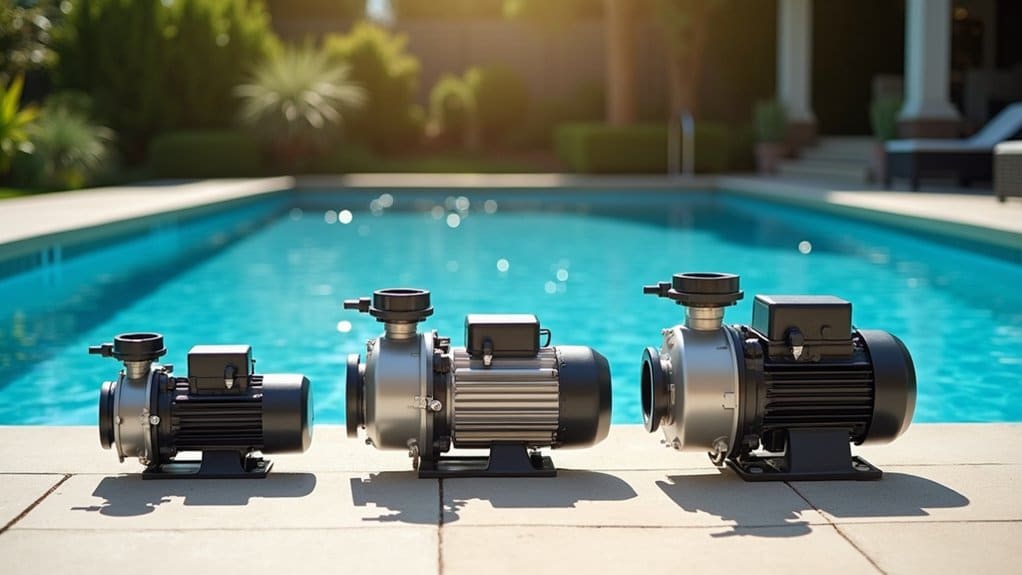


To find the right pool pump size, you’ll need to calculate your pool’s volume in gallons, determine a target turnover rate of 8 10 hours, and divide volume by turnover time in minutes to get your required GPM. You’ll also need to factor in your system’s total dynamic head (typically 30 60 feet for residential pools) and match those specs to your plumbing diameter and filter capacity. Below, we’ll break down each calculation step by step.
Calculate Your Pool’s Volume for Pump Sizing

Accurate volume calculation forms the foundation of proper pump sizing get this number wrong, and every downstream decision suffers. For rectangular pools, multiply length × width × average depth × 7.5 to determine gallons. A 32 ft × 16 ft pool with 5.5 ft average depth yields 21,120 gallons. Round pools require 3.14 × radius² × depth × 7.5. A pool water volume calculator can simplify this process by providing immediate feedback when you enter your pool dimensions. For variable depth pools, calculate average depth by adding the shallow and deep ends together and dividing by two before plugging that figure into your formula.
Once you’ve established volume, you can address what size pool pump do you need through pool flow rate calculation. Divide total gallons by your target turnover time (typically 8 hours) to get gallons per hour, then divide by 60 for GPM. This GPM figure drives your pool pump horsepower calculation, ensuring you spec a unit that matches your system’s exact hydraulic demands. Keep in mind that estimating volume without measuring can result in up to 10% error, leading to improper pump sizing and water chemistry challenges down the line.
Pick the Right Turnover Rate for Your Pool
Because turnover rate directly dictates the flow rate your pump must deliver, selecting the correct target value is a non-negotiable step in the sizing process. Industry standards specify a minimum turnover of 6 hours, but most residential applications target an 8 10 hour cycle for ideal filtration. Your pool circulation system pump should complete at least two full water cycles within every 24-hour period.
For any pool pump sizing guide to yield accurate results, you’ll divide your pool’s total volume by the target turnover rate to establish the required flow rate in GPM or cubic meters per hour. Commercial facilities demand stricter turnover rates based on pool dimensions and maximum bathing load calculations, so always verify local regulatory requirements before finalizing specifications.
Figure Out How Many GPM Your Pool Needs
How precisely you calculate your required flow rate in gallons per minute determines whether your pump delivers adequate circulation or falls short. Apply this formula: divide your pool’s total volume by your target turnover time in minutes. A 16,830-gallon pool with a 480-minute turnover yields 35.06 GPM your minimum threshold for proper swimming pool pump selection.
Your plumbing constrains maximum flow: 1.5-inch lines cap at 42 GPM, while 2.0-inch pipes handle 73 GPM. Target the 50 60 GPM range for ideal pool pump efficiency. A variable speed pool pump lets you dial flow rates precisely between your calculated minimum and pipe-imposed maximum, eliminating guesswork. Match your GPM requirement to pump performance curves before finalizing your specification.
What Total Dynamic Head Means for Your Pump
GPM alone doesn’t determine your pump’s real-world performance Total Dynamic Head (TDH) defines the actual resistance your pump must overcome to move water through the entire system.
TDH combines three components: static head (vertical lift from water level to discharge point), friction head (energy lost through pipes, fittings, and valves), and velocity head (kinetic energy calculated as V²/2g). You’ll calculate TDH using this formula: Static Head + Friction Head + Velocity Head.
For accurate sizing, you must match your required GPM and calculated TDH to a pump’s performance curve. A pump operating at mismatched TDH wastes energy, shortens equipment life, and delivers poor circulation. Most residential pools fall between 30 60 feet TDH. Higher TDH demands greater horsepower to maintain adequate flow rates through your filtration system.
Match Your Pump to Your Plumbing and Filter
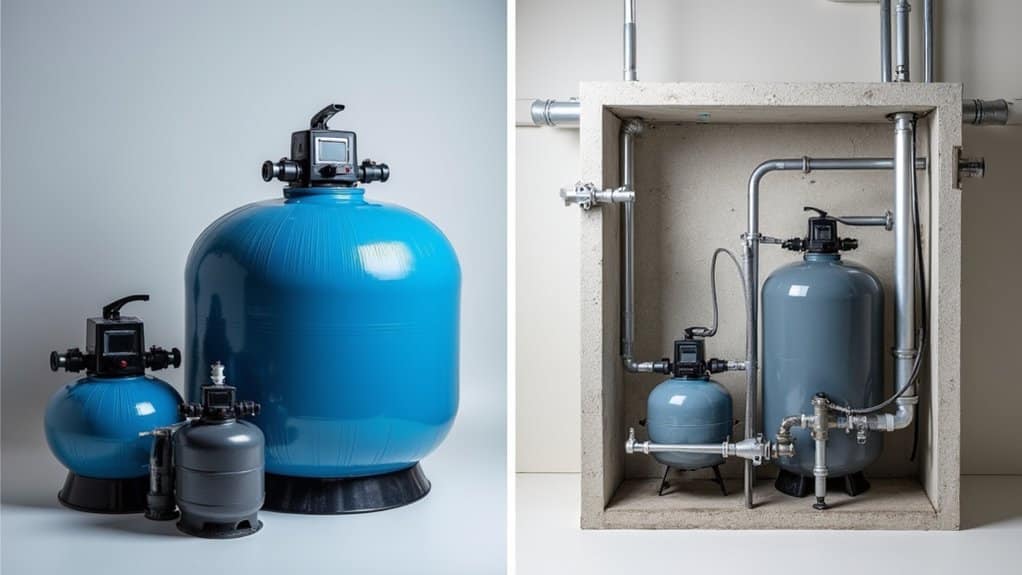
Your pump’s flow rate must stay within the limits set by both your plumbing diameter and your filter’s maximum capacity whichever is lower defines your system’s true ceiling. With 1.5-inch PVC, you’re capped at 42 44 GPM. Two-inch PVC handles up to 73 GPM. If your filter supports 96 GPM but your plumbing maxes at 73 GPM, your system limit is 73 GPM.
Exceeding these thresholds risks motor overheating, filter media breakdown, and pump damage. Always oversize your filter relative to your pump a larger filter like the Hayward S210T over the S180T pairs better with a 1.5 HP pump. It holds more debris, reduces cleaning frequency, and lowers pump stress. Select a pump rated between your minimum turnover GPM and your system’s maximum flow.
Choose the Right Horsepower for Your Pool Size
Once you’ve confirmed your pool’s gallon count and required GPM, you can match the correct horsepower to your specific volume range pools between 15,000 and 25,000 gallons typically need 0.75 1.0 HP for single-speed or 1.0 1.5 HP for variable-speed models. Oversizing your pump beyond these specs forces excess flow through your plumbing and filter, increasing energy costs and accelerating wear on system components. You’ll get the best performance by selecting the lowest HP that consistently meets your calculated turnover rate without pushing the system past its designed capacity.
Match HP to Gallons
Five key variables pool volume, turnover rate, flow rate, plumbing diameter, and total dynamic head determine the exact horsepower you’ll need from your pump. Use these benchmarks to match HP to your pool’s gallon capacity:
- 8,000 12,000 gallons: 0.75 1.0 HP delivering 17 25 GPM
- 12,000 18,000 gallons: 1.0 1.5 HP delivering 25 38 GPM
- 18,000 24,000 gallons: 1.5 2.0 HP delivering 38 50 GPM
- 24,000 35,000 gallons: 2.0 2.5 HP delivering 50 73 GPM
- 35,000 50,000 gallons: 2.5 3.0 HP delivering 73 104 GPM
These ratings assume a standard 8-hour turnover and 2-inch plumbing on in-ground systems with 50 60 feet of total dynamic head. If you’re running 1.5-inch pipes or exceeding 60 feet of head, you’ll need to upsize. Always verify your pump’s performance curve against your system’s specific resistance profile.
Avoid Oversizing Your Pump
Although it’s tempting to install the highest-horsepower pump available, exceeding your system’s design parameters causes more damage than undersizing ever will. A 200LPM pump paired with a 150LPM-rated filter overpressures internal elements, cracking manifolds, ripping cartridges, and breaking grids. Your pressure gauge reads high even after cleaning because the pump forces water beyond the filter’s capacity.
You’ll also violate suction safety standards. A 3HP pump on a single 2-inch PVC line generates entrapment hazards and exceeds safe water velocity thresholds. The pump operates off its best efficiency point, wasting energy as heat and vibration. HI standards recommend 80 110% BEP operation anything below risks cavitation and seizure. Match your pump’s flow rate to your filter’s capacity and plumbing diameter, not your pool’s square footage alone.
Single-Speed vs. Variable-Speed Pool Pumps
When comparing single-speed and variable-speed pool pumps, you’ll find the most significant difference in energy consumption single-speed models draw a constant 1.5-2 kW, while variable-speed pumps operate at 200-800 watts on lower settings, cutting electricity use by 50-90%. Variable-speed pumps equipped with VFD technology let you program specific RPM settings to match circulation, cleaning, or heating demands, delivering only the flow rate your system actually requires. Although variable-speed units cost $800-1,500 upfront compared to $300-600 for single-speed, you’ll typically recoup the difference within 1-2 years through annual savings of $300-700.
Energy Efficiency Comparison
Single-speed pumps draw a fixed 1,500 2,500 watts regardless of your pool’s actual circulation demand, while variable-speed models operate across a 300 1,200 watt range by adjusting motor RPM to match real-time flow requirements. At 8 hours daily, a 2,000-watt single-speed consumes 480 kWh monthly versus just 72 kWh for a variable-speed unit at 300 watts.
Consider the real impact on your energy bill:
- Daily draw: 16 20 kWh (single-speed) vs. 2.4 kWh (variable-speed)
- Monthly consumption: 480 600 kWh vs. 72 kWh an 80 90% reduction
- Annual cost: up to $918 (single-speed) vs. a fraction with variable-speed
- Household impact: single-speed pumps drive 40 50% higher total electricity usage
Variable-speed technology delivers up to 70% annual cost savings without sacrificing circulation performance.
Speed Control Benefits
Beyond raw energy savings, variable-speed pumps reveal five key performance advantages that single-speed models can’t match. You gain precise flow rate adjustability, matching output to your pool’s exact volume requirements. Extended low-speed operation delivers superior filtration and chemical distribution compared to single-speed high-RPM bursts.
Noise reduction is substantial variable-speed units run as low as 600 RPM versus single-speed’s fixed 3,450 RPM, eliminating disruptive motor noise in residential settings. You’ll also access programmable speed settings for task-specific operation, including vacuuming and circulation modes, plus self-priming capabilities.
From a regulatory standpoint, DOE mandates now favor variable-speed pumps for new installations and replacements. You achieve over twice the water turnover at comparable energy consumption, and many states offer rebates that offset your upfront investment.
Cost and Savings
The performance advantages of variable-speed pumps translate directly into measurable cost differences that affect your total investment over the pump’s lifespan. Variable-speed units cost $500 $1,000 more upfront, but their permanent magnet motors operate at 90% efficiency versus 30 70% for single-speed induction motors.
Consider the real numbers that impact your wallet:
- Monthly operating cost for a single-speed 1.5 HP pump runs $45.96 at 5 hours/day
- Energy reduction at half speed reaches one-eighth consumption per ENERGY STAR data
- Annual savings hit up to 90% compared to single-speed operation
- 84-month cycle savings total $4,297.10 on a 20,000-gallon pool
You’ll recoup your additional investment within 1 2 years. After that, every dollar saved goes directly back into your budget.
Signs You Picked the Wrong Pool Pump Size
Several clear warning signs indicate you’ve installed the wrong pool pump size, and catching them early prevents equipment damage and wasted energy.
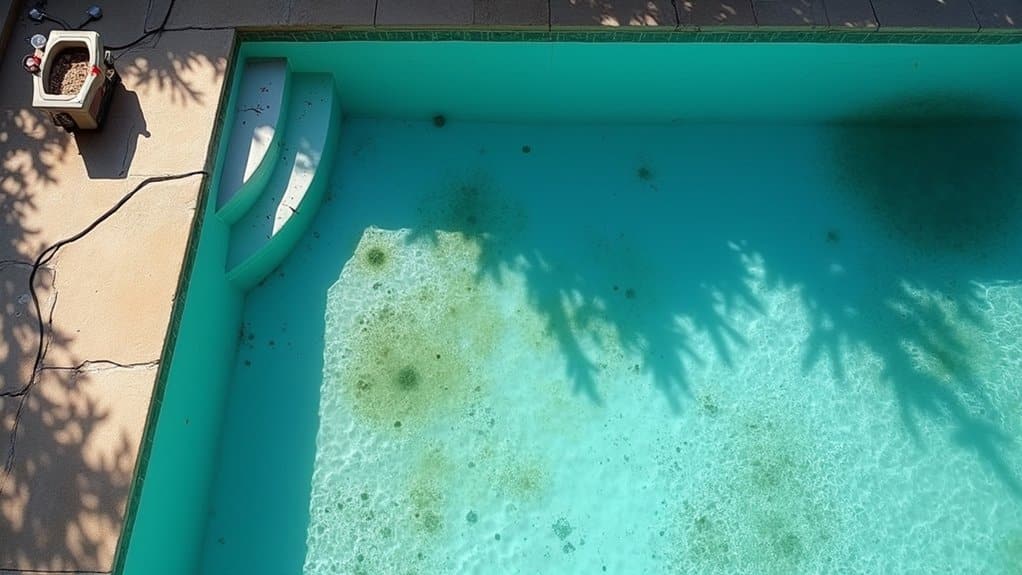
Undersized pump indicators: You’ll notice reduced jet flow, persistent cloudy water, and automatic cleaners that barely move. Your filter pressure gauge reads abnormally low, and the strainer basket won’t fill properly.
Oversized pump indicators: Expect high pressure readings even with clean filters, excessively loud operation, and water features that gush rather than flow smoothly. Sustained overpressure damages filter grids, rips cartridges, and can detach filter lids.
Port mismatch symptoms: If your pump ports don’t match existing plumbing dimensions, you’ll experience restricted flow rates, unnecessary resistance, and undersized suction lines cause cavitation reducing overall system performance greatly.
Frequently Asked Questions
How Long Should a Pool Pump Run Each Day?
You should run your pool pump a minimum of 8 hours daily to achieve one complete water turnover cycle. Apply the 1-hour-per-10°F rule at 90°F, you’ll need 9 hours. If you’re using a variable-speed pump, target 12 hours total: 3-4 hours at high speed for active circulation and 8-9 hours at low speed for energy-efficient filtration. During extreme heat above 90°F, add 2 extra hours to prevent algae growth.
Can an Oversized Pool Pump Damage My Pool Filter?
Yes, an oversized pump can absolutely damage your pool filter. When your pump pushes more water than your filter’s design capacity allows, you’ll see heightened pressure readings, stressed filter elements, and premature media failure. You’re risking cracked manifolds, ripped cartridges, and channeled sand beds. For example, running a 200LPM pump against a 150LPM-rated filter creates 50LPM of back pressure, forcing your motor to overwork and accelerating component breakdown across your entire system.
Do Saltwater Pools Require a Different Size Pump?
Saltwater pools don’t require a different-sized pump than freshwater pools. You’ll calculate pump size the same way based on your pool’s volume, desired turnover rate, and plumbing specifications. However, you should verify your pump’s materials are saltwater-compatible, as salt corrodes standard components. Look for pumps with salt-rated seals, impellers, and housings. Variable-speed pumps perform particularly well in saltwater systems, delivering ideal flow rates while reducing operational strain on your chlorine generator.
How Much Does It Cost to Run a Pool Pump Monthly?
You’ll typically spend $30 $200 monthly to run your pool pump, with the national average landing around $82 at 16 cents/kWh. Single-speed pumps drive the highest costs at $75 $150/month, while variable-speed models cut consumption by up to 80%, dropping your bill to $30 $50/month. Horsepower directly impacts cost a 1.5 HP pump averages $80/month versus $50 for a 0.75 HP unit. Your local electricity rate considerably shifts these figures.
When Should You Replace Your Pool Pump Instead of Repairing It?
Replace your pool pump when repair costs exceed 50% of a new unit’s price, it’s past 75% of its expected lifespan, or you’re facing repeated breakdowns. If your pump’s over 10 years old or has severe damage like cracked housings or burned motors, replacement delivers better ROI. Upgrading from a single-speed to a variable-speed pump saves $300 $500 annually, typically paying for itself within 2 3 years.