
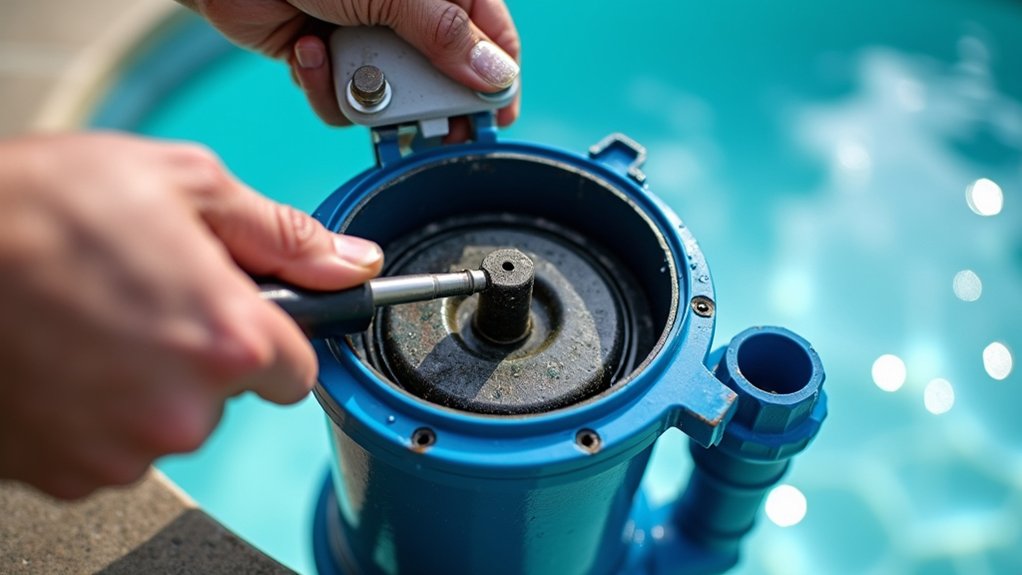
Running a pool pump typically costs you between $30 and $200 per month, depending on your pump type, runtime hours, and local kWh rate. A standard 2,000W single-speed pump operating eight hours daily costs roughly $2.55 per day at the national average of $0.1595/kWh. Variable-speed models slash that to $30 $50 monthly thanks to permanent magnet motor efficiency. Below, you’ll find detailed calculations, runtime recommendations, and proven strategies to minimize your operational costs.
What Does It Cost to Run a Pool Pump?
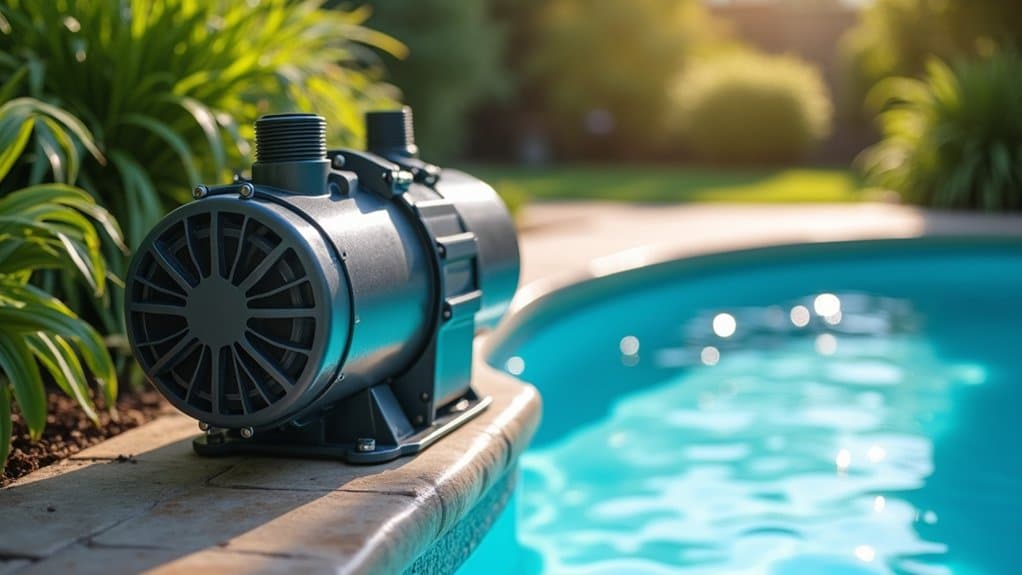
Running a pool pump typically costs between $30 and $200 per month, depending on your pump type, horsepower rating, daily runtime, and local electricity rates. Single-speed pumps generally run $50 to $150 monthly, while variable-speed models drop your pool pump electricity cost to $30 $50 per month.
On a daily basis, you’re looking at roughly $2.07 to $6.48, depending on your state’s kWh rate. A standard 2000W pump operating eight hours at the national average of $0.1595/kWh costs approximately $2.55 daily. Annually, that translates to $360 $6,000, with high-rate states like Hawaii pushing a 1.5 HP pump to $2,333 per year, while lower-rate regions like North Dakota keep costs closer to $572. You can calculate your specific expense by multiplying your pump’s energy usage in kWh by your local electricity rate.
How to Calculate Your Pool Pump’s Energy Use
Five data points stand between you and an accurate pool pump energy estimate: nameplate voltage, amperage, wattage, daily runtime, and your local kWh rate. Pull voltage and amperage directly from your motor’s nameplate label, then multiply them together (e.g., 230V × 8.5A = 1,955W). Divide watts by 1,000 to convert to kilowatts.
Next, multiply kilowatts by your daily runtime hours to determine electricity consumption pool pump owners actually incur. At 1.955 kW running eight hours daily, you’re consuming 15.64 kWh. Multiply that figure by your utility’s per-kWh rate say $0.164 and you’ve got $2.56 in daily operating costs.
Understanding how to calculate your pool pump’s energy use lets you project monthly expenses and evaluate whether equipment upgrades justify the investment. In addition to energy use, knowing how to reduce the cost of building a pool can help you save money in the long run. Exploring options like alternative materials or DIY installation can significantly lower your initial investment. It’s also wise to consider long-term maintenance costs when planning your budget.
What Drives Your Pool Pump Electric Bill Up?
Several factors conspire to inflate your pool pump’s electric bill, and motor horsepower tops the list. Oversized motors waste electricity by circulating water faster than necessary, while single-speed pumps compound the problem by running at full power constantly.
| Factor | Impact on Pool Pump Energy Usage |
|---|---|
| Dirty Cartridge Filters | Double energy consumption by forcing higher pump loads |
| System Resistance | Clogged plumbing and worn impellers elevate power draw |
Beyond hardware, your operating voltage matters. A 230V × 6.5A setup draws 1,495 watts voltage mismatches contribute to inefficiency. Air leaks on the suction side further degrade performance.
You’ll also see spikes from clogged filter media and plumbing restrictions that increase system head pressure. Clean filters reduce pump workload, directly lowering your electrical load.
How Many Hours Should You Run Your Pool Pump?
How long should you run your pool pump each day? Standard residential pools require 8 12 hours of daily runtime during swim season to achieve one full water turnover. Apply the temperature-based rule: one hour per 10°F of ambient air temperature. At 80°F, that’s 8 hours; at 100°F, budget 10 hours minimum.
- Variable-speed pumps: Run 12 hours daily 3 4 hours at high speed for turnover, 8 9 hours at low speed for efficiency
- High-demand periods: Extend to 12 16 hours during extreme heat or heavy bather loads
- Concrete pools: Require two full turnovers daily, effectively doubling your runtime and pool circulation cost
- Off-peak scheduling: Run 6 PM 6 AM to reduce electricity expenses without sacrificing filtration performance
Five Ways to Cut Your Pool Pump Costs
Switching from a single-speed pump to a variable-speed pump (VSP) is the highest-impact upgrade you can make, with permanent magnet motors delivering up to 90% efficiency and cutting pumping costs by as much as 75%. Pairing your VSP with a programmable timer lets you limit daily runtime and schedule operation during off-peak TOU hours, compounding your energy savings through both reduced consumption and lower per-kWh rates. Together, these two upgrades can drop daily energy use from over 12 kWh down to roughly 2 kWh while maintaining proper turnover for your pool volume. Switching from a single-speed pump to a variable-speed pump (VSP) is one of the most effective upgrades, with permanent magnet motors reaching up to 90% efficiency and reducing pumping costs by as much as 75%. When paired with a programmable timer to control runtime and shift operation to off-peak hours, you can significantly cut both energy use and rates, lowering daily consumption from over 12 kWh to around 2 kWh making it a practical strategy for how to lower electric bill in house while maintaining proper pool circulation.
Use Variable-Speed Pumps
Variable-speed pumps deliver the single largest reduction in pool pump operating costs, cutting energy expenditure by 50 90% compared to single-speed models. Their Permanent Magnet Motors achieve approximately 90% efficiency, drawing just 300 watts versus 2,000 watts for standard induction motors. The Pump Affinity Law drives your variable speed pump savings reducing speed by 50% cuts energy consumption by roughly 88%.
- Lower wattage draw: You’ll consume approximately 72 kWh monthly versus 480 kWh with single-speed units
- Extended low-speed runtime: Operate 19 hours daily at reduced flow while using less total energy
- Annual cost reduction: Expect roughly $205 annually versus $1,455 for single-speed operation
- Off-peak scheduling: Run longer cycles during lower-rate periods to maximize cost efficiency
Install a Timer
Even with a high-efficiency variable-speed pump, you’re leaving money on the table if the unit runs without automated scheduling. When you install a timer, you gain precise control over pump cycles, eliminating unnecessary runtime and reducing energy consumption by up to 60%.
Programmable digital timers let you schedule operation during off-peak utility windows, while smart timers auto-adjust runtimes based on pool volume and usage patterns. Astronomical timers align cycles with sunrise and sunset, optimizing daylight-driven circulation. Basic timer installation runs $50 to $100, with total costs averaging $200 to $500 depending on wiring complexity. Paired with an energy efficient pool pump, a timer prevents 24/7 operation equivalent to powering six refrigerators and can drop annual electricity costs from $240 to approximately $100.
Single-Speed vs. Variable-Speed: Which Costs More to Run?
How dramatically do operating costs differ between these two pump types? When you compare pool pump cost per month, the numbers tell a compelling story. Single-speed units lock in at 3,450 RPM, drawing 1,500 2,500 watts continuously regardless of hydraulic demand.
Key cost differentials you should evaluate:
- Single-speed monthly draw: 432 600 kWh, costing $71 $98 at average utility rates
- Variable-speed monthly draw: 48 192 kWh, costing $8 $31
- Annual single-speed expense: up to $900 versus under $300 for variable-speed
- Variable-speed wattage at low RPM: 200 800 watts, achieving 60 85% energy reduction
You’ll recoup a variable-speed pump’s higher upfront cost through substantial operational savings within 1 2 swimming seasons.
Will a Variable-Speed Pump Lower Your Electric Bill?
Because variable-speed pumps obey the Pump Affinity Law where halving RPM cuts power consumption to roughly one-eighth they don’t just trim your electric bill; they slash it. You can achieve 50% to 90% reduction in energy expenditures by running at minimum speed for code-required turnover. A single-speed pump consuming 2,000 watts needs 12.6 kWh to turn over 25,000 gallons; a variable-speed unit accomplishes the same at 116 watts, using just 2.2 kWh.
When calculating how much does it cost to run a pool pump, consider that 24-hour variable-speed operation costs roughly what three hours of single-speed runtime costs monthly. ENERGY STAR certified models save over $2,800 over their lifetime, with payback periods typically under two years. You’ll also gain quieter operation and reduced system strain. When calculating how much it costs to run a pool pump, note that 24-hour variable-speed operation can cost about the same as just three hours of single-speed runtime per month, with ENERGY STAR models saving over $2,800 across their lifespan and typically paying for themselves in under two years. Along with quieter performance and reduced system strain, these savings complement broader decisions like solar vs electric vs gas pool heater, helping you optimize overall pool energy efficiency.
Frequently Asked Questions
Does Pool Pump Size Need to Match My Pool’s Gallon Capacity?
Yes, you need to match your pump size to your pool’s gallon capacity for maximum efficiency. Calculate your required GPM by dividing total gallons by your target turnover time (typically 6-8 hours), then by 60. For example, a 25,000-gallon pool at an 8-hour turnover needs 52 GPM. You’ll want to select a pump whose performance curve delivers that GPM at your system’s total dynamic head without oversizing, which wastes energy and stresses components.
Can Solar Power Be Used to Run a Pool Pump?
Yes, you can absolutely run your pool pump on solar power. Solar DC pump systems eliminate grid electricity costs entirely, dropping your operating expense to $0 on sunny days. A DIY kit including two 400-watt PV panels, a 500-watt DC pump, cabling, and a timer runs about $881, with a payback period of roughly 3.55 years. You’ll want to size your array to match your pump’s wattage and daily run-time requirements.
Do Pool Pumps Use More Electricity in Summer Than Winter?
Yes, your pool pump consumes considerably more electricity in summer than winter. You’re running longer daily cycles often 10-12 hours versus 4-6 in winter to maintain water clarity under higher bather loads and algae pressure. Summer on-peak rates (around 24¢/kWh June August) compound costs further. A single-speed 1.5 HP pump can exceed $100 monthly in summer, while winter operation drops substantially due to shorter runtimes and lower tiered rates.
Is It Cheaper to Run a Pool Pump at Night?
Yes, it’s considerably cheaper if your utility offers time-of-use pricing. You’ll pay off-peak rates during nighttime hours often 50% less per kWh than daytime peak demand charges. Running your pump 8 10 hours overnight provides adequate turnover without compromising water quality. A standard 1HP pump at 17¢/kWh peak can drop from roughly $100/month to $50/month with night scheduling. Check your utility’s rate structure and install a programmable timer to maximize savings.
How Long Does a Pool Pump Typically Last Before Needing Replacement?
Most pool pumps last 8 12 years with proper maintenance, though your specific lifespan depends on pump type, usage, and environment. If you’re running a single-speed pump, expect 7 10 years before replacement. Variable-speed models typically outlast them at 10 15 years due to reduced motor wear. You’ll need to replace seals and gaskets every 2 3 years and monitor the impeller for debris damage to maximize your pump’s operational longevity.