
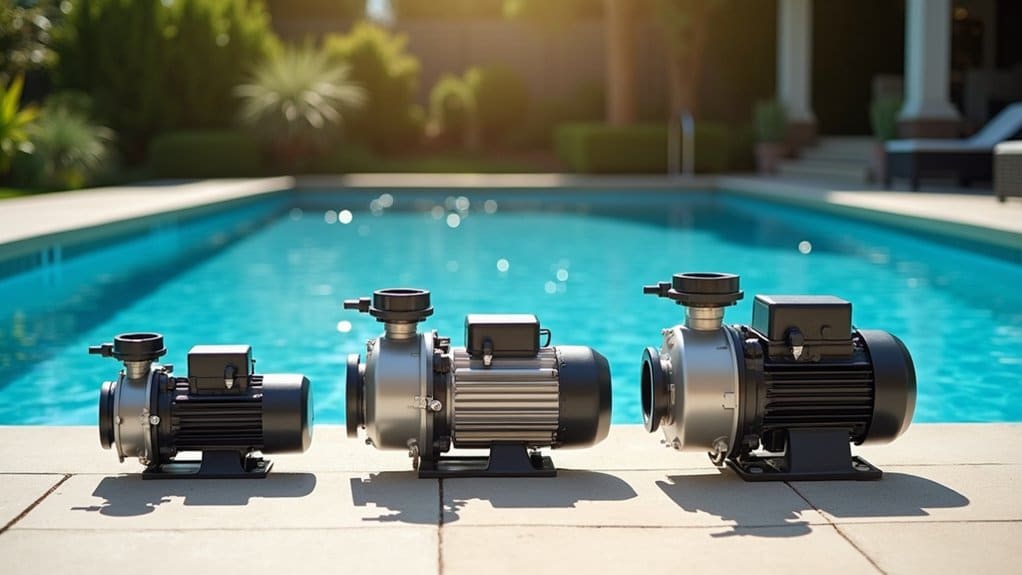
Above ground and inground pool equipment differ in power, capacity, and durability. Above ground pumps run 0.5 2 HP with 30 60 GPM flow rates, while inground pumps deliver 0.75 3+ HP at 75 150 GPM to handle greater water volumes and head pressure. Inground filters cycle up to 10,000 gallons per hour; above ground filters process considerably less. You’ll also find major differences in cleaner design, cost, lifespan, and compatibility that directly affect your pool’s performance.
Why Inground and Above Ground Pools Need Different Equipment
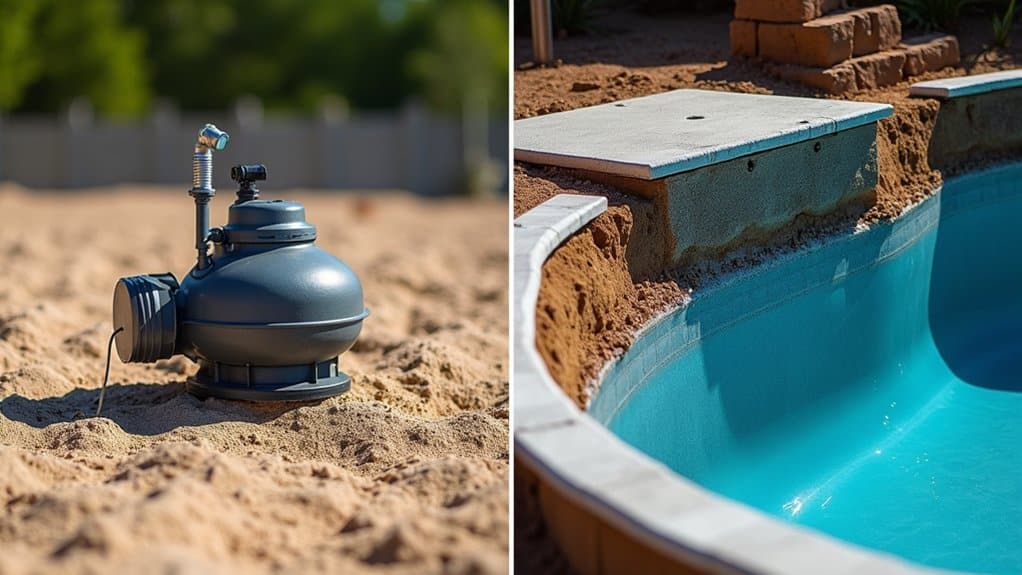
Inground and above ground pools operate under fundamentally different engineering constraints, which directly dictate the equipment specifications each system requires. When comparing above ground vs inground pool equipment, you’ll find that pool equipment differences stem primarily from water volume, structural depth, and plumbing complexity. Inground systems demand higher-horsepower pumps, self-priming capabilities, and heavy-duty materials built for continuous operation. Above ground setups prioritize compact, lightweight components with flooded suction designs. Inground pumps can be installed above or below ground level, and below-ground installation reduces strain on the pump by minimizing the lift distance required. Because inground pools can last 50-100 years or more with proper maintenance, their equipment is engineered for long-term durability to match that extended lifespan.
Among swimming pool equipment types, inground pumps handle 75 150 GPM, while above ground models manage 30 60 GPM. You’ll need equipment matched to your pool’s turnover requirements typically every 8 10 hours. Selecting incompatible components reduces filtration efficiency and shortens equipment lifespan. Above ground pools also require periodic liner replacements, typically every 5-10 years, which influences how their equipment connections and fittings are designed for easier access and serviceability. Each pool type demands purpose-built systems for peak performance.
Pool Size Limits That Shape Every Equipment Decision
Because pool dimensions directly determine water volume, they set the baseline for every equipment specification you’ll select from pump flow rate to filter capacity. A 12-foot round above ground pool holds approximately 2,975 gallons, while a 24-foot model reaches 11,895 gallons a fourfold increase demanding proportionally scaled systems.
In any pool equipment comparison, you’ll find above ground pools cap at 33-foot round or 21’x43′ oval configurations, with wall heights between 48 and 54 inches. A 30-foot round at 52-inch walls holds 21,240 gallons, requiring a robust above ground pool pump and filter system. Inground pools with 5.5-foot average depths maximize capacity further. These volume differentials directly dictate your pool installation equipment specifications, including plumbing diameter, heater BTU output, and sanitizer demand.
Inground vs Above Ground Pumps: Power and Flow Rate
Once you’ve established your pool’s water volume, the pump becomes the first equipment decision that translates those gallons into a functional circulation system. Above-ground pumps deliver 30 60 GPM with 0.5 2 HP ratings, while an inground pool equipment system demands 75 150 GPM to achieve proper turnover within 8 10 hours.
Pools under 15,300 gallons require a minimum 1 HP above-ground pump; larger volumes need at least 1.5 HP. Inground pumps handle higher head pressure and flow resistance through heavier construction.
Pool system compatibility depends on matching pump flow to filter design rates precisely. Excessive flow damages filter media, while insufficient flow compromises sanitation. You’ll want specifications aligned, not oversized, to maintain efficient, reliable operation.
Inground vs Above Ground Filters: Sizing and Flow Capacity
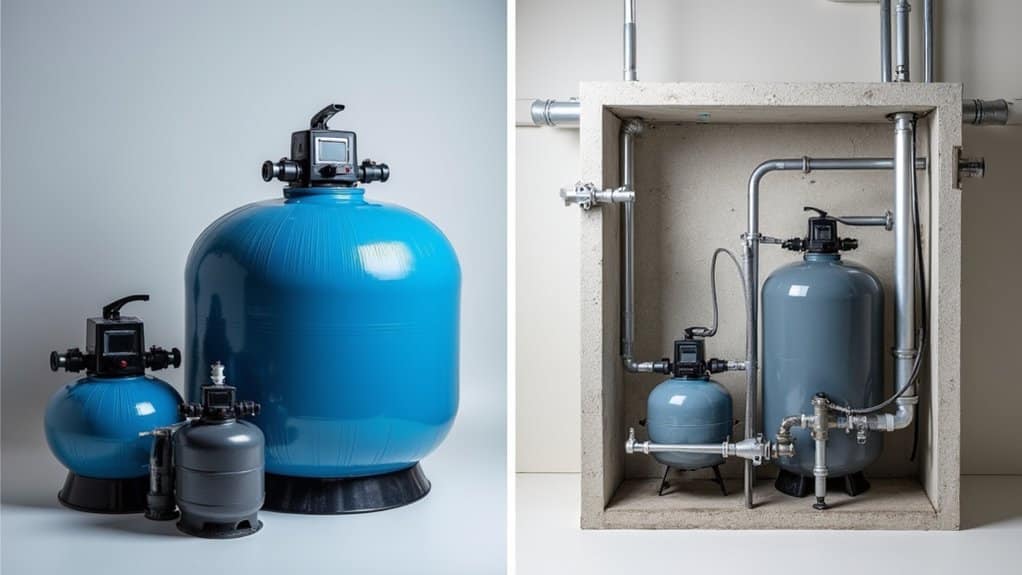
While your pump determines how fast water moves, the filter dictates how clean it gets and the gap between above ground and inground filter specifications is substantial.
- Above ground filters handle under 3,000 to over 20,000 gallons, while inground filters process up to 10,000 gallons per hour.
- Inground filters cycle your entire pool volume within 6-8 hours when properly sized.
- Above ground filters aren’t engineered for 100+ feet of piping runs.
- Inground sand filters require 300-500 pounds of sand depending on tank size.
- DE filters trap particles down to 3-5 microns but lose pressure faster than sand or cartridge alternatives.
You’ll find inground filters support considerably higher flow rates, matching the demands of larger water volumes and extended plumbing configurations.
Inground vs Above Ground Cleaners: Shape and Surface Design
Filtration keeps your water clean, but your pool cleaner determines how effectively debris gets removed from surfaces and the equipment differences between above ground and inground models reflect fundamentally different design challenges.
Above ground pools feature flat floors and simple cylindrical or rectangular geometries, allowing lightweight, portable cleaners to map and navigate efficiently. Their vinyl surfaces demand gentler cleaning action to prevent damage.
Inground pools present curved designs, varying depths, steps, and multiple wall angles requiring robust, maneuverable systems. Plaster and tile surfaces withstand stronger cleaning force. Track-based systems like the TracVac™ navigate obstacles and adapt to complex shapes more effectively than standard wheeled alternatives. Robotic cleaners with advanced navigation systems dodge obstacles without manual adjustment a critical specification when your pool’s contours make straight-line cleaning impossible.
Can Above Ground Equipment Work in an Inground Pool?
You might wonder whether your above-ground pump can handle inground pool demands, but compatibility hinges on power output, flow rate alignment, and priming capability. Above-ground pumps rated between 0.5 and 2 HP often fall short of the 0.75 to 3+ HP range inground systems require, and their reliance on below-waterline placement creates priming challenges when installed above the water level. However, mixing equipment can work in specific scenarios such as when an equipment pad sits below the pool’s waterline or when you pair a self-priming above-ground model with properly matched filters and adapters.
Compatibility and Limitations
Above ground pool equipment operates within a narrow performance envelope that doesn’t translate well to inground applications. You’ll encounter critical mismatches across every major component category when attempting cross-compatibility.
- Pumps: Above ground units produce 30-80 gpm and lack self-priming capability, failing against inground head pressure exceeding 40-50 ft.
- Filters: Low-flow cartridge and sand filters can’t handle inground debris loads or maintain adequate circulation in larger volumes.
- Heaters: 115V above ground heaters deliver insufficient BTU output, heating larger inground masses at only 1-1.5°F/hour.
- Cleaners: Suction and pressure cleaners designed for flat vinyl liners can’t navigate inground gunite or fiberglass contours effectively.
- Ladders: A-frame designs lack stable mounting points on inground coping and exceed safe depth ratings beyond 54 inches.
When Mixing Works
While the previous section outlined clear compatibility limitations, specific scenarios exist where above-ground pump equipment can function in an inground pool provided the installation geometry and system specs align precisely.
You’ll need an equipment pad positioned below your pool’s waterline, creating gravity-fed flooded suction that eliminates the self-priming requirement. Downhill gradients or hill placements achieve this naturally. Your above-ground pump’s GPM must match your inground filter’s rated capacity exactly mismatched flow rates cause debris buildup or filter damage.
Verify connection sizes between components, since above-ground hoses often mismatch inground fittings. You’ll likely need adapters for leak-free integration. Energy-efficient above-ground models can work if their specifications align with your inground plumbing demands, but confirm horsepower handles your pool’s volume and pipe pressure gradients before committing.
What Does Each Pool Equipment Setup Actually Cost?
Three distinct cost tiers separate above ground and inground pool equipment setups, and the gap between them is wider than most buyers expect.
- Above ground pump/filter combo: $250 $2,000, averaging $1,000; DE systems reach $4,500
- Above ground heaters: $50 $2,400 per unit
- Inground replacement pumps: $400 $1,200, roughly double above ground entry points
- Inground filters: $300 $1,000 as standalone components
- Inground heaters: $700 $3,500, with gas and heat pump models commanding the upper range
You’ll notice inground equipment floors sit near above ground ceilings. An above ground setup totals $1,300 $4,900 for core components. Inground equivalents run $2,400 $5,700 before plumbing and electrical costs add another $4,000 $6,000. That installation overhead alone exceeds many complete above ground equipment packages.
How Long Does Inground vs Above Ground Equipment Last?
Equipment longevity hinges on component type, not just whether your pool sits above or below grade though installation context does shift wear patterns. Pumps typically deliver 8 12 years, while sand filter tanks exceed 10 years before needing replacement. Cartridge housings match that timeline, but cartridges themselves require swaps every 2 4 years.
Heaters diverge sharply by fuel source: gas units run 5 10 years, electric models stretch 10 15, and solar systems surpass 20. Above-ground pool liners last 5 9 years versus 10 15 for inground variants a significant cost differential over time.
Robotic cleaners average 4 8 years, salt cells tap out at 3 5 years, and LED lights persist up to 15. You’ll maximize each component’s lifespan through consistent maintenance and proper water chemistry management.
Matching Equipment to Your Pool Type and Budget
Your pool type dictates specific equipment specifications above ground setups require flooded-suction pumps rated at 30 60 GPM with compact filters, while inground systems demand self-priming pumps pushing 75 150 GPM paired with larger filter assemblies. Budget alignment follows naturally, as above ground packages ranging $2,500 $12,000 use lower-capacity components versus inground systems at $30,000 $100,000+ that accommodate higher flow rates and custom features. Properly sizing your pump’s flow rate to your filter’s design flow rate guarantees efficient turnover without overtaxing equipment or compromising water clarity.
Pool Type Equipment Needs
Because above-ground and inground pools differ fundamentally in water volume, plumbing complexity, and structural design, the equipment you’ll need for each type operates within distinct performance ranges.
- Pump capacity: Above-ground pumps handle 30 60 GPM; inground pumps require 75 150 GPM to achieve proper turnover within 8 10 hours.
- Priming system: Inground pumps use self-priming technology for raised placement, while above-ground pumps rely on flooded suction at or below water level.
- Filter sizing: Both pool types use cartridge, DE, or sand filters, but design flow rates must match the pump’s output oversizing improves clarity and reduces maintenance.
- Cleaner complexity: Inground cleaners navigate curves, steps, and deep ends; above-ground models skip wall-climbing entirely.
- Installation scope: Above-ground setups take days; inground systems require 6 8 weeks for integrated customization.
Budget-Friendly Equipment Choices
Once you’ve matched equipment categories to your pool type, the next step is aligning those choices with realistic budget parameters. Above-ground pool kits, including installation, run $2,500 $10,000, while inground pools reach $30,000 $100,000+. This cost gap extends directly to equipment pricing above-ground components carry lower price points due to smaller capacity requirements and market segmentation.
You’ll find above-ground pumps rated at 30 60 GPM cost markedly less than inground units pushing 75 150 GPM. Filters follow the same pattern: smaller above-ground models handle lower design flow rates at reduced expense. Factor in long-term costs too. Above-ground liners need replacement every 5 10 years, but inground pools demand higher ongoing repair expenses. Above-ground kits also install in days, cutting upfront labor costs considerably.
Sizing Equipment Properly
Accurate sizing starts with calculating your pool’s volume. You’ll use different formulas depending on your pool’s shape, and these calculations directly determine pump horsepower and filter capacity requirements.
- Rectangular pools: Multiply length × width × average depth × 7.5 for total gallons
- Round above-ground pools up to 24′: You’ll need a minimum 1 HP pump and 16-inch sand filter
- Round pools over 24′: Step up to 1.5 HP with an 18-inch sand filter tank
- Oval pools up to 15’×30′: A 1 HP pump handles circulation adequately
- Cartridge filters: Require 100 square feet of media per 10,000 gallons minimum
Undersizing equipment reduces turnover rates and compromises water quality. Oversizing wastes energy and increases operational costs. Match specifications precisely to your pool’s calculated volume.
Frequently Asked Questions
Can Inground Pool Equipment Be Used on an Above Ground Pool?
You shouldn’t use inground pool equipment on an above ground pool. Inground pumps exceed 1.5 HP and generate high head pressures that’ll overstress your above ground pool’s flexible hoses, thinner wall fittings, and liner. Inground filters require pressure ratings incompatible with above ground plumbing, risking leaks or damage. You’ll also face excessive flow rates that shorten filtration cycles. Instead, choose dedicated above ground systems like Pentair’s lineup sized specifically for your pool’s dimensions.
Do Above Ground Pools Need a Separate Heater From Inground Pools?
Yes, you’ll need a separate heater designed specifically for your above ground pool. Above ground heaters are rated at 100,000 150,000 BTU, while inground models range from 150,000 400,000 BTU far exceeding what your smaller water volume requires. You’ll also find installation differences: above ground units typically use 120V plug-in connections and mount on raised non-combustible surfaces, whereas inground heaters integrate with more complex plumbing systems requiring different electrical configurations.
How Often Should Above Ground Pool Liners Be Replaced?
You should replace your above ground pool liner every 6 to 10 years, though you’ll extend it to 8 12 years with diligent maintenance. By comparison, inground liners outlast them at 10 20 years due to thicker gauge materials. Watch for tears, cracks, persistent fading, or water loss exceeding one inch weekly these indicate immediate replacement. You’ll maximize durability by maintaining balanced water chemistry, limiting UV exposure with covers, and cleaning weekly.
Is DIY Installation Possible for Inground Pool Equipment?
Yes, you can install inground pool equipment yourself with proper planning and tools. You’ll need a rotary laser level for precise alignment, wrenches and socket sets for plumbing assembly, and PVC fittings to connect your pump, filter, heater, and chlorinator. However, you’ll face challenges plumbing misalignment errors are common, and main drain installations must comply with the Virginia Graeme Baker Safety Act. Manufacturer-specific manuals are essential to prevent component mismatches.
Does an Inground Pool Increase Home Resale Value Significantly?
Yes, your inground pool can boost your home’s resale value by 5% to 8%, with the national average hitting 7%. You’ll recoup roughly 56% of your investment. In warmer markets like Fort Myers, Florida, you’ll see premiums reaching 20.4%. However, you won’t offset full installation costs ($50,000 $100,000+) plus annual maintenance ($1,200 $1,800). Comparatively, above-ground pools add virtually no resale value and often reduce buyer interest.