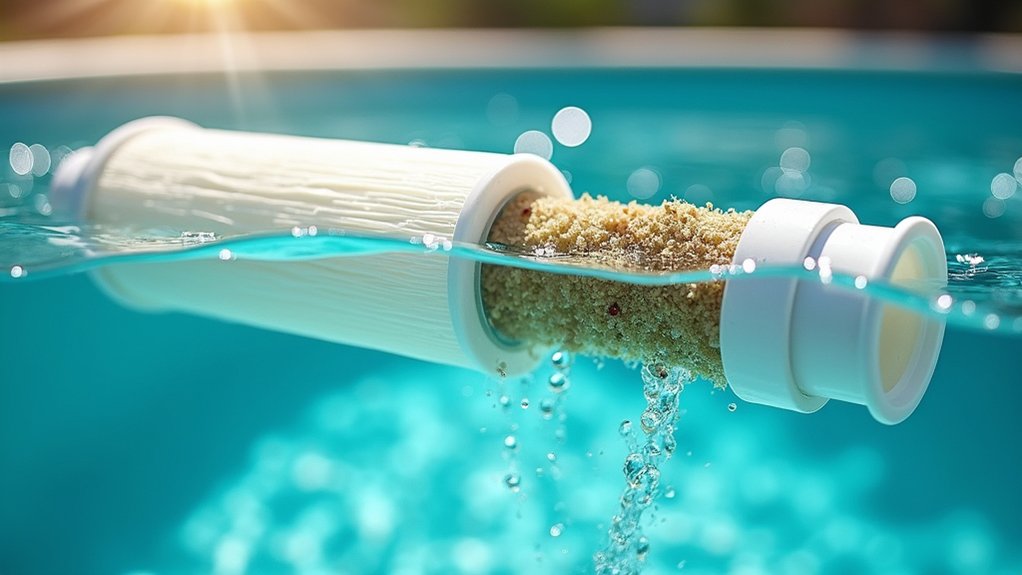

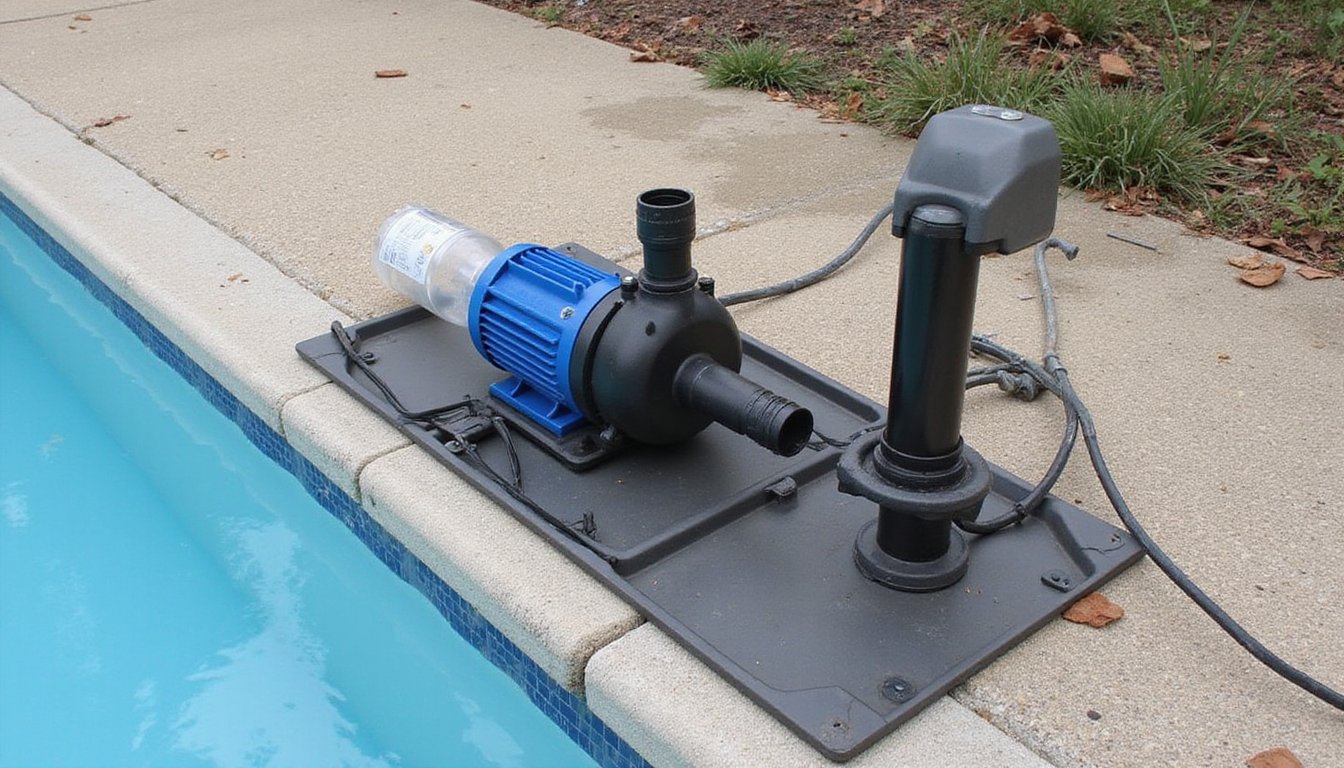
You’ll find the best filter depends on your pool’s specific needs. Sand filters offer budget-friendly operation with 20-40 micron capture and minimal maintenance. Cartridge filters balance affordability with superior 10-15 micron filtration, ideal for smaller pools. DE filters deliver exceptional 2-5 micron clarity but demand higher costs and regular maintenance. Consider your pool size, budget, and water quality priorities when deciding. Understanding how each system performs will help you make the right choice.
Understanding Sand Filters: Budget-Friendly Filtration
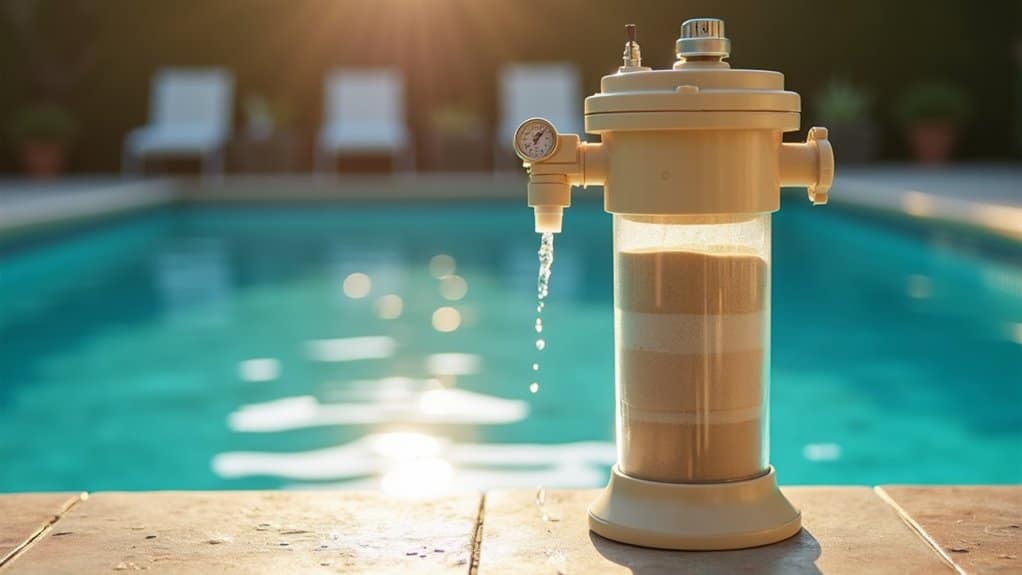
When you’re looking for a straightforward filtration solution, sand filters operate on a simple yet effective principle: water gets pumped into a tank filled with graded sand media, typically #20 silica, glass, or zeolite, where it flows downward through the sand bed and traps debris and particles along the way. Clean water then exits through underdrains beneath the sand and returns to your pool.
You’ll benefit from durable tank construction made from fiberglass, stainless steel, or plastic, ensuring long-lasting filter media performance for 5 7 years. Sand filters capture particles as small as 20 40 microns, providing adequate clarity for most residential and commercial applications. The filtered water re-enters your pool’s circulatory system through the lateral assembly and outlet line. With weekly backwashing via simple multiport valves and minimal maintenance requirements, you’ll enjoy reliable operation at one of the lowest price points among filtration options. Monitoring the pressure gauge helps you determine when backwashing is needed to maintain optimal performance. Sand filters are particularly ideal for Arizona due to the dusty, arid conditions that require efficient debris removal.
Cartridge Filters: The Balanced Approach to Pool Cleaning
You’ll find that cartridge filters strike an attractive middle ground between affordability and performance, offering moderate upfront costs with substantial long-term savings through reduced energy and water consumption. You’re responsible for straightforward hands-on maintenance, simply rinse or replace cartridges when pressure climbs 8 10 psi above baseline, without dealing with complex backwashing systems or multiport valves. You’ll also benefit from superior flow rate performance that minimizes pump strain while delivering exceptional water clarity through efficient capture of particles as small as 10 15 microns. Cartridge filters require less space than sand filters, making them an ideal choice for smaller pool installations where space constraints are a concern. However, be aware that cartridge filters may not work well with pool clarifiers, which can gum up the filter media and reduce effectiveness.
Moderate Cost and Efficiency
Many pool owners find cartridge filters strike an ideal middle ground; they’re more affordable than DE systems yet deliver superior filtration compared to sand filters. You’ll invest $500 $1,500 upfront, with cartridge replacements every 2 3 years costing $100 $400.
Your operating cost efficiency shines through because cartridge filters require no backwashing, eliminating thousands of gallons of wasted water annually. Energy usage considerations become favorable since these systems operate effectively at lower pressures, reducing pump strain and electricity consumption over time. Cartridge filters can filter contaminants as small as 10 microns, providing noticeably clearer water than sand alternatives. Unlike sand filters that need replacing every 5 7 years, cartridge systems require more frequent cartridge replacements.
You’ll balance initial investment against long-term savings from minimal water waste and decreased energy demands. While routine maintenance occurs every 4 6 weeks, the straightforward cleaning process demands minimal effort. This practical approach makes cartridge filters ideal for homeowners prioritizing both affordability and sustainable pool operation.
Hands-On Cartridge Maintenance
Keeping your cartridge filter operating at peak efficiency requires regular hands-on care that builds on the cost-saving advantages we’ve discussed. You’ll monitor your pressure gauge and clean cartridges when PSI rises 8 10 points above baseline, typically every 3 6 months. During replacement cartridge inspection, you’ll examine pleats for tears, cracks, or deterioration before reinstalling. Cartridge handling safety demands a complete system shutdown and air-relief valve opening before removal. Use a moderate-pressure garden hose at 45-degree angles to dislodge debris without damaging fabric. For stubborn buildup, soak cartridges 15 20 minutes in mild detergent solution, then rinse thoroughly. For heavily soiled filters with algae or mineral residues, consider using a muriatic acid wash to restore cartridge performance after the detergent soak. Proper reassembly with secure clamp tightening and air-bleeding prevents leaks and airlocks. This maintenance routine extends filter lifespan to 3 4 years. Release pressure from the filter system before beginning any cartridge removal to prevent accidents or injuries.
Superior Flow Rate Performance
Cartridge filters excel where sand filters struggle: delivering superior hydraulic efficiency without sacrificing water clarity. You’ll achieve filtration down to 30 microns while maintaining robust flow rates, something sand filters can’t match at comparable sizes.
Their low maintenance requirements stem from intelligent design: no multi-port valves restrict flow, and larger surface areas (up to 520 sq. ft.) reduce pressure differentials. You can run smaller footprint filters that support higher pump outputs, making efficient water circulation achievable even in compact installations. The cartridge assembly features four easy-to-clean cartridges that maximize dirt capacity and extend time between maintenance cycles. The filtration rate directly impacts filter performance by balancing the cost and efficacy of removing unwanted particles while accounting for your pool’s specific temperature, soil load, and other physical properties. To extend your cartridge filter’s lifespan and maintain peak performance, clean the cartridge thoroughly every couple of months using a hose rinse followed by an overnight soak in clean water with filter cleaner.
Diatomaceous Earth Filters: Premium Filtration Performance
If you’re willing to invest in premium filtration, you’ll find that diatomaceous earth (DE) filters deliver the finest particle removal available, capturing particles as small as 2 5 microns compared to sand filters’ 20 30 microns. Your pool water will achieve exceptional clarity and purity that rivals drinking water standards, though you’ll need to accept higher operational costs from regular DE powder replacement every 4 6 weeks and frequent backwashing cycles. DE filters also operate with lower pump pressure compared to sand filters, reducing wear and tear on your pool equipment and plumbing systems. Beyond superior clarity, DE filters eliminate harmful bacteria and algae, creating a healthier swimming environment with better water circulation and chemical distribution. This superior performance comes with a trade-off: more frequent maintenance and material expenses than alternative filter types, but many pool owners consider the dramatically improved water quality worth the commitment.
Finest Filtration Capability
When you’re seeking the finest filtration available for your swimming pool, diatomaceous earth (DE) filters deliver unmatched performance by capturing particles as small as 2 5 microns, far exceeding the capabilities of sand filters (20 40 microns) and cartridge filters (10 15 microns). Your DE filter’s microscopic debris elimination surpasses what the human eye can detect, which tops out at 35 microns. This superior particle trapping efficiency stems from DE’s crystalline, porous structure formed from fossilized diatoms. The DE cake creates an exceptionally fine filtration barrier that traps algae, bacteria, oils, and amoebae with consistency. You’ll achieve premium water quality that residential and commercial pool operators demand when hygiene standards matter most.
Superior Water Clarity
DE filters deliver exceptional clarity by capturing contaminants down to 3 5 microns, particles over 100 times smaller than a grain of sand. You’ll achieve crystal clear water that noticeably transforms your pool’s appearance.
Your pool benefits from:
- Invisible debris removal Organic particles invisible to the naked eye are trapped, eliminating water turbidity
- Algae and spore elimination Effective capture prevents algae blooms and maintains visual clarity
- Reduced cloudiness Common pool haziness disappears through superior particle retention compared to sand filters
- Improved swimmer safety Fewer contaminants mean lower recreational water illness risks and reduced eye and skin irritation
Because DE filters outperform alternatives in particle retention, you’re investing in visibly sparkling water that supports a healthier swimming environment for all users.
Higher Operational Costs
While DE filters deliver superior water clarity, that premium performance comes with a measurable price tag across every operational phase. You’ll face higher maintenance demands than sand or cartridge alternatives, requiring monthly servicing costs of $80 $150. DE powder refills ($10 $25 each) represent recurring consumables absent in other systems, while grid replacements every 3 7 years run $50 $300. Average repair jobs range from $400 $1,000, reflecting the system’s complexity. Your operational budgeting must account for these compounding expenses: initial installation ($1,200 $2,500), ongoing maintenance, specialized labor, and consumables collectively drive total ownership costs 50% higher than alternatives over 7 10 years. While DE filters excel at filtration, their long-term financial commitment demands careful consideration against your pool maintenance budget.
Filtration Efficiency: How Each Filter Type Performs
Because filtration efficiency directly impacts your pool’s water clarity, maintenance demands, and long-term costs, understanding how each filter type performs is essential.
Sand filters effectively trap particles at 20 40 microns but require frequent backwashing frequency, which compromises water conservation. Cartridge filters outperform sand at 10 20 microns without backwashing needs, reducing operational strain. DE filters dominate with 2 5 micron filtration, delivering superior clarity.
Alternative media options greatly enhance system efficiency improvements:
- Zeolite media captures particles down to 2 5 microns with 90% efficiency gains
- Glass media performs similarly to zeolite while reducing backwash needs considerably
- FilterBalls increase flow rates by 45% while filtering at 5 15 microns
- Cellulose fiber additives rival DE filters at 2 microns for sand systems
Each option directly influences your maintenance schedule and chemical costs.
Particle Size Capabilities: What Each Filter Can Capture
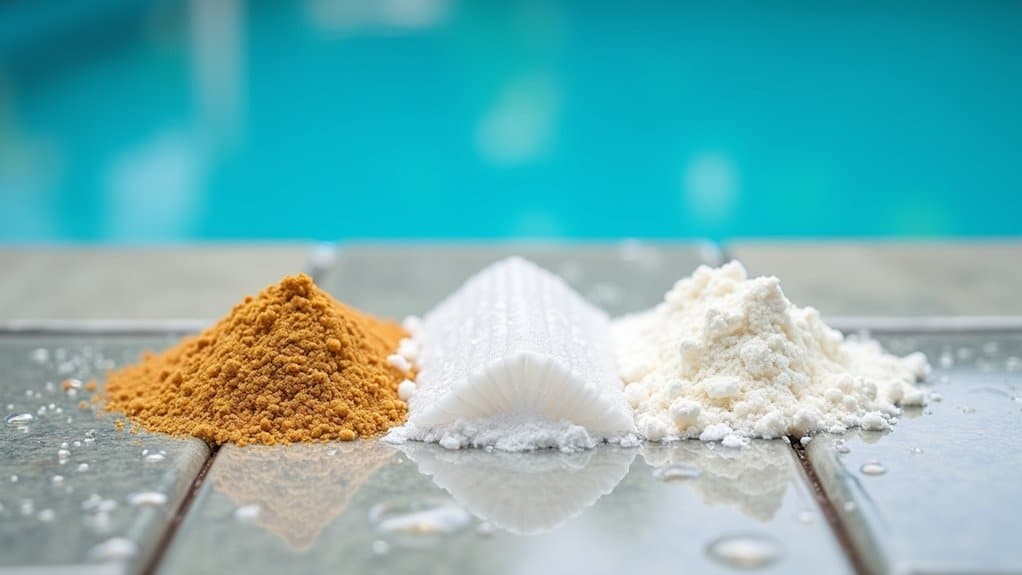
The filtration capabilities of different pool filter types can be likened to a sieve, each with its own unique mesh size that captures particles of varying dimensions. You’ll find that sand filters capture 20 40 microns, while cartridge filters excel at 10 20 microns. D.E. filters outperform both, achieving 1 5 microns for microscopic particle filtration that removes algae, bacteria, and amoebae invisible to your eye.
| Filter Type | Particle Size |
|---|---|
| Sand Filters | 20 40 microns |
| Cartridge Filters | 10 20 microns |
| D.E. Filters | 1 5 microns |
| Glass Media | 5 10 microns |
Alternative filtration media like FilterBalls and glass substantially enhance performance. You can achieve 5 15 microns with FilterBalls and 5 10 microns with glass media, reducing backwashing frequency while improving energy efficiency.
Maintenance Requirements: Time and Effort Comparison
Now that you’ve assessed which filter captures the particle sizes you need, it’s time to evaluate the upkeep demands that come with each option.
Maintenance intensity varies markedly across filter types. Consider your available time and physical capacity:
- Sand filter ease: Occasional backwashing and rare sand replacement every 3 5 years; minimal day-to-day intervention required
- Cartridge filter handling: Regular removal and rinsing when pressure rises, plus deep cleaning 1 2 times yearly; no backwashing needed
- DE filter: Frequent backwashing, powder replenishment after each cycle, and seasonal grid disassembly; highest labor demands
- Annual tasks: All filters require O-ring and gasket inspection; DE filters demand additional winterization effort
Sand filters demand the least commitment, typically 5 10 minutes monthly. Cartridge filters require moderate hands-on work. DE filters consume the most time due to powder handling and component maintenance.
Water Loss and Backwashing: Operational Considerations

When you backwash sand or DE filters every 2 4 weeks, you’re discharging 200 300 gallons per cycle, water loss that compounds considerably over a season and can strain local resources during droughts. You’ll avoid this waste entirely with cartridge filters, which require no backwashing and eliminate the need to repeatedly refill your pool and rebalance chemicals. By monitoring your pressure gauge and backwashing only when the 8 10 psi rise occurs, you’ll reduce both your water consumption and utility costs while protecting your filter media‘s longevity.
Backwashing Water Waste Impact
As your pool’s filter accumulates debris and pressure rises, backwashing becomes necessary, but it’s also one of the most significant sources of water waste in pool operations. Each cycle consumes 200 to 1,000 gallons of already-heated water, representing substantial resource loss.
Untreated backwash water poses serious challenges:
- Contains E. coliand Pseudomonas aeruginosa requiring microbial contaminant removal before reuse
- Holds heightened suspended solids and residual chlorine exceeding regulatory discharge standards
- Discharges directly to sewers or environments without proper treatment
- Causes annual water losses reaching 2.8 million m³ in Poland alone
Advanced treatment technologies achieve 96% water recovery and over 99% pathogen removal, enabling safe recycling. Without treatment compliance, you’ll face regulatory violations and environmental contamination while wasting both water and energy.
Cartridge Efficiency Without Loss
While sand and DE filters demand substantial water waste through regular backwashing cycles, cartridge filters offer a fundamentally different operational approach that eliminates this problem entirely. You’ll conserve up to 6,000 liters per backwash cycle since cartridge cleaning requires only manual rinsing or soaking, no pool water drainage needed.
Your cartridge debris accumulation actually improves filtration efficiency as particles distribute evenly across the pleated surface. With typical cartridge cleaning frequency of once per season for residential pools, you’ll experience minimal operational interruptions. This reduced maintenance burden translates to lower energy costs, extended pump lifespan, and stable pool chemistry without backwash-induced dilution. You’ll also avoid discharge bans affecting your operation, making cartridge systems an environmentally responsible choice that protects both your water supply and chemical investment.
Cost Analysis: Purchase Price vs. Long-Term Expenses
Though you’ll initially spend less on a sand filter ($300 $1,200) compared to a DE system ($1,099 $1,819), the true cost of pool ownership extends far beyond that first purchase. Long term budget planning reveals significant upfront cost tradeoffs that reshape your financial picture.
Initial savings on sand filters mask hidden costs, true pool ownership expenses extend far beyond first purchase price.
Consider these recurring expenses:
- Sand media replacement: $25 per 50-pound bag every 3 7 years
- Cartridge filters: $50 $100 replacements every 1 3 years versus sand’s longer intervals
- Water loss: Sand filters waste 2 inches weekly through backwashing; cartridge systems eliminate this expense
- Professional cleaning: $139+ for sand versus $60 $125 for cartridge systems
Cartridge filters demonstrate 92% greater energy efficiency, offsetting their higher initial investment. Over 15 years, cartridge systems typically cost less despite premium pricing, making them the smarter long-term investment for budget-conscious pool owners.
Media Replacement Schedules: Planning for Future Maintenance
To keep your pool filter operating at peak efficiency, you’ll need to replace the media on a predictable schedule, but the timeline varies considerably depending on which filter type you’ve chosen. Sand filters typically last 3 7 years, while cartridge filters need replacement every 2 3 years. DE media requires replacement after every backwash, though the grid component lasts 1 2 years. Glass media offers the longest lifespan, often exceeding 10 years.
For effective media lifespan tracking, monitor pressure gauge readings, an 8 10 psi elevation signals degradation. Include annual replacement budgeting in your maintenance plan, accounting for each filter type’s specific needs. Water clarity decline and increased cleaning frequency also indicate replacement timing. Establishing a systematic replacement schedule prevents channeling, maintains filtration efficiency, and reduces unexpected costs associated with neglected maintenance.
Selecting the Right Filter: Matching Your Pool’s Needs
Now that you understand how to maintain your filter media, you’ll want to select the right filter type that aligns with your pool’s specific requirements. Your pool sizing considerations and equipment upgrading choices depend on several factors:
- Pool capacity and bather load: Large commercial pools benefit from sand or D.E. filters for superior throughput; smaller residential pools favor cartridge filters for efficiency.
- Debris type: Fine particulates like pollen and silt demand D.E. filters’ 3 5 micron capability, while larger debris suits sand filters adequately.
- Maintenance tolerance: Cartridge filters require minimal intervention; D.E. filters demand regular teardown and inspection.
- Visual clarity priorities: Pools with LED lighting or night use benefit from D.E. filters’ premium water clarity.
Match your equipment upgrading choices to your operational priorities and budget constraints.
Frequently Asked Questions
Can I Switch From One Filter Type to Another Without Replacing My Existing Pool Equipment?
You can switch filter types in most cases if your pool equipment compatibility aligns with the new system. You’ll need to verify that your pump’s flow rate matches the filter specifications and that standard plumbing sizes fit your connections. However, filter installation considerations matter; you may need to remove backwash valves, modify mounting hardware, or adjust your plumbing layout. Some older systems use proprietary connections that’ll limit your switching options considerably.
How Do Weather Conditions and Seasonal Changes Affect Which Filter Type Performs Best?
Your filter choice depends directly on seasonal weather patterns and temperature fluctuations in your region. D.E. filters excel during algae blooms and storms, clearing debris in 1 2 days. Cartridge filters maintain consistent performance across seasons but degrade in extreme heat. Sand filters struggle in cold weather and heavy rainfall, requiring frequent backwashing. You’ll maximize efficiency by selecting based on your local climate’s specific challenges and seasonal demands.
Which Filter Type Is Most Environmentally Friendly Considering Water Usage and Chemical Requirements?
You’ll find that cartridge filters offer the best environmental performance by eliminating routine backwashing, which conserves water substantially. They’re highly efficient at particle removal, reducing your water conservation requirements and minimizing chemical usage since less debris recirculates. Glass media filters rank close behind; they last over 10 years and demand fewer chemicals while requiring minimal backwashing. Both options vastly outperform traditional sand filters regarding overall environmental impact.
Do Pool Size and Shape Influence Which Filter Type Will Work Most Effectively?
Yes, your pool’s design characteristics directly determine which filter works best. Larger pools need high-flow cartridge or DE filters, while small pools suit cartridge systems. Irregular shapes demand finer filtration to capture debris in corners. Your pool maintenance requirements also matter; complex designs benefit from cartridge or DE filters’ superior particle capture, reducing cleaning frequency and ensuring consistent water clarity.
How Does Filter Type Choice Impact Pool Chemistry and Chlorine Effectiveness?
Your filter’s impact on water balance directly shapes your chlorine demands. D.E. filters capture finest particles (1 5 microns), dramatically reducing organic contaminants that consume sanitizer. Cartridge filters remove 10 20 micron debris moderately. Sand filters allow smaller organics through, increasing chlorine consumption. Since cartridge filters don’t require backwashing, they maintain stable chemistry parameters. You’ll spend less on chemicals overall because superior filtration means your chlorine works efficiently, lowering treatment frequency and costs.