
To choose pool lights for performance and style, you’ll want to start with LED technology it delivers up to 90% energy efficiency, a 50,000-hour lifespan, and dynamic RGB or RGBW color-changing capabilities. Match your fixture’s voltage to local NEC codes, confirm an IP68 waterproof rating, and select a wattage that suits your pool’s size and depth. From safety certifications to brand comparisons and color control options, each specification below will sharpen your decision. To choose pool lights for both performance and style, start with LED technology it offers up to 90% energy efficiency, a 50,000-hour lifespan, and advanced RGB or RGBW color-changing options. Make sure to match the fixture voltage with local NEC codes, verify an IP68 waterproof rating, and select wattage based on your pool’s size and depth. Considering these technical details alongside how to choose pool heater helps ensure your entire pool system is optimized for efficiency, safety, and long-term performance.
Four Pool Light Types and How They Compare
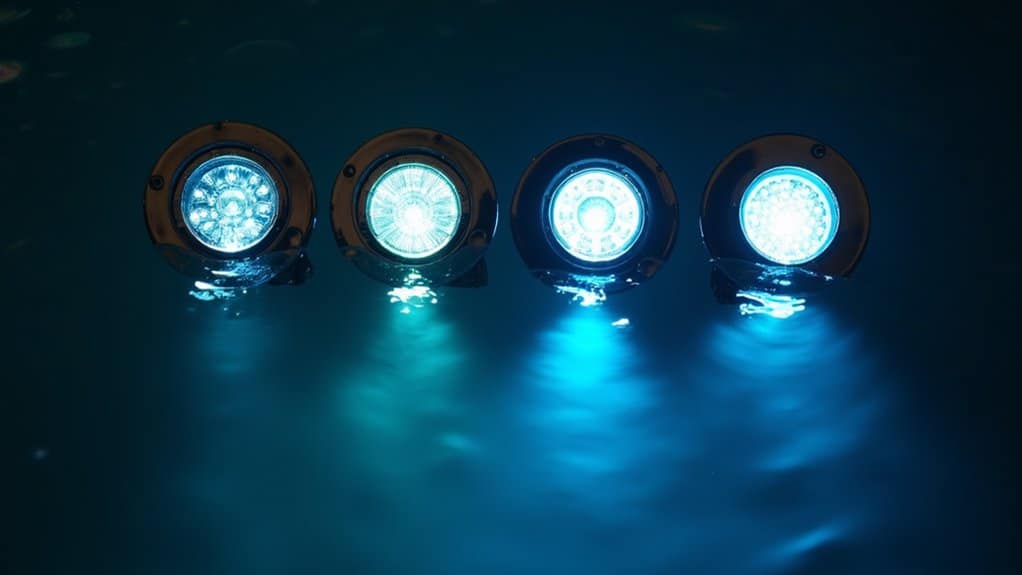
Four primary pool light types dominate the market, each with distinct performance characteristics that affect your pool’s ambiance and long-term operating costs. When evaluating pool lighting options, you’ll encounter incandescent, halogen, LED, and fiber optic technologies.
Incandescent lights consume 250 500 watts and last roughly 5,000 hours. Halogen models run more compactly but offer limited color capability. When comparing LED pool lights vs halogen, LEDs deliver up to 90 percent greater efficiency, 50,000-hour lifespans, and color-changing programs across five distinct colors. Fiber optic systems house their light source outside the water for maximum safety but produce noticeably less brightness. Standard incandescent fixtures can also accept LED bulb replacements for cost savings without requiring a full fixture swap.
For energy efficient pool lighting, LEDs dominate offering the strongest combination of longevity, color versatility, and reduced operational costs. Their durable construction also makes them exceptionally well suited for outdoor and underwater use, standing up to the demanding conditions of pool environments. Beyond brightness and efficiency, fiber optic setups offer a unique advantage by enabling custom light patterns and programmable fades that create one-of-a-kind visual experiences across your pool and landscape.
Why LED Pool Lights Save You the Most Energy
You’ll realize long-term cost savings through two channels: drastically lower electricity bills and reduced replacement frequency. LEDs last 25,000 50,000 hours up to 50 times longer than incandescent alternatives minimizing maintenance labor and fixture costs over a decade-plus lifespan. As LED chip efficiency continues advancing, you’re investing in technology that’ll only decrease your consumption further.
How Long Each Pool Light Type Actually Lasts
Beyond energy savings, each light type’s actual service life determines your total cost of ownership and maintenance schedule. When learning how to choose pool lights, you’ll find lifespan varies dramatically across technologies. Incandescent bulbs last just 1,000 5,000 hours, requiring frequent replacements. Halogen lights extend slightly to 2,000 2,500 hours but still underperform considerably.
LED pool lights dominate with 25,000 50,000 hours of operation, reducing maintenance cycles greatly. Fiberoptic systems reach up to 50,000 hours but deliver dimmer output. This swimming pool lighting guide recommends prioritizing pool light brightness alongside longevity. Material quality, proper installation, and water chemistry directly impact durability beyond base ratings. Stainless steel housings resist corrosion better than plastic alternatives. You’ll achieve ideal performance by matching specifications to your pool’s environmental conditions. LED pool lights dominate with 25,000 50,000 hours of operation, significantly reducing maintenance cycles, while fiber optic systems can reach similar lifespans but provide dimmer output. This swimming pool lighting guide emphasizes balancing brightness with longevity, as material quality, proper installation, and water chemistry all influence durability stainless steel housings, for example, resist corrosion better than plastic. Aligning these specifications with broader system decisions like variable speed pump vs single speed pump ensures consistent, efficient performance across your entire pool setup.
Pool Light Safety Ratings and Voltage Risks
Because electrical current and water create life-threatening hazards, every pool light you install must carry proper safety certifications and operate within strict voltage limits. All underwater pool lights require UL 676 listing and a minimum IP68 ingress protection rating to seal against water penetration. California caps fixture voltage at 150V between conductors, while NEC Article 680 mandates GFCI protection for 120V fixtures installed 5 10 feet from the pool edge.
For your pool lighting design, 12V LED systems offer the safest profile operating below the low-voltage contact limit of 15V AC RMS and eliminating GFCI requirements on the secondary side when fed by UL 379-listed transformers. Color changing pool lights must meet these same standards. Always verify your state’s adopted NEC edition and local amendments before specifying fixtures.
Pool Light Colors That Transform Your Backyard
You can select from a broad spectrum of LED colors warm whites (2700K 3000K), blues, greens, reds, and dynamic RGB combinations to match any mood or occasion, from tranquil spa settings to vibrant poolside parties. Standard white lighting, while functional for visibility, lacks the versatility to create themed or layered atmospheres that color-changing LEDs deliver with superior energy efficiency. WiFi-enabled smart color systems let you customize hues, shifts, and patterns directly from your smartphone, giving you precise control over your pool’s aesthetic without manual adjustments.
LED Color Options
How dramatically your pool’s nighttime atmosphere shifts depends largely on the LED color system you choose specifically, whether you opt for RGB or RGBW technology.
RGB LEDs blend red, green, and blue diodes to generate a broad color spectrum. They’re ideal for decorative lighting and mood-driven effects but can’t produce a true, clean white. If you’re prioritizing ambiance at a lower cost, RGB delivers strong value.
RGBW LEDs integrate a dedicated white diode alongside the standard RGB array. This addition yields a purer, brighter white light with superior color accuracy and higher overall illumination. You’ll get both functional visibility and refined aesthetics critical for nighttime swimming.
For pools requiring dual-purpose lighting safety and visual impact RGBW technology offers measurably better performance across brightness, color fidelity, and versatility.
White Light Limitations
While white LEDs deliver reliable brightness, they introduce a set of limitations that undercut both aesthetics and functionality in pool environments. You’ll notice uniform white illumination flattens water depth perception, eliminating the visual contours and movement dynamics that color-shifting LEDs produce. Surface imperfections become more pronounced, and your pool’s overall appearance reads as clinical rather than inviting.
White light restricts your ambiance control to basic on/off brightness, preventing you from simulating sunset tones, twilight effects, or festive atmospheres. Water features like fountains and jets lose their visual energy under uniform illumination textures wash out and motion appears diminished.
From a safety perspective, white-only lighting creates glare that reduces swimmer awareness. You can’t delineate pool edges or depth shifts effectively without color differentiation, compromising underwater navigation and hazard identification.
Smart Color Control
Because smart color control systems now pair advanced LED hardware with app-driven software, you’re no longer locked into static white illumination. You can select from up to 1,500 changing colors across seven predefined theme-based routines all managed through a smartphone app, remote, or direct control panel.
| Feature | Specification | Benefit |
|---|---|---|
| Fixed Colors | 5 10 selectable | Instant mood setting |
| Dynamic Shows | 7 color-changing themes | Automated ambiance shifts |
| Color Range | Up to 1,500 hues | Full jewel-tone spectrum |
| Multi-Zone Sync | Pool, spa, waterfall | Unified lighting design |
| Scheduling | App-based automation | Hands-free operation |
You’ll synchronize colors across pool, spa, and waterfall features simultaneously while setting automated schedules for timed color modes delivering precise control over your backyard’s nighttime aesthetic.
Upfront Cost vs. Long-Term Pool Light Savings
When you’re comparing pool lights, you’ll find LED fixtures cost more upfront than incandescent or halogen alternatives, but their up to 90% reduction in energy consumption delivers up to 80% electricity savings that offset the initial premium. LED lamps last 30,000 50,000 hours versus just 1,000 5,000 hours for incandescent bulbs, dramatically cutting your replacement frequency and long-term maintenance expenses. Evaluating total cost of ownership including purchase price, energy draw, and replacement cycles reveals that efficient technologies like LED and solar-powered options consistently outperform budget fixtures over a multi-year horizon.
Initial Purchase Price Comparison
Three main pool lighting technologies LED, incandescent, and fiber optic occupy distinct price tiers that directly affect both your upfront budget and long-term cost trajectory. Incandescent fixtures represent your lowest entry point at $450 $650 per bulb installed, though they’re limited to approximately 1,000 hours of operational life. LED installations range from $700 $900 for compact models like the Pentair Globrite to $1,000 $1,500 for full-size fixtures in concrete or vinyl liner pools. Color-changing LED configurations run $500 $1,000 per light with app-based control integration.
Fiber optic systems command the highest premium at $1,300 $1,700 installed. However, their declining market position against LEDs which deliver comparable color-changing capabilities at considerably lower price points makes them increasingly difficult to justify from a pure cost-performance standpoint.
Energy Savings Over Time
Although LED pool lights carry a higher upfront cost $700 $1,500 versus $450 $650 for incandescent their energy consumption tells a fundamentally different financial story over time. You’ll achieve up to 86% energy reduction compared to incandescent alternatives, with models like the Pentair IntelliBrite delivering 82% less consumption at just 26 watts.
Your long-term ROI compounds through two critical vectors: electricity savings reaching 80 85% annually and dramatically fewer replacements. LEDs sustain 25,000 50,000 operational hours versus halogen’s 2,000 4,000 a 10 20x lifespan advantage that eliminates recurring fixture costs. The GalaxyBrite LED, consuming only 31 watts, cuts energy expenses by 80% while maintaining full-spectrum color output. These efficiency metrics mean you’ll offset the initial price differential within the first few years, with every subsequent season delivering net savings.
Replacement and Maintenance Costs
Beyond energy savings, the true financial divergence between lighting technologies emerges in replacement and maintenance cycles. LED bulbs last 10 to 20 years, while incandescent options require swapping every 1 to 3 years. Fiber optic bulbs fall mid-range at 3 to 7 years. You’ll spend $50 to $600 per LED bulb versus $30 to $70 for incandescent replacements.
Factor in labor at $50 to $130 per hour, and full LED replacement runs $500 to $1,700 per light. Incandescent full replacements cost $500 to $700. The national average sits at $1,100 per light. Gasket and seal repairs add $70 to $150 when needed. You can reduce installation costs up to 40% by bundling with scheduled maintenance. LED’s extended lifespan minimizes these recurring expenses considerably.
How Many Pool Lights You Actually Need
Most pool owners underestimate the number of fixtures they need, defaulting to a single light when their pool’s dimensions demand two or three. A 15 x 30 pool maxes out at one fixture, while a 20 x 40 requires two, and anything beyond 20 x 42 demands three. The reliable formula: divide your pool’s square footage by 200 300 to estimate fixture count.
Your pool’s finish color directly impacts this calculation. Dark finishes absorb light aggressively, requiring 1.5 times more fixtures than light finishes meaning you’ll need three lights where a lighter surface gets by with two. Shape matters equally. Rectangular pools benefit from uniform eight-foot spacing, while L-shaped and kidney configurations require sectional placement. Angular pools perform best with dedicated corner fixtures targeting shadowed zones.
Pool Light Installation: Wiring, Placement, and Timing
Knowing how many fixtures your pool requires only gets you halfway proper installation determines whether those lights perform safely and last their rated lifespan.
Wiring: Kill power at the breaker before touching any conductors. Strip 6 inches of casing from wire ends, then join pool light wires to your GFCI breaker wires using wire nuts. Attach the ground to the green screw.
Placement: Install the niche through the pool wall from inside out, tightening the lock ring to seal. Position the top edge of the light lens at least 18 inches below the water surface for ideal illumination and code compliance.
Timing: Run conduit from the niche to a junction box mounted 18 inches above water level and 10 feet from the pool’s edge. Test at evening for visibility confirmation.
Best Pool Light Brands for Every Budget
Three budget tiers entry-level, mid-range, and premium define today’s pool light market, and each delivers a distinct balance of color range, wattage efficiency, and build quality. At the entry level, you’ll find the SHONE Solar Pool Light with IP67 rating, 3000lm output, and 12 color modes all solar-powered. Spa Electrics provides durable retro-fit options at accessible price points.
Mid-range selections like GalaxyBrite LED consume just 30VA, cut energy costs by 80%, and last 50,000 hours. Hayward’s ColorLogic 2.0 delivers 10 solid colors plus 7 dynamic shows with automation compatibility.
For premium performance, Pentair’s IntelliBrite 5G draws 45 70 watts while offering color-changing, dimming, and high brightness. PAL Lighting’s Evenglow system produces millions of colors through its lens optic system at only 30 35W, with multi-zone control capability.
Which Pool Light Type Is Right for Your Pool?
Once you’ve narrowed down a brand and budget, the next decision light type shapes everything from energy draw and color output to maintenance intervals and safety profile. Each technology delivers distinct performance characteristics you’ll want to match against your pool’s design requirements. When considering how to choose a pool cleaner, be sure to evaluate the cleaning method that best suits your pool’s shape and size. Additionally, factors like the efficiency of the motor and the reliability of the brand can greatly influence your overall satisfaction. Taking the time to research these elements will ensure your pool stays spotless with minimal effort.
| Feature | LED | Fiber Optic |
|---|---|---|
| Lifespan | Up to 50,000 hours | ~25,000 hours |
| Color Output | Up to 5 colors, 7 programs | Color wheel effects |
| Installed Cost | $700 $1,500 | $1,300 $1,700 |
LEDs deliver the strongest efficiency-to-brightness ratio at 80 90% savings over incandescent. Fiber optics keep electrical components outside the water, making them the safest option for spas and hard-to-access niches. If you’re retrofitting an older incandescent setup, LED’s PAR56-compatible models simplify the swap without modifying your existing niche.
Frequently Asked Questions
Can Pool Lights Be Added to an Existing Pool Without Major Renovation?
Yes, you can add pool lights to an existing pool without major renovation. You’ll find magnetic-mount underwater lights that adhere directly to your pool wall using included glue, requiring no draining or structural changes. They’re compatible with fiberglass, concrete, vinyl, and above-ground pools. You can also choose floating lights, deck-mounted fixtures, or LED replacements that install into existing niches. Make certain any underwater option carries an IPX8 waterproof rating and doesn’t exceed 12V AC.
Do Pool Lights Attract Bugs or Insects During Nighttime Swimming?
Yes, pool lights can attract bugs, but your color choice makes a significant difference. Cool-toned lights white, blue, and UV-emitting wavelengths (300 495 nm) draw moths, beetles, and mosquitoes most aggressively. You’ll minimize insect activity by selecting amber or warm-white LEDs below 3000K, which emit virtually no UV light. LEDs inherently attract fewer bugs than incandescent fixtures. You should also angle lights downward and position them away from seating areas to reduce nighttime interference.
Are Pool Lights Safe to Use During Thunderstorms or Heavy Rain?
You shouldn’t use pool lights during thunderstorms. Water and metal components including light fixtures, handrails, and electrical housings conduct electricity, creating severe electrocution risks if lightning strikes nearby. Even well-grounded systems can’t guarantee safety during active storms. Follow the 30-30 rule: wait 30 minutes after the last thunder before resuming operation. Heavy rain without lightning poses fewer risks, but you’ll want to verify your lighting system’s IP-rated weatherproofing specifications before continued use.
How Do You Clean Pool Lights Without Damaging the Sealed Housing?
You’ll start by powering off the breaker and removing the light assembly via its single Phillips head screw no draining required. Pry the clip-fitting lens gently with a flat-edged screwdriver at the top joint, then brush algae from between the lens and housing using a soft terry cloth dampened with a chlorine-level solution. Clean O-rings carefully, replacing any that show wear. Rinse all components with fresh water, avoiding abrasive tools that’d compromise the sealed housing’s integrity.
Can Pool Lights Be Synced With Outdoor Music or Entertainment Systems?
Yes, you can sync pool lights with outdoor music and entertainment systems using DMX lighting controllers or app-based platforms like Poolside Tech’s Attendant. Beat-matching technology analyzes your music’s tempo, triggering precise color shifts and pulsing effects in real time. You’ll want color-changing LEDs with Spotify integration for seamless playlist synchronization. LyLmLe’s 40W LED fixtures offer millions of programmable colors via app control, while voice-compatible systems integrate directly with smart home assistants.