


Your pool light likely trips its breaker due to a ground fault, an overloaded shared circuit, or a degraded GFCI. Deteriorated wiring insulation or water intrusion creates current imbalances that GFCI breakers detect at just 4 6 mA. If your light shares a circuit with a pool pump, startup surges alone can exceed a 20-amp breaker’s capacity. Each trip signals worsening damage and real electrocution risk in a wet environment understanding the specific cause helps you fix it safely. eureka pool light malfunction reasons can also stem from outdated equipment or faulty installations. Regular maintenance checks are essential to identify issues before they become significant hazards. Aside from these electrical concerns, common remote control problems can also interfere with your pool light’s functionality. Issues such as dead batteries, interference from other devices, or a misconfigured remote can complicate the situation further. Identifying and resolving these remote control issues is crucial to ensure seamless operation and enhance safety around your pool area. In addition to addressing remote control problems, following eureka pool light troubleshooting steps can help you pinpoint the source of electrical issues more effectively. Start by inspecting the light fixture for any visible signs of damage and ensure all connections are secure. If issues persist after these checks, consulting a professional for a thorough examination may be necessary to prevent further complications.
Pool Light Tripping the Breaker? Start With These Checks
When your pool light keeps tripping the breaker, the first step is to assess the total circuit load before assuming the fixture itself is at fault. On a 20-amp circuit rated for 2,400W at 120V, two LED pool lights drawing 50W each total only 100W. However, shared loads from pumps or filtration systems can push the circuit into overcurrent territory. Disconnect non-essential devices to isolate the load contribution.
If the breaker still trips, you’re likely dealing with a pool light short circuit, a pool wiring issue, or a ground fault pool light condition. Use a GFCI tester to detect current imbalances exceeding the 5mA threshold. Inspect all connections for exposed conductors, and verify THHN-rated wiring per NEC requirements. When multiple LED fixtures share a single GFCI breaker, cumulative leakage from each light’s LED driver can combine to exceed the 5mA trip threshold, causing nuisance trips even when individual lights test fine.
Ground Faults: The Top Reason Pool Lights Trip Breakers
When your pool light’s wiring insulation deteriorates whether from age, corrosion, or physical damage exposed conductors create a ground fault by allowing current to escape its intended path into the surrounding water or grounding system. Your GFCI outlet detects this current imbalance, as little as 4 6 milliamps between the hot and neutral conductors, and trips the breaker within milliseconds to prevent electrocution. If your GFCI repeatedly trips when you activate the pool light, you’re likely dealing with compromised wiring that demands immediate inspection and repair before anyone enters the water. Because the NEC requires a continuous cord for underwater connections, improper wire splicing by technicians who drain the pool and use tape or epoxy instead of pulling new cord can introduce ground faults that cause persistent breaker tripping. Much like how automated systems detect potential threats on websites to block harmful activity, your GFCI operates as an automated safety mechanism that continuously monitors for dangerous current leaks in your pool’s electrical system.
Exposed Wiring Causes Faults
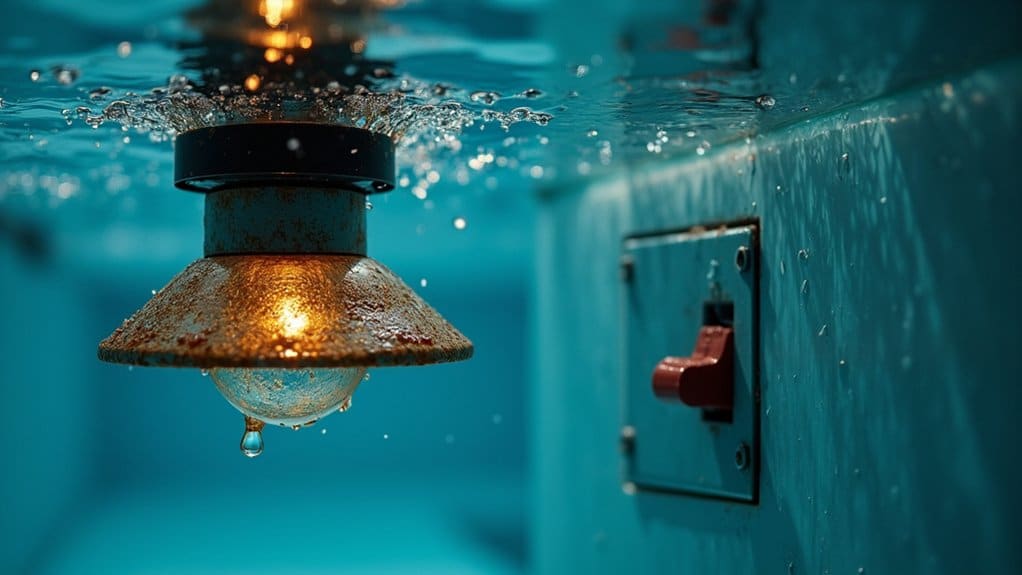
Exposed wiring inside a pool light fixture creates a direct fault path between energized conductors and the surrounding water a ground fault that’ll trip your GFCI breaker every time. Corroded aging wires from decades of chemical and water exposure deteriorate conductor insulation, leaving bare copper in direct contact with pool water. This pool electrical fault condition is especially dangerous in older 120V systems where degraded cord casings expose live conductors.
Spliced or field-repaired underwater cords accelerate insulation failure, compounding the risk. Improper grounding issues such as a missing bonding lug or failed potting compound in the wet niche eliminate your safety backup when insulation breaks down. You should never repair underwater light cords; replace the entire fixture assembly instead.
GFCI Detects Current Leakage
A ground fault current escaping its intended circuit path and flowing to ground through an unintended conductor like pool water is the single most common reason your pool light trips the breaker. When your GFCI detects current leakage as small as 4-6 milliamps between hot and neutral conductors, it cuts power instantly. This sensitivity is calibrated specifically to prevent electrocution in wet environments.
Your pool light breaker trips because of an underlying underwater lighting electrical problem, typically involving:
- Water invading the cord seal, creating a conductive fault path to ground
- Condensation accumulating on the light lens, signaling internal moisture breach
- Damaged insulation allowing current to contact the fixture’s grounded housing
- Corroded wiring connections reducing resistance between conductors and ground
Shared Equipment That Overloads Your Pool Light Circuit
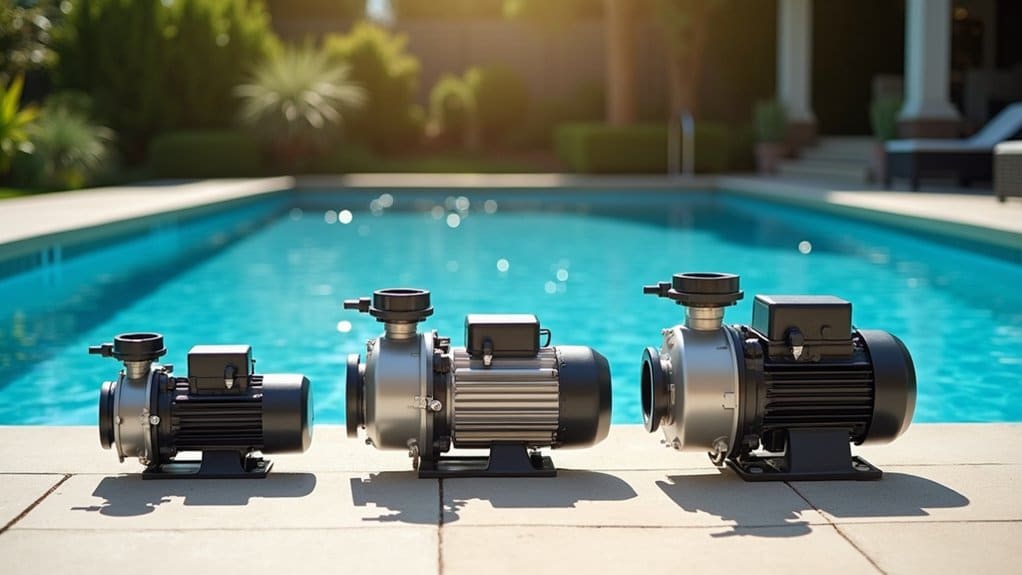
Though your pool light may function perfectly on its own, sharing its circuit with other equipment like pumps, heaters, or additional fixtures often pushes the total load beyond the breaker’s rated capacity, causing repeated trips. When your pool light keeps tripping breaker, the root cause may not be the light itself but cumulative demand from connected devices.
Pool pump startup surges alone can exceed a 20-amp breaker’s capacity. Adding your light creates a consistent overload condition. NEC requires breakers rated at 125% of continuous motor loads, making shared configurations non-compliant. A pool GFCI tripping light scenario often stems from these combined loads triggering protective devices. For proper pool light safety, you should install dedicated circuits for each high-draw component.
When a Worn GFCI Breaker Causes Nuisance Tripping
Your GFCI breaker‘s internal components degrade over its 15 25 year lifespan, causing it to trip on normal electrical fluctuations that don’t represent actual ground faults a condition known as nuisance tripping. You should test your breaker’s performance by pressing the TEST/RESET buttons monthly per NEC 110.3(B) manufacturer instructions, and if it fails to hold under light loads or trips intermittently in dry conditions, the device has likely reached end-of-life. Replacing a worn GFCI breaker with a current-rated unit restores reliable shock protection and guarantees your pool light circuit meets NEC 680.23(F)(2) requirements for ground-fault circuit interruption.
GFCI Sensitivity Over Time
Because GFCI breakers rely on internal components that degrade from prolonged exposure to heat, moisture, and electrical stress, they don’t maintain factory calibration indefinitely. Per UL 943, Class A devices must trip at 4 6 mA of current imbalance. As internals wear, the effective threshold drops below this range, causing trips from normal electrical fluctuations rather than actual ground faults.
You should watch for these key degradation indicators:
- Cumulative leakage from pool equipment exceeds the device’s lowered threshold, triggering false trips
- Capacitive leakage on long conductor runs activates worn sensors disproportionately
- Test/reset failure signals internal component breakdown requiring immediate replacement
- Humidity-driven trips occur without measurable ground faults present
Replace GFCIs every five years per manufacturer guidelines, and test monthly to verify reliable operation.
Testing Breaker Performance
When a GFCI breaker trips repeatedly without a verifiable ground fault, you’ll need systematic testing to determine whether the device itself has degraded beyond its operational threshold. Per NEC 230.95(C), primary injection testing verifies full system performance, including sensors and wiring integrity.
| Test Method | Key Indicator |
|---|---|
| Multimeter resistance | Below 10Ω or above 1000Ω between hot and neutral signals a shorted breaker |
| No-trip verification | Breaker remains untripped when test current exceeds pickup and time delay settings |
| Trip confirmation | Apply 125% of ground fault pickup setting; breaker must trip |
| Voltage measurement | Zero volts between ground and hot on line side confirms proper function |
You should isolate the breaker and remove source power before applying any test current.
Replacing Faulty Breakers
Even after thorough testing confirms the breaker itself is the problem, you shouldn’t rush into replacement without first understanding why GFCI breakers degrade. Over time, internal components lose calibration, triggering shutdowns at current imbalances well below the standard 5mA threshold. This wear-induced sensitivity creates nuisance tripping that mimics actual ground faults.
When replacing a faulty GFCI breaker in pool circuits, follow these code-aligned steps:
- Disconnect all power and verify zero voltage with a multimeter before removing the old unit.
- Install a replacement GFCI breaker matching your circuit’s exact specifications (e.g., 20A at 120V).
- Test the new breaker under load using a certified GFCI tester to confirm proper trip response.
- Consult a licensed electrician for final verification, ensuring NEC pool wiring compliance.
Voltage Spikes and Wiring Flaws Behind Pool Light Trips
Wiring flaws compound this damage. Corroded connections increase resistance, creating voltage irregularities that trigger GFCI protection. Loose or damaged grounding introduces stray voltage into pool water a direct NEC Article 680 violation. Improper equipotential bonding fails to equalize voltage potentials, allowing leakage current to bypass light surfaces. You’ll notice flickering before full breaker trips, signaling progressive wiring deterioration requiring immediate inspection.
How to Diagnose a Pool Light That Keeps Tripping
Before touching any pool lighting component, you’ll need to de-energize the circuit at the main breaker panel not just the switch. Reset your GFCI breaker and document the trip timing immediate, delayed, or intermittent as each pattern indicates a distinct fault type.
Always kill power at the breaker panel first then note exactly when your GFCI trips to pinpoint the fault.
Follow this diagnostic sequence:
- Inspect the fixture visually for cloudy lenses, cracked housings, corroded screws, or condensation indicating water intrusion past the seal.
- Test GFCI sensitivity using a dedicated tester that detects current imbalances as low as 5mA between hot and neutral conductors.
- Disconnect lights individually to isolate the faulty fixture, then use a megger to probe hot-to-ground and neutral-to-ground resistance.
- Assess circuit loading by verifying total wattage doesn’t exceed the breaker’s rated capacity with all connected devices operational.
When to Call an Electrician for a Tripping Pool Light
Diagnosing a tripping pool light yourself can pinpoint common issues, but certain fault conditions demand a licensed electrician’s expertise and in some cases, local codes require it. If you notice sparks, burning smells, or hot equipment, shut off power immediately and call a professional. Water inside panels, junction boxes, or outlets creates deadly shock hazards you shouldn’t attempt to resolve yourself.
Texas regulations prohibit DIY work on high-voltage underwater systems. You’ll also need licensed intervention when voltage testing at the panel, GFCI, or junction box is required, or when wiring traces through conduit reveal breaks. Repeated GFCI resets risk equipment damage and fire hazards. If your breaker trips persistently after basic troubleshooting, don’t delay schedule a professional inspection.
What Happens if You Ignore a Tripping Pool Breaker
Although a tripping breaker might seem like a minor nuisance, ignoring it sets off a chain of escalating hazards that threaten your property, your equipment, and anyone near the pool.
- Electrical fire risk Unresolved ground faults and short circuits generate heat buildup in wet environments, escalating to property-endangering blazes when breaker protection fails.
- Electrocution danger Short circuits near water create lethal shock conditions for swimmers and bystanders, especially when dampness contacts compromised wiring.
- Equipment destruction Overcurrent cycles burn out motor windings, capacitors, and pool lights progressively, driving components beyond repair.
- System-wide failure Repeated overload stress degrades wiring insulation and weakens breakers themselves, causing ground fault trips to cascade into your home’s main panel.
Don’t delay diagnosis each trip signals worsening damage.
Frequently Asked Questions
Can Pool Water Chemistry Cause Corrosion That Leads to Breaker Tripping Over Time?
Yes, your pool’s water chemistry can absolutely cause corrosion that triggers breaker tripping. High chlorine levels above 3 ppm, low pH below 7.2, and saltwater systems accelerate oxidation on wire terminals and connections. This corrosion increases electrical resistance, generating excessive heat that activates your breaker’s thermal overload protection. You’ll notice intermittent tripping at first, worsening over time. Don’t keep resetting the breaker you need a licensed electrician to inspect corroded connections before they cause fire hazards.
Does Cold Weather Increase the Chance of a Pool Light Tripping the Breaker?
Yes, cold weather increases your pool light’s trip risk considerably. Freeze-thaw cycles crack and deteriorate wire insulation, exposing conductors to moisture. Cold temperatures also cause condensation inside fixtures, creating ground faults that’ll trip your GFCI which detects imbalances as low as 5mA per NEC standards. Additionally, wiring contracts in cold conditions, making brittle insulation more prone to cracking. You should inspect seals, conduit wiring, and GFCI functionality before winter to prevent hazardous faults.
Are LED Pool Lights Less Likely to Trip Breakers Than Halogen Pool Lights?
Yes, LED pool lights are less likely to trip breakers than halogen models. LEDs draw only 7 20 watts compared to halogen’s 50 500 watts, reducing your circuit load by up to 85%. They also run considerably cooler, minimizing thermal stress on wiring and components. You’ll experience fewer failures since LEDs last 25,000 50,000 hours versus halogen’s 1,000 4,000, which means less electrical cycling and fewer installation errors from frequent replacements.
Can a Tripping Pool Light Breaker Increase My Monthly Electricity Bill Significantly?
No, a tripping pool light breaker won’t greatly increase your monthly electricity bill. When your GFCI detects a 5mA imbalance, it cuts power within milliseconds, halting energy consumption almost instantly. Repeated trips actually *reduce* your total watt-hours since they prevent sustained operation. You’re consuming less electricity, not more. However, you shouldn’t ignore the trips they signal hazards like moisture intrusion or short circuits that violate NEC safety standards and require immediate professional diagnosis.
Is It Safe to Swim While the Pool Light Is Tripping the Breaker?
No, you shouldn’t swim when your pool light’s breaker keeps tripping. A tripping GFCI signals a ground fault, meaning current may be flowing through the pool water posing a lethal electrocution risk. Per NEC guidelines and Sonoma County safety protocols, you must vacate the pool immediately upon an unexplained GFCI trip. Don’t re-enter until a qualified electrician inspects your fixture, wiring, and GFCI for moisture intrusion or short circuits.