
You’ll calculate your pool volume, determine the required flow rate using an 8-10 hour turnover target, and select an appropriate filter type, sand, cartridge, or D.E., based on your debris load and budget. Next, you’ll match your filter size to your pump’s GPM output, guaranteeing compatibility and compliance with local codes. Understanding pressure head balance and flow velocity limits secures ideal performance. The details behind each step reveal critical decisions that directly impact your system’s efficiency and water quality.
Calculate Pool Volume
Before you can select the right filter size, you’ll need to determine your pool’s volume in gallons, a straightforward calculation that hinges on accurate measurements and the correct formula for your pool’s shape. Start by measuring your pool’s length, width, and depth using a tape measure. Account for pool depth variability by calculating average depth: (shallow end + deep end) ÷ 2. Pool shape complexity requires different formulas: rectangular pools use Length × Width × Average Depth × 7.5, while round pools use 3.14 × (Radius)² × Average Depth × 7.5. Oval, kidney-shaped, and freeform pools each have specific multipliers. For irregular designs, obtain builder-supplied CAD data when possible. Estimated volumes can easily be off by 2000-3000 gallons, representing approximately a 10% error that significantly impacts chemical dosing accuracy. For pools with complicated irregular shapes, consulting a professional can help ensure your volume calculations are precise and reliable. Accurate volume calculation directly determines your filter’s required flow rate and turnover capacity.
Determine Flow Rate and Turnover
Now that you’ve calculated your pool’s volume, the next critical step is determining how quickly water must circulate through your filter system. Flow rate, measured in gallons per minute (GPM), dictates your filter and pump sizing. Use this formula: Pool Volume ÷ Turnover Rate ÷ 60 = Flow Rate. For residential pools, aim for an 8-10 hour turnover; commercial pools require 6 hours.
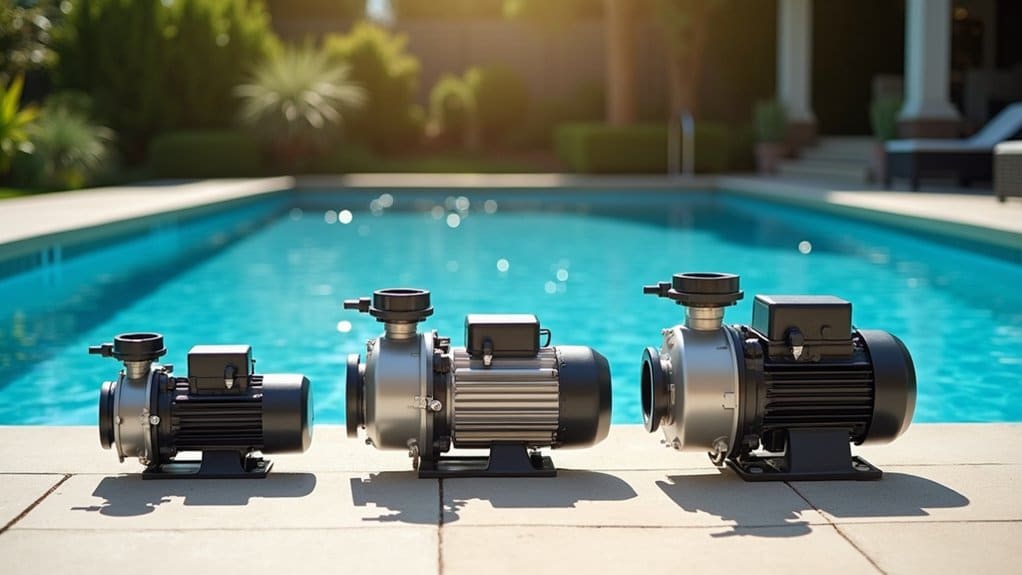
Implement flow meter monitoring on your return line to track actual GPM performance daily. This reveals system inefficiencies immediately. Simultaneously, measure pressure head balance using gauges to assess total dynamic head, the resistance your pump must overcome. These measurements confirm whether your equipment achieves calculated requirements. Variable-speed pumps let you adjust RPM, optimizing energy consumption while maintaining adequate turnover rates and filtration quality.
Select Pool Filter Type
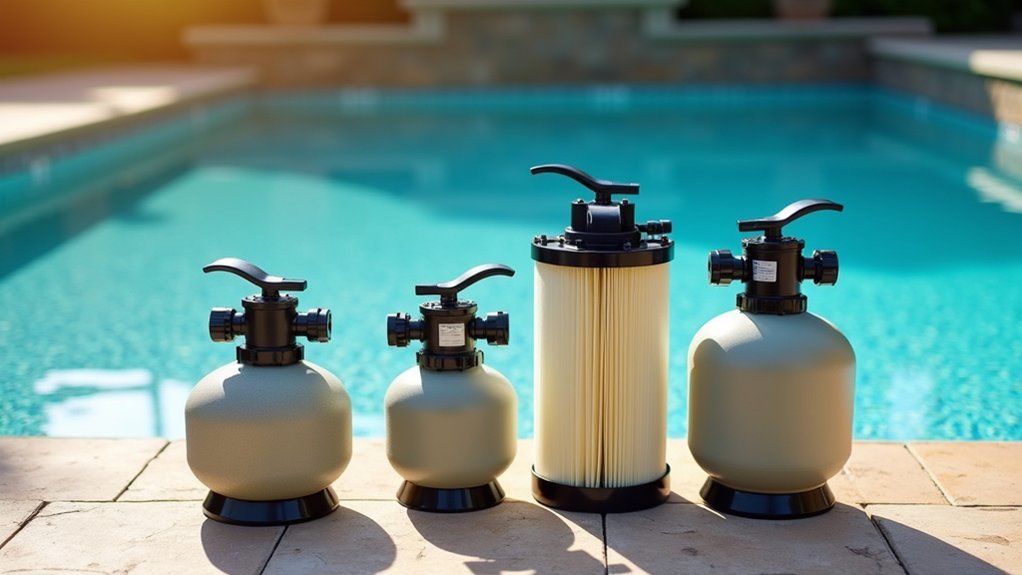
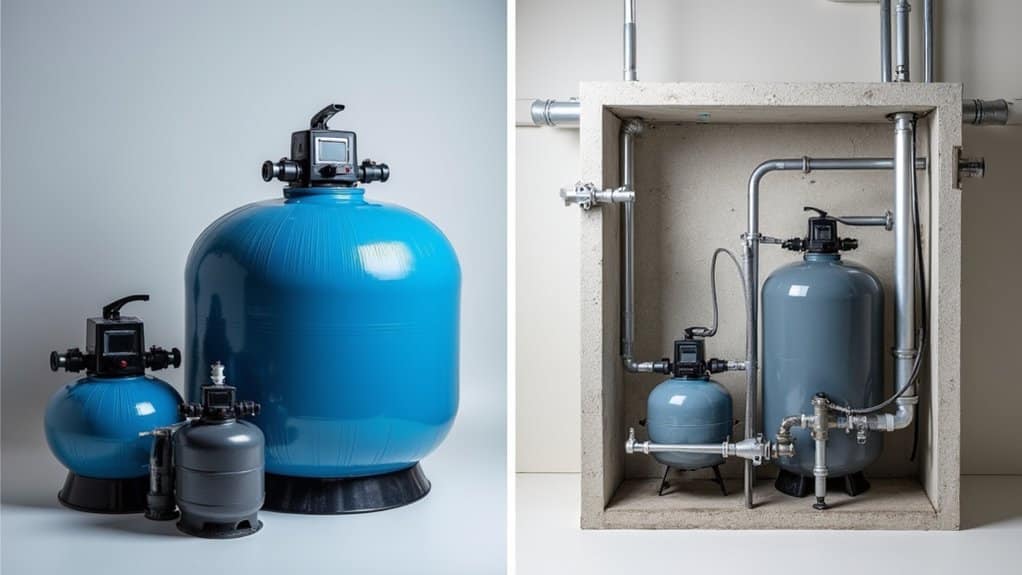
Three primary filter types dominate the residential and commercial pool market, each offering distinct advantages based on your filtration needs, budget, and maintenance preferences.
Sand filters cost the least upfront and handle high volumes efficiently, but they filter particles down to only 20 40 microns. Cartridge filters offer superior energy efficiency and water conservation since they don’t require backwashing, filtering 10 20 micron particles while maintaining better water clarity. They’re ideal if you’re conscious about resource usage. Cartridge filters last approximately 6 years, making them a reliable mid-range investment compared to sand and D.E. alternatives. Cartridge filters require frequent manual cleaning to maintain their filtration capacity over time. Replacement cartridges typically range from $20 to over $100 depending on filter specifications and brand.
Diatomaceous Earth (D.E.) filters provide the finest filtration at 1 3 microns, delivering exceptional water clarity for premium applications. However, they demand the highest initial investment and ongoing maintenance costs.
Consider your pool size, typical debris load, and bather frequency when selecting your filter type. Align your choice with your performance expectations and budget constraints for ideal results.
Match Filter Size to Pool and Pump
Once you’ve selected your filter type, you’ll need to match its size precisely to your pool’s volume and your pump’s flow rate, because an undersized filter clogs rapidly while an oversized one wastes money without delivering better results. Your pump’s GPM output must never exceed your filter’s maximum flow rating. Calculate your required flow rate by dividing pool volume by 8 hours, by 60 minutes to get minimum GPM needed.
Select a filter that meets or slightly exceeds this requirement. Consider filter capacity constraints when evaluating cartridge, sand, or D.E. options. Account for backwash flow requirements, which demand additional system capacity. Following manufacturer’s recommendations ensures your selected filter size will effectively handle your pool’s specific needs and pump capacity. Verify manufacturer specifications for both components, ensuring compatible operational ranges. Purchasing a slightly larger filter size can provide longer filter cycles and more efficient filtration than the minimum requirement. Proper alignment prevents high pressure, reduces maintenance frequency, and extends equipment lifespan while maintaining clear water quality.
Account for Regulatory and Practical Considerations
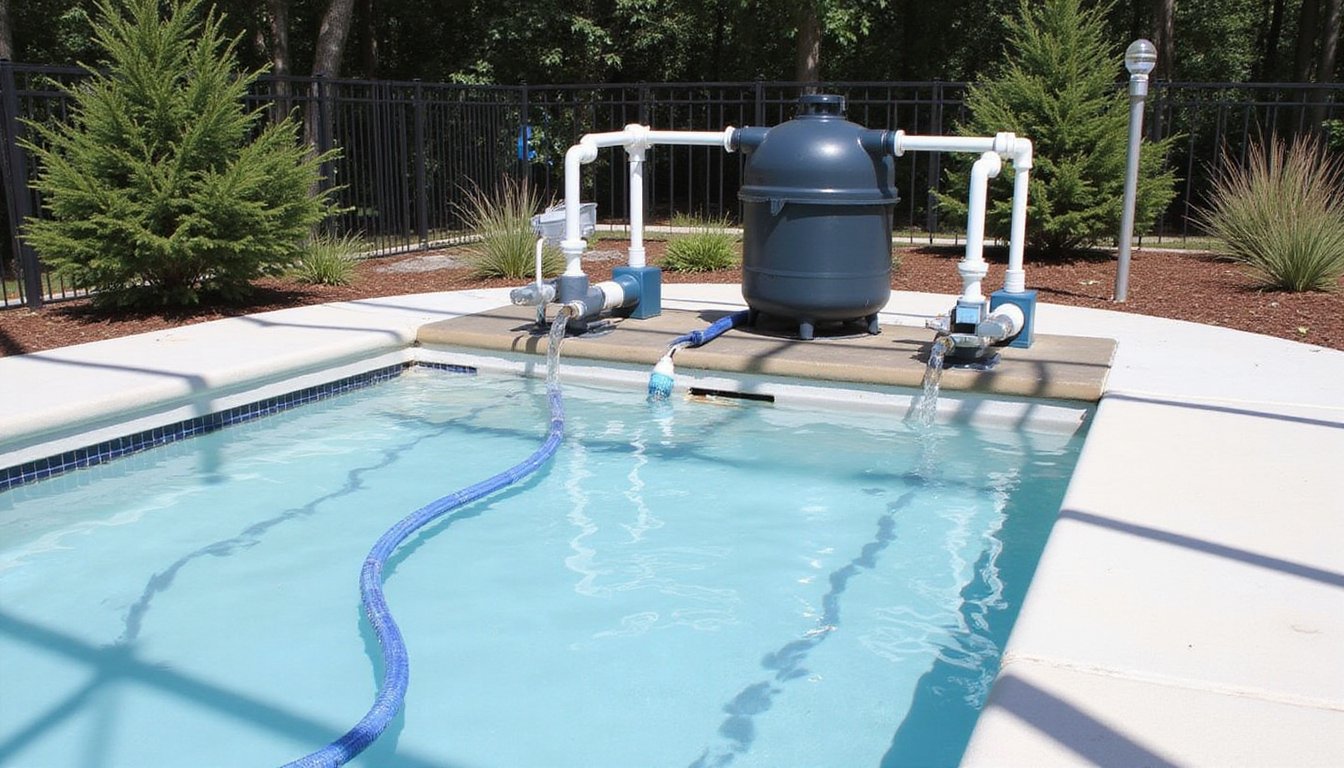
While matching your filter size to your pool’s specifications guarantees ideal hydraulic performance, you’ll also need to verify that your chosen system complies with applicable regulatory standards and addresses practical installation constraints. Check your local building codes, which often mandate NSF/ANSI 50 compliance for health and safety assurance. You must guarantee your filter positioning accommodates maintenance access and safe backwashing procedures. Proper installation requires adequate clearance around the unit and adherence to maximum flow velocity limits, typically 6 fps for suction lines and 8 fps for return lines. Additionally, verify that your system supports minimum turnover rates, generally every 6 8 hours for public pools. For residential pools, the maximum filtration flow rate should be calculated based on a 6-hour turnover to ensure compliance with energy standards. Undersizing the filter can cause additional strain on the pump and compromise overall system efficiency. Consider future integration requirements, such as solar heating compatibility, which may influence your filter layout and piping configuration decisions.
Frequently Asked Questions
How Often Should I Replace My Pool Filter Media or Cartridge Elements?
You’ll need to follow a consistent filter cleaning schedule based on your filter type. For cartridge elements, you’re looking at replacement every 1 3 years with proper maintenance. Sand filters typically last 3 7 years, while glass media extends to 5 10 years. Your filter maintenance frequency depends on usage and water clarity. You’ll know it’s time to replace when you notice cloudy water, increased pressure, or reduced flow, even after cleaning.
What Is the Average Cost of Different Pool Filter Types and Installation?
You’ll find sand filters offer the lowest average operating costs at $250 $600 upfront, with professional installation estimates ranging $300 $500. Cartridge filters cost $300 $900, requiring $200 $400 installation. DE filters run highest at $450 $1,200+ with $350 $550 professional installation estimates. Long-term expenses vary: sand media costs $12 $20 per bag every 5 7 years, cartridges run $60 $120 annually, and DE media costs $20 $35 monthly. Your choice depends on balancing upfront investment against ongoing maintenance expenses.
Can I Upgrade My Pump Without Replacing My Existing Filter System?
You can upgrade your pump alone, but you’ll face pump upgrading considerations regarding filter compatibility requirements. Your existing filter must handle the new pump’s output; exceeding its rated flow causes inefficient filtration, cloudiness, and potential damage. You’ll need to monitor pressure gauges and water quality closely. If problems emerge, you’ll need to upgrade your filter simultaneously. Consult manufacturer specs to confirm your current filter can safely accommodate the higher flow rate.
How Do I Know if My Current Filter Is Undersized or Failing?
You’ll identify an undersized or failing filter by monitoring signs of poor circulation and decreased filtration efficiency. Watch for cloudy water persisting after filtration cycles, rapid pressure gauge increases, and weakened return jets. You’re dealing with a problem if you’re backwashing frequently, noticing debris accumulation, or requiring excessive chemicals. Compare your filter’s surface area against manufacturer specifications for your pool volume. If pressure readings consistently exceed 8 10 psi above baseline post-cleaning, you’ve likely got undersizing.
What Warranty Coverage Is Typically Included With Pool Filter Purchases?
You’ll typically receive manufacturer warranty terms covering defects in materials and workmanship for 90 days to 3 years, depending on your brand and purchase channel. Coverage usually includes parts only or parts and labor for bundled equipment purchases. You can extend protection through extended service plans lasting 5 20 years for an additional fee. However, you’ll need proof of purchase, professional installation, and proper maintenance documentation to validate your claim eligibility.