


Solar pool heating costs more upfront typically $2,500 to $9,000 versus $1,500 to $6,000 for gas but it’s far more affordable long-term. You’ll spend just $10 to $25 monthly operating a solar system compared to $150 to $350 for gas. That’s $1,200 to $2,400 in annual savings, with most solar systems paying for themselves in 2 to 4 years. When you factor in lifespan, maintenance, and environmental impact, the full cost picture becomes even clearer below.
Solar vs Gas Pool Heating: The Quick Cost Verdict
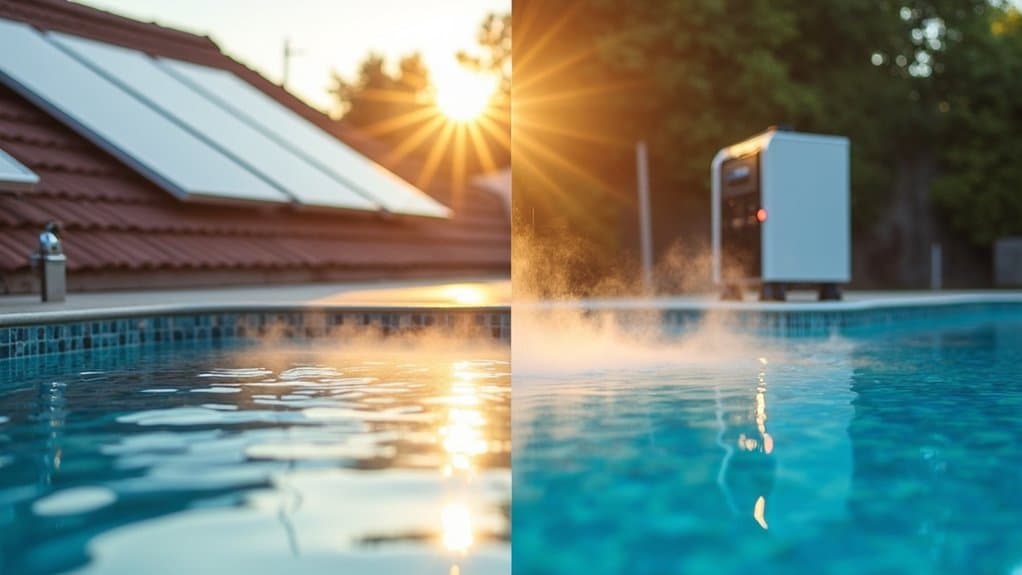
The pool heating savings comparison becomes even more decisive long-term. Solar systems last 15+ years; gas heaters need replacement every 5 10 years, compounding your total ownership costs considerably. Gas heaters can cost between $300 to $500 monthly to operate, quickly eroding any upfront savings. Additionally, solar heaters offer virtually zero operating costs, making them the clear winner for budget-conscious pool owners over time. It’s also worth noting that gas prices are expected to rise, further widening the cost gap between the two heating options in the years ahead.
Upfront Price for Gas Heaters vs Solar Systems
When you’re comparing upfront costs, gas pool heaters typically run $1,500 to $6,000 installed, while solar pool heating systems range from $2,500 to $9,000 depending on pool size and panel type. You’ll pay more initially for solar, but the gap narrows quickly since solar operating costs drop to just $1 to $1.50 per day while gas heaters require continuous fuel purchases. Understanding these price differences upfront helps you calculate the true long-term value of each system.
Gas Heater Costs
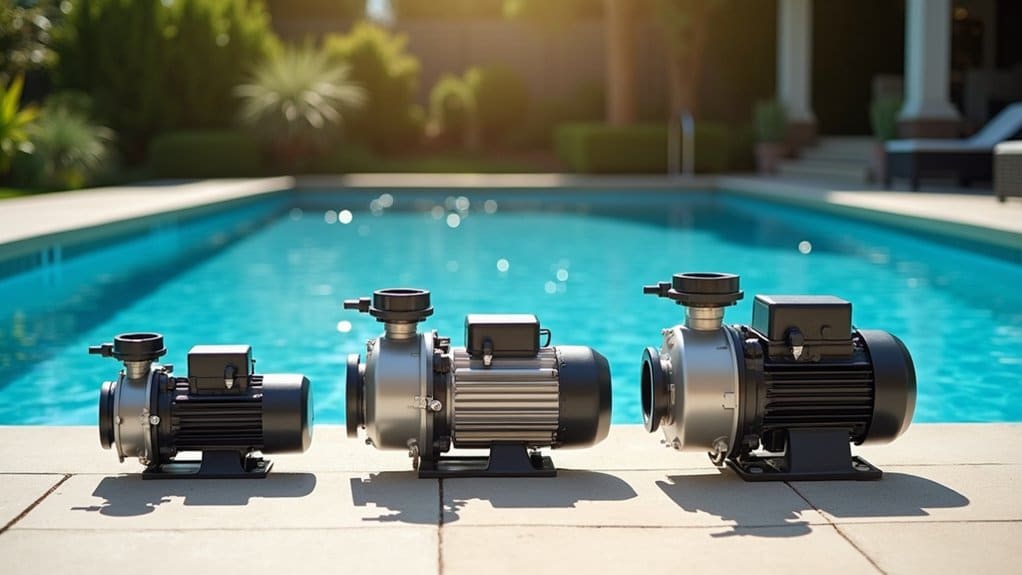
Your pool heater installation cost adds $500 $2,000 for labor, plus $500 $2,000 for gas line setup. For a 20,000-gallon pool, you’ll need 80K 120K BTU, costing $2,000 $3,500 installed. Compared to the solar pool heater cost, gas heaters carry lower upfront expenses but don’t harness free renewable energy. You’re fundamentally trading a smaller initial investment for ongoing fuel dependency a trade-off worth calculating before committing.
Solar System Pricing
How much more does a solar pool heating system actually cost upfront compared to gas? You’ll typically spend $2,500 to $7,000, with the national average at $4,500. Your pool’s size directly determines collector area and total cost. Solar pool heating systems typically cost $2,500 to $7,000 upfront, with a national average around $4,500, compared to lower initial costs for gas heaters, though long-term savings often offset the difference. Since your pool size determines the required collector area and total investment, factoring in ongoing expenses like how much does it cost to run a pool pump helps you evaluate the true overall cost of ownership.
| Pool Size (Gallons) | Estimated Cost |
|---|---|
| 10,000 | $2,500 $4,000 |
| 20,000 | $4,000 $7,000 |
| 30,000 | $6,000 $8,000 |
| Glazed Panels | $3,000 $10,000 |
| DIY Kits | $250 $1,600 |
Collectors run $20 to $40 per square foot, covering 50% to 100% of your pool’s surface area. While solar’s upfront price exceeds gas, your pool energy cost heating drops to near zero afterward. Superior pool heating system efficiency means you’ll recoup the difference through eliminated fuel expenses, making solar the sustainability-forward choice. Solar collectors cost about $20 to $40 per square foot and typically cover 50% to 100% of your pool’s surface area, resulting in a higher upfront investment than gas systems but near-zero ongoing heating costs. With superior efficiency and no fuel expenses, you can recover the initial cost over time, making solar a sustainable option that also supports how to reduce pool maintenance costs through long-term savings and reduced system strain.
Why Solar Heaters Convert More Energy Into Heat
Solar pool heaters convert up to 80% of available solar radiation directly into usable heat a process that bypasses fuel combustion entirely and delivers roughly 1,000 1,200 BTU per square foot per day under ideal sun exposure. Sunlight strikes absorber surfaces, converting photons into thermal energy while circulating pool water draws off that heat through bonded tubing.
Monthly Operating Costs That Add Up Fast
That impressive 80% conversion efficiency means little if monthly costs erode your savings and that’s exactly where gas and solar systems diverge sharply.
You’ll spend $150 to $350 monthly running a gas heater, averaging $7 to $15 daily on fuel alone. Cooler temperatures push those figures higher as your system burns more fuel to compensate. Daily use accelerates costs fast.
Solar’s monthly expense? Just $10 to $25 for pump electricity. That’s it. With sufficient sunlight, your daily operating cost drops to zero.
The math is stark: gas costs 10 to 20 times more monthly than solar. Over a typical swimming season, you’re looking at $1,000+ in gas versus roughly $150 in solar pump electricity. Those savings compound every year you own the system.
Annual Savings With Solar Pool Heating
Every year you run a gas heater, you’re spending roughly $1,700 in fuel costs while a solar system delivers the same heating for just $70 annually. That’s a 96% reduction in heating expenses, translating to $1,200 $2,400 in annual savings depending on your region and usage.
| Heating Type | Annual Operating Cost | Annual Savings vs. Solar |
|---|---|---|
| Gas Heater | $1,700 | $1,630 |
| Electric Heater | $840 | $770 |
| Heat Pump | $1,050 | $990 |
| Solar Heater | $70 |
Your payback period against gas heating averages just 2.35 years based on a $5,500 initial investment. Over five years, you’ll spend $6,800 total with solar compared to $17,500 with gas keeping $10,700 in your pocket.
Maintenance Costs for Solar and Gas Pool Heaters
Beyond the annual fuel savings, maintenance costs further widen the gap between solar and gas pool heaters. Solar systems require minimal upkeep, with annual maintenance plans running $100 $300 and one-time service visits costing $185 $250. Common solar repairs leaks, pumps, and sensors range from $150 $600, keeping long-term expenses predictable.
Gas heaters demand more frequent service due to their mechanical complexity. You’ll pay an average of $472 per repair, with common fixes ranging $300 $800. Control panel and circuit board replacements can hit $500 $1,200, greatly increasing ownership costs.
Solar panels last 20 30 years with warranties spanning 5 12 years, while gas heaters accumulate higher repair bills over shorter lifespans. Apply the 50% rule: if any repair exceeds half your system’s replacement cost, it’s time to upgrade.
How Solar Pays for Itself in 2 to 4 Years
When you install a solar pool heater, you’ll typically recover your full investment within 2 to 4 years since you’re eliminating monthly gas fuel costs that can run $200 $400 during heating season. Once you’ve hit that break-even point, every dollar you’d have spent on gas becomes pure savings that compound year after year. With solar systems lasting 10 to 20 years, you’re looking at 6 to 18 years of fundamentally free pool heating after your initial payback period ends.
Breaking Even Quickly
Although solar pool heaters cost around $6,500 upfront per the Department of Energy they’ll pay for themselves in roughly 2 to 4 years when you compare them against gas heating. Although solar pool heaters cost around $6,500 upfront according to the U.S. Department of Energy they typically pay for themselves within 2 to 4 years compared to gas systems, making them a strong long-term option when evaluating the cheapest way to heat pool water.
Here’s why the break-even timeline is so short:
- Annual gas savings reach $2,340 after accounting for $60 in solar maintenance.
- A $5,500 baseline investment divided by $2,340 in yearly savings equals a 2.35-year payback a 42.6% ROI.
- Gas heaters last only 5 years, while solar systems endure up to 20, giving you 17+ years of practically free heating post-payback.
- Five-year total costs tell the story: $6,800 for solar versus $17,500 for gas.
You’re not just cutting fuel bills you’re eliminating 15 lbs of CO₂ per sunny day while locking in decades of savings.
Long-Term Savings Accumulate
Every year you run a gas heater, you’re spending $2,400 $4,000 on fuel alone money that a solar system eliminates almost entirely. With solar operating costs of just $10 $25 monthly, you’ll cut heating expenses by up to 70%. A $5,000 solar installation saving $1,200 annually pays for itself in roughly four years.
The real advantage compounds over time. Solar panels last 15+ years with 12-year warranties, while gas heaters need replacement every 5 10 years. Over eight years, an $8,000 solar system totals approximately $8,720 in combined costs significantly less than gas alternatives facing rising fuel prices and declining efficiency. You’re not just reducing monthly bills; you’re avoiding future replacement cycles and maintenance escalation. Each year beyond the payback period delivers pure savings directly to your budget.
How Long Do Solar and Gas Heaters Last?
Because solar pool heaters rely on fewer mechanical components, they consistently outlast gas heaters by a significant margin. You’ll typically get 15 20+ years from a solar system, while gas heaters average just 5 10 years before requiring replacement.
Solar systems last 15 20+ years outlasting gas heaters by double thanks to fewer mechanical components that can wear out.
Here’s how lifespan breaks down by key factors:
- Solar panels: EPDM collectors last 20+ years with 15-year warranties; polypropylene panels deliver 10 15 years.
- Gas heaters: Heavy use accelerates wear, pushing replacements within 5 10 years.
- Maintenance impact: Well-maintained solar systems exceed 20 years; gas units rarely surpass 15 even with diligent upkeep.
- Component durability: Gas valves fail within 5 10 years, while UV-stabilized solar materials resist degradation for decades.
You’re effectively buying two gas heaters for every one solar system’s lifespan doubling your long-term costs.
Environmental Impact: Solar vs Gas Pool Heating
The environmental gap between solar and gas pool heating is stark and it’s widening as regulations tighten. Gas heaters emit 5,000 pounds of CO₂ annually per pool, while solar systems produce zero operational emissions. That’s a 6,000-pound annual reduction in greenhouse gases when you switch to solar.
| Metric | Solar | Gas |
|---|---|---|
| Annual CO₂ Emissions | 0 lbs | 5,000 lbs |
| Energy Source | Renewable sunlight | Fossil fuels |
| Operational Pollution | None | Ongoing |
| Regulatory Trend | Favored | Facing bans |
| Sustainability Rating | Gold standard | Least eco-friendly |
California already bans gas pool heaters in new constructions, and similar regulations are spreading. If you’re prioritizing long-term cost savings alongside environmental responsibility, solar’s zero-emission profile makes it the clear winner.
Solar vs Gas: Which Pool Heater Saves More?
When you compare long-term savings, solar pool heaters pull ahead decisively delivering up to 70% lower heating costs and achieving full payback within 2 3 years, according to 2024 HomeAdvisor data. Your operating cost breakdown tells a stark story: gas heaters drain $2,400 $6,000 annually in fuel expenses, while solar systems run on free sunlight with only $300 $1,000 in added pump electricity costs per year. Over a 20-year ownership period, that gap compounds dramatically, especially as gas prices have tripled in the past decade and continue to introduce unpredictable cost fluctuations into your budget.
Long-Term Savings Comparison
Although gas heaters cost roughly 35% less upfront than solar systems, that initial savings erodes quickly once you factor in operating expenses. Solar heaters run about $90 annually, while gas systems cost $2,400 $6,000 per year. Over time, solar reduces total heating costs by up to 70%.
Here’s how the numbers break down over a typical ownership period:
- A $5,000 solar system saving $1,200 annually reaches payback in just over four years.
- Solar delivers free heat for a decade or more beyond that break-even point.
- Gas heaters never achieve payback, requiring replacement every 5 10 years.
- An $8,000 solar system totals $8,720 over eight years, versus $12,800 for a heat pump.
You’ll maximize returns by choosing solar early.
Operating Cost Breakdown
Once you’ve seen the long-term savings solar delivers, it helps to understand exactly where those numbers come from. Solar pool heaters achieve up to 85% energy conversion efficiency and cost virtually nothing to run you’re only powering your existing circulation pump. Gas heaters operate at just 60 75% efficiency, burning natural gas ($1.20 $1.80/therm) or propane ($2.50 $4.00/gallon) continuously.
During peak season, you’ll spend $200 $500 monthly on gas heating. Solar? Zero fuel costs. That gap adds up to roughly $1,000 in annual savings, cutting your heating expenses by 60 70%. Propane users face even steeper bills it’s 70% less efficient per dollar than natural gas.
Gas heaters also lose efficiency as they age, driving maintenance costs higher. Solar panels maintain performance for 15+ years, keeping your operating costs predictably low.
Frequently Asked Questions
Can Solar Pool Heaters Work Effectively During Cloudy or Rainy Days?
Yes, your solar pool heater still works on cloudy days, though it’ll produce only 10 30% of its peak output. On partly cloudy days, you’ll get about 80% efficiency. You can boost performance by adding a thermal pool cover to cut 50 70% of heat loss and pairing your system with a heat pump for consistent temperatures. These enhancements maximize your solar investment while keeping long-term operating costs low.
Is It Possible to Combine Solar and Gas Pool Heating Systems?
Yes, you can combine solar and gas pool heating into a hybrid system. Solar handles primary heating at 85% efficiency, while gas kicks in as backup, heating 2 5°F per hour. You’ll cut operational costs by up to 70%, reducing monthly bills from $150 $350 to minimal amounts. With a payback period of 1.5 7 years and solar panels lasting 15+ years, you’ll maximize savings while lowering your carbon footprint.
Do Solar Pool Heaters Work Efficiently in Colder Northern Climates?
Yes, solar pool heaters can work in colder northern climates, but you’ll need the right setup. Evacuated tube collectors perform best, even at 40°C, while unglazed panels struggle below 10°C. You’ll want collectors sized at 80 120% of your pool’s surface area and a pool cover to minimize heat loss. These systems extend your swim season May through September and reduce heating costs 70 90% compared to gas or electric alternatives.
How Does Pool Size Affect the Choice Between Solar and Gas?
Pool size directly shapes your heating decision. For small pools or spas, gas heaters work well for quick heating, though you’ll still pay $200 $500/month in fuel. As your pool grows, gas costs escalate proportionally large pools can hit $975/year without a cover. Solar’s fixed pump costs of $10 $25/month don’t scale with size, giving you better ROI on larger pools. Long-term, solar’s 70% cost reduction makes it economical across all sizes.
Are There Tax Credits or Rebates Available for Solar Pool Heaters?
You can claim the 30% federal Residential Clean Energy Credit on solar pool heater purchase and installation costs through 2032. You’ll file IRS Form 5695 with your tax return, and your system must be SRCC-certified to qualify. Beyond federal incentives, you should check state and local rebates California, for example, offers additional rebates and property tax exemptions. These combined savings greatly reduce your upfront solar investment compared to gas.