
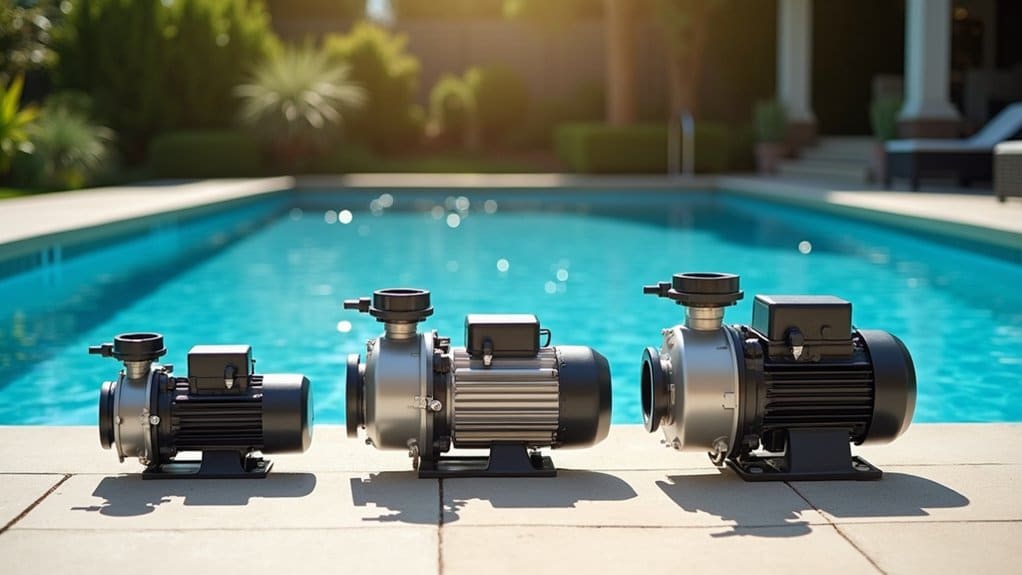
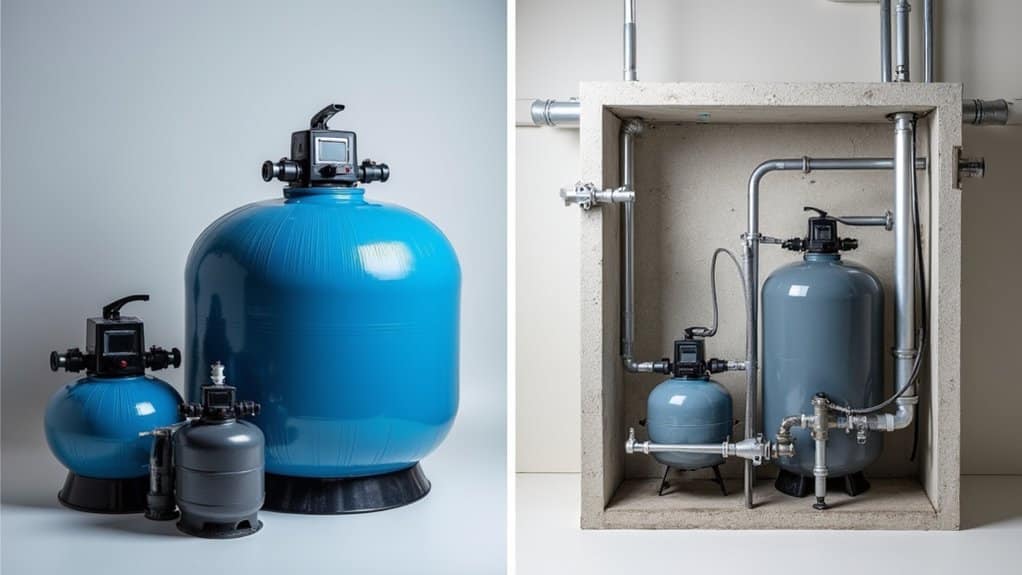

The cheapest way to heat your pool is a solar cover, starting at $200 $350, which eliminates 95% of evaporation and can save you $480 $1,225 annually. For active heating, heat pumps cost $40 $150 per month up to 85% less than gas heaters. Solar panel systems deliver near-zero operating costs after a $3,000 $7,000 installation. Your best setup depends on climate, budget, and how you combine these options for maximum savings. The most affordable way to heat your pool is with a solar cover, costing around $200 $350 and reducing evaporation by up to 95%, which can save $480 $1,225 annually. For active heating, heat pumps run about $40 $150 per month up to 85% cheaper than gas while solar panel systems offer near-zero operating costs after a $3,000 $7,000 installation. Choosing the right combination based on your climate and budget is key to how to reduce pool costs effectively over time. The cheapest way to heat your pool is with a solar cover, costing $200 $350 and reducing evaporation by up to 95%, saving $480 $1,225 annually, while heat pumps offer active heating at $40 $150 per month up to 85% less than gas and solar panel systems provide near-zero operating costs after a $3,000 $7,000 installation. Combining these options based on your climate and budget maximizes savings, and evaluating upgrades like are energy efficient pool pumps worth it further enhances long-term cost efficiency and overall system performance.
Why Pool Heating Costs Vary So Much
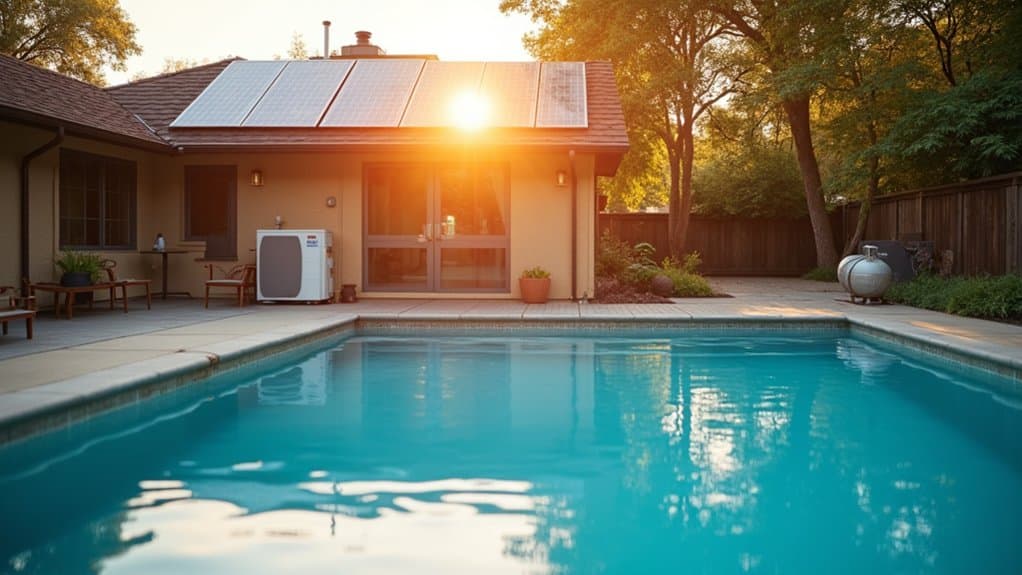
Evaporation accounts for up to 75% of heat loss, so a quality cover can slash expenses by 50%. Each degree you raise the thermostat increases costs by 10 30%. When you’re evaluating energy efficient pool heating systems, factor in heater efficiency ratings units reaching 97% deliver measurable long-term savings. Running your heat pump during the warmest hours of the day maximizes efficiency and reduces overall energy consumption. Additional features like waterfalls or fountains increase heat loss, further driving up your overall heating expenses. Pools in mountain locations require larger heaters and more frequent operation, which significantly drives up costs compared to warmer desert climates. Prioritizing covers, conservative set points, and right-sized equipment remains the most reliable path to low cost pool heating.
Every Pool Heating Method Compared by Cost
When you compare pool heating methods side by side, the upfront cost gaps narrow considerably gas heaters start around $1,500, heat pumps range from $1,500 to $6,600, and solar systems run $3,000 to $4,000 installed. The real separation shows up in monthly operating expenses, where heat pumps cost $40 to $150 per month versus $150 to $400+ for natural gas and $3,000 to $5,000 annually for electric resistance heaters. Understanding both cost categories lets you calculate your true break-even point and identify which system delivers the lowest total cost of ownership for your specific pool setup.
Upfront Costs Breakdown
Five main pool heating methods compete for your budget, and their upfront costs vary dramatically from under $200 for a single solar panel to over $7,000 for a fully installed heat pump system. When evaluating pool heating options, you’ll find gas heaters land between $2,000 $6,000 installed, while electric heat pumps run $3,000 $7,000+. Solar heaters cost $2,500 $6,500 installed, and electric element heaters offer the lowest installation fees at $350 $850 on top of $875 $5,400 for the unit. In this upfront costs breakdown, the cheapest way to heat a pool initially is a single solar panel at $150 $350 for small pools. Electric element heaters follow closely, with complete installations starting around $1,650 for a typical 15×30 pool.
Monthly Operating Expenses
Pool heater efficiency rankings confirm heat pumps operate 85% cheaper than gas or electric resistance units. Electric resistance heaters cost 5 6x more than heat pumps. In warm coastal regions, heat pumps average $50 $120 monthly, while solar approaches zero ongoing expense.
Solar Covers: The Cheapest Way to Keep Heat In
Though solar covers rank among the simplest pool accessories available, they deliver outsized returns by tackling the single biggest source of heat loss: evaporation. A properly installed cover eliminates 95% of evaporation, yielding 10-15°F temperature gains with just six hours of direct sunlight.
| Cover Type | Cost | Effectiveness |
|---|---|---|
| Budget Solar Cover | $200-350 | 85-90% |
| Premium Solar Cover | $350-500 | 90-95% |
| Solar Rings | $300-600 | 60-70% |
You’ll want 12-16 mil thickness for ideal heat absorption and durability. Premium materials with UV inhibitors last 2-3 years longer than budget options. Annual savings of $480-$1,225 translate to a 1-6 month payback period, delivering 300-600% ROI over the cover’s lifespan. Measure your pool dimensions plus 12 inches for proper overlap coverage.
Liquid Solar Covers as a Low-Cost Alternative
Physical solar covers deliver the best heat retention, but they’re not practical for every pool owner especially those who swim daily or dislike the hassle of rolling and storing a bulky blanket. That’s where liquid solar covers come in.
These products combine alcohol and calcium hydroxide to form a microscopically thin film across your pool’s surface. This invisible layer increases surface tension, slowing water molecule escape and reducing evaporation by roughly 15 40% in calm conditions. Since evaporation accounts for up to 70% of pool heat loss, you’ll retain meaningful warmth overnight without operating your heater.
You won’t see or feel the product in the water, and there’s no drowning risk. However, wind diminishes effectiveness, and you’ll need regular reapplication to maintain coverage.
Solar Panels: Free Pool Heat After the Initial Cost
Solar panels can cut your annual heating costs by up to 70% compared to gas heaters or heat pumps, with installation running $3,000 $7,000 and annual operating expenses staying under $550 effectively delivering free heat once you’ve recouped the upfront investment. High-efficiency collectors convert 70 80% of solar radiation into usable heat, generating 1,000 1,200 BTU per square foot per day under ideal conditions, which makes them the most cost-effective long-term heating solution in sun-rich climates. However, your savings depend directly on available sunlight performance drops on cloudy days, and you’ll need 50 100% of your pool’s surface area in panel coverage depending on your location’s solar exposure.
Long-Term Cost Savings
Once you’ve covered the initial $3,000 $9,000 installation cost, a solar pool heating system fundamentally delivers free heat your only ongoing expense is the electricity to run the circulation pump, which typically stays under $550 annually or less than $1.50 per day. That translates to a 50% 80% reduction in water heating bills compared to conventional systems. Once you’ve covered the initial $3,000 $9,000 installation cost, a solar pool heating system effectively provides free heat, with ongoing expenses limited to running the circulation pump typically under $550 annually or less than $1.50 per day. This results in a 50% 80% reduction in heating costs compared to conventional systems, making solar vs gas pool heater comparisons clearly favor solar for long-term savings and efficiency.
Over five years, you’ll spend roughly $6,800 total with solar versus $17,500 $18,600 for gas or $10,750 for a heat pump. A $6,500 solar array saves $11,100 against gas heating in that timeframe alone. With a 15 20 year lifespan, you’ll recoup three to four times your original investment. You’re also insulated from fuel price volatility, locking in $1,200 $2,400 in annual savings with minimal maintenance requirements.
Sunlight Dependency Drawbacks
Because solar pool heaters depend entirely on direct sunlight to generate thermal energy, they can’t produce heat at night and that’s when your pool loses up to 70% of its accumulated warmth through evaporation and radiation. Each morning, the system restarts from a deficit, requiring a full day to replenish lost heat.
Key operational limitations you’ll encounter:
- Morning unusability water temperatures drop overnight, leaving you with cold water until late afternoon reheating completes.
- Cloudy-day performance collapse overcast conditions severely reduce solar energy conversion, delivering inadequate BTU output when you need consistent warmth.
- Winter efficiency decline shorter daylight hours and lower sun angles limit heat buildup during peak demand seasons.
Without thermostat control, you can’t maintain a target temperature like 28°C, making supplementary heating systems necessary in low-sun scenarios.
Heat Pumps: Lowest Operating Cost for Longer Seasons
Although gas heaters deliver rapid temperature gains, heat pumps consistently outperform them on operating cost averaging $50 $150 per month versus $200 $500 for gas. You’ll pay roughly $0.63 per hour to operate a heat pump compared to $3 $9 for gas, translating to daily costs of $1.20 $1.80. This efficiency stems from COP ratings between 3.0 7.0, meaning you’re extracting 300% 700% more energy than you consume.
You’ll invest $2,500 $5,000 for equipment and installation, but you’ll recover that through annual savings of approximately $400 at 85°F year-round. High-efficiency models rated at COP 7.1 drop daily costs to just $0.84 while consuming only 5.63 kWh. In warmer climates with extended seasons, you’ll reduce heating bills by 50 75% compared to gas making heat pumps your most cost-effective long-term option.
Gas Heaters: Fast Heat at a Higher Price
Gas heaters flip the cost equation trading long-term efficiency for immediate heating power that raises water temperature 2 5°F per hour. You’ll pay $1,500 $4,500 for the unit, plus $500 $2,000 for installation. If you lack an existing gas line, add $1,500 $2,000 for trenching and hookup.
Operating costs hit hard compared to heat pumps:
- Natural gas runs $200 $400 monthly during regular use
- Propane escalates to $400 $850 monthly
- Hourly burn rates reach $3 $9 depending on BTU output
Modern units achieve 89% 95% thermal efficiency, but you’re still consuming 4 therms per hour at 400k BTU. With a 5 7 year lifespan, gas heaters work best for spa heating or occasional quick warm-ups not season-long economy.
Which Cheap Pool Heating Method Fits Your Climate?
How effectively your pool retains heat depends entirely on where you live and matching the wrong method to your climate wastes money fast.
In sunny, warm regions, solar covers deliver the strongest ROI raising temps up to 10°F while cutting monthly costs between $120 and $850. Solar sun rings offer flexible deployment where consistent sunlight’s available but full coverage isn’t practical.
For variable or overcast climates, liquid pool blankets reduce evaporation without physical deployment hassles, complementing other methods during changing seasons.
If you’re in a cooler but sunny climate, glazed solar collectors copper tubing behind tempered glass capture heat efficiently despite lower ambient temps. They’ll pay for themselves within 1.5 to 7 years.
Passive strategies like wind barriers and shade removal work best as baseline supplements everywhere.
Solar + Heat Pump Combos That Cut Monthly Bills
Why run a heat pump at full capacity when solar thermal collectors can pre-heat your pool water for free? A hybrid setup lets solar handle bulk heating while your heat pump activates only during cloud cover or shoulder seasons cutting heating costs by 50% or more versus gas alone.
Here’s what makes this combo work:
- Solar pre-heating raises water temperature, so your heat pump achieves COPs of 5+ with shorter run cycles.
- Smaller heat pump sizing becomes viable since solar offsets peak demand, reducing your upfront installation cost.
- Zero operating costs on the solar side beyond your existing pool pump’s electricity draw.
You’ll need 75 100% pool surface area in collector coverage for peak performance.
Frequently Asked Questions
Can You Heat a Pool Using a Wood-Burning Stove or Fire Pit?
Yes, you can heat a pool using a wood-burning stove by running copper pipe through the firebox, circulating pool water directly. You’ll achieve roughly 69 gallons per hour with a 33°F temperature rise. For a 15,000-gallon pool, expect about 27 hours for a 4°F increase. Wood boiler systems offer greater efficiency up to 95% gasification with heat exchangers that separate boiler and pool water, delivering consistent BTU output.
Does Adding a Windbreak Around the Pool Reduce Heating Costs Significantly?
Yes, adding a windbreak considerably cuts your heating costs. Wind drives up to 90% of nighttime heat loss through evaporation, so blocking it is critical. A solar pool cover doubles as the most effective windbreak, reducing evaporation by nearly 95% and slashing heating expenses by 50% 70% for outdoor pools. You’ll save $100 $500 per season, typically recovering the cover’s cost within one swimming season.
How Much Does Pool Color Affect Water Temperature and Heating Expenses?
Your pool’s liner color has a minimal impact on water temperature dark liners absorb more infrared radiation but only raise temps by 1 2°F in sunny conditions. Since each degree increase cuts energy costs by 10 30%, you’re looking at negligible savings. Shaded pools or cloudy climates see virtually zero benefit. You’ll get far greater cost reductions from a solar cover that limits evaporation than from changing your liner color alone.
Are There Government Rebates or Tax Credits for Pool Heating Systems?
You won’t find federal tax credits or rebates specifically targeting pool heating systems as of March 2026. Section 25C expired in December 2025, and the active Section 25D Residential Clean Energy Credit covers geothermal heat pumps for space conditioning only not pools. State programs like California’s HEEHRA and Massachusetts’ Mass Save exclude pool heating from eligible categories. Utility-sponsored incentives from providers like FPL and Austin Energy similarly don’t extend to pool heating equipment.
Does Pool Depth Significantly Impact the Overall Cost of Heating Water?
Yes, pool depth greatly impacts your heating costs. Deeper pools hold more water volume, requiring higher BTU heaters you’ll need 125,000 200,000 BTU for medium-sized deep pools versus 60,000 90,000 BTU for shallower ones. Each additional degree above 78°F adds 10% 30% to your energy bill, amplified by that extra volume. You’ll also lose more heat through ground conduction. However, you can offset these costs by installing a pool cover, which reduces heat loss by 50% 90%.