
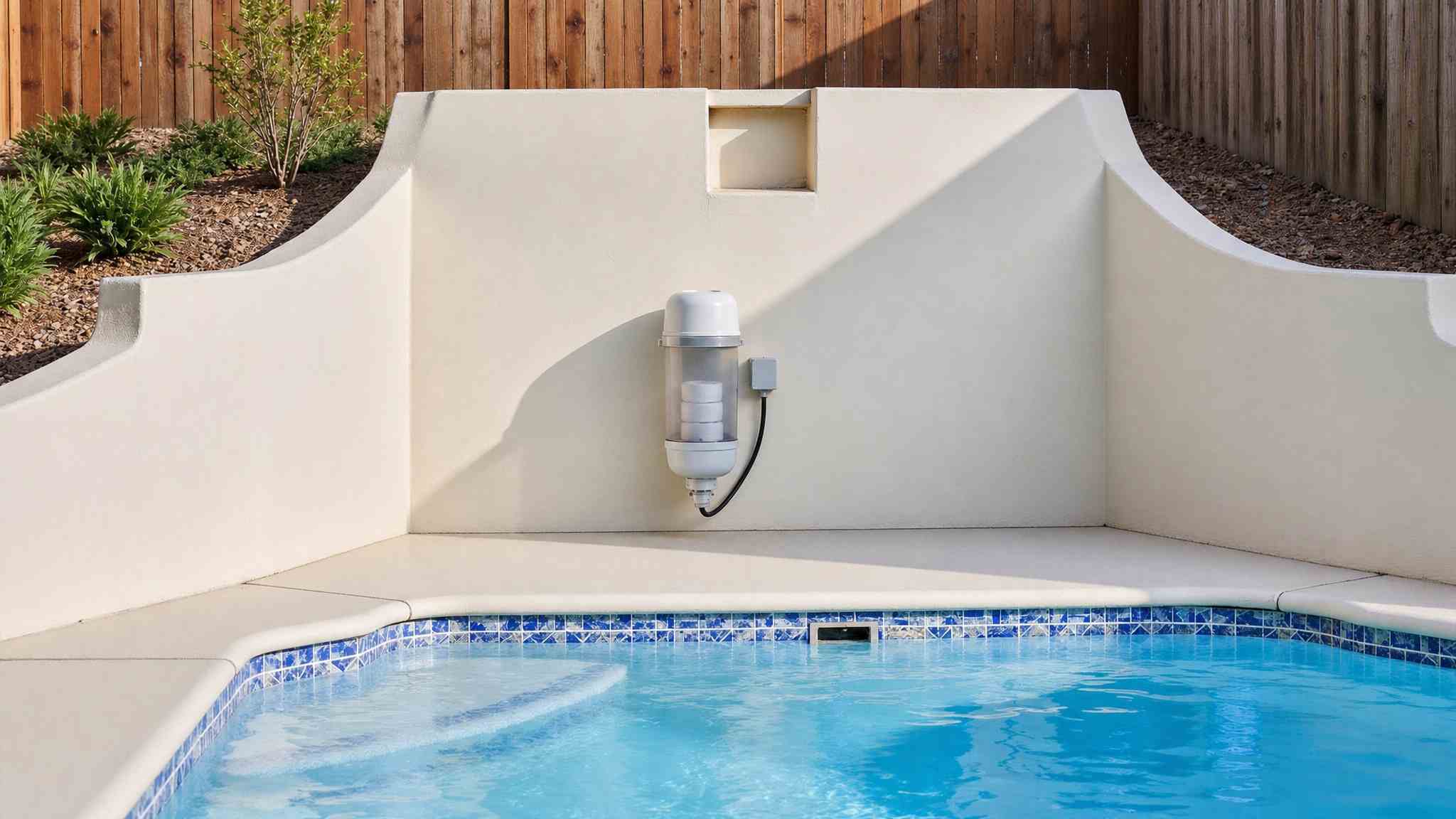
Every pool chlorine type produces hypochlorous acid, but each carries distinct byproducts. Trichlor tablets (65 70% available chlorine) add cyanuric acid and lower pH. Liquid chlorine (10 12.5% active chlorine) disperses in 30 60 minutes without adding CYA. Granular cal-hypo (65 73% available chlorine) delivers breakpoint chlorination for shock treatments. Salt systems generate chlorine on-site at 2,700 3,400 ppm salt. Understanding how each option affects pH, calcium, and CYA will help you choose the right fit below.
Key Takeaways
- Every chlorine type produces the same sanitizer, but each leaves different byproducts in the water.
- Trichlor tablets dissolve slowly for steady daily chlorine but add cyanuric acid and lower pH.
- Liquid chlorine works fast and adds no cyanuric acid.
- Granular chlorine delivers a concentrated dose for shocking and algae control.
- Test free chlorine, pH and cyanuric acid regularly, whichever chlorine you use.
Why Your Pool Chlorine Type Matters

Every chlorine product forms the same active sanitizer, hypochlorous acid (HOCl), but the byproducts each one leaves behind change your water chemistry in different ways. Chlorine tablets like trichlor add cyanuric acid with every dose and carry a pH around 2.8, steadily depressing your water’s pH while raising stabilizer levels. Liquid chlorine delivers a neutral pH impact, reducing your acid demand. Saltwater chlorination generates chlorine through electrolysis at 3,000 3,500 ppm salt, eliminating bulk chemical additions entirely.
These differences compound over a season. Choosing the wrong type creates recurring balancing work: extra acid, rising CYA, or unwanted calcium buildup. Matching your chlorine source to your pool’s setup, location, and usage pattern minimizes corrective chemistry and keeps your sanitation effective without unnecessary maintenance. Cal hypo, for instance, delivers 65 80% available chlorine but steadily increases calcium hardness in water, which can lead to scale formation if levels are not managed through periodic draining and refilling.
Pool Chlorine Tablets for Steady Daily Sanitizing
Because chlorine tablets dissolve gradually over days rather than minutes, they’re the most common method for maintaining a steady chlorine residual without frequent manual dosing. As stabilized chlorine, pool chlorine tablets resist UV degradation, extending sanitizer life in direct sunlight. They kill bacteria, viruses, and control algae through continuous release.
Standard 3-inch tablets treat up to 5,000 gallons each. Smaller pools under 10,000 gallons benefit from 1-inch tablets to prevent over-chlorination. You’ll load tablets into an automatic chlorinator, floating dispenser, or skimmer basket: chlorinators offer the most precise dissolution control.
Among pool chemicals, tablets require minimal weekly oversight. Check your feeder, test water, and monitor both chlorine and cyanuric acid levels. High readings signal you should reduce tablet count or lower dispenser settings. Refill weekly to maintain consistent output.
Liquid Pool Chlorine for Fast, Residue-Free Dosing
Liquid chlorine (sodium hypochlorite) disperses immediately in pool water and can produce a measurable free chlorine increase within 30 to 60 minutes, making it the fastest-acting chlorine source available. It leaves no solid residue on surfaces and doesn’t add cyanuric acid to your water, so you can raise sanitizer levels without shifting your stabilizer balance. Because it’s unstabilized, you should dose at night and verify that your existing CYA level provides adequate UV protection before relying on liquid chlorine for routine maintenance. Keep the pump running during addition to ensure even distribution throughout the pool.
Instant Chlorine Level Boost
When free chlorine drops and you need a fast correction, liquid chlorine (sodium hypochlorite) is the quickest option available. As an unstabilized chlorine source, it won’t add cyanuric acid to your water. Pour it near a return jet with the pump running for rapid distribution.
| Factor | Guideline |
|---|---|
| Maintenance dose | 1 gallon per 10,000 gallons |
| Pool shock treatment dose | Double the maintenance dose |
Test free chlorine, pH, and CYA before dosing. Adjust pH to 7.4 7.6 first, since chlorine performs better in balanced water. Apply liquid chlorine at night to prevent UV degradation, and run circulation for at least 8 hours. Retest before swimming: wait 8 to 12 hours or until levels return to a safe range.
No Residue Left Behind
This characteristic makes liquid chlorine particularly efficient for routine chlorine pool maintenance. You’re targeting 1 4 ppm free chlorine without introducing material that lingers beyond the chemical treatment itself. The result is cleaner application cycles and fewer post-dosing tasks throughout your maintenance schedule.
Unstabilized Dosing Considerations
Because liquid chlorine contains no cyanuric acid (CYA), each dose raises free chlorine without incrementally building stabilizer concentration in your water. This unstabilized chemistry gives you direct control over CYA levels, which you’ll manage separately based on UV exposure conditions.
If your pool’s stabilizer already reads high, liquid chlorine lets you sanitize without compounding the problem. You’re adding precise dosing capability without the chemical baggage that stabilized products carry. Each application delivers sodium hypochlorite alone: no secondary compounds accumulating in your water over repeated treatments.
However, unstabilized chlorine degrades faster under sunlight. You’ll need to pair liquid chlorine with independent CYA management in outdoor pools to prevent rapid UV loss. Monitor free chlorine readings post-dose and adjust stabilizer additions based on measured demand rather than estimates.
Granular Pool Chlorine for Shock and Algae Control
Granular pool chlorine delivers a concentrated dose of free chlorine to achieve breakpoint chlorination, raising free chlorine to roughly 10 times the combined chlorine level, which eliminates chloramines, bacteria, and algae in a single treatment. Products like cal-hypo-based Power Powder target severe algae blooms, while options like Chlor Brite offer a near-neutral pH formula suited for saltwater pools and sensitive surfaces. For best results, you’ll want to test and adjust your pH to 7.2 7.4 before shocking, apply granular chlorine at dusk to minimize UV degradation, and run your pump for at least 6 to 8 hours afterward.
How Granular Shock Works
| Condition | Dose per 10,000 Gallons | Application Note |
|---|---|---|
| Routine shock | 1 lb | Apply at dusk |
| Cloudy/light green algae | 2 lbs | Double standard dose |
| Dark green/black algae | 3 4 lbs | Triple or quadruple dose |
Run your pump 8 12 hours post-treatment and retest before swimming.
Fighting Algae Effectively
When algae takes hold in your pool, granular shock serves as the primary corrective treatment to eliminate it. Calcium hypochlorite delivers a rapid free chlorine spike that destroys green, mustard, and black algae cells through aggressive oxidation. Unlike trichlor tablets designed for slow-release maintenance, granular shock targets active outbreaks by overwhelming the organic load fueling the bloom.
Among pool chlorine types, granular shock performs best when you prepare conditions first. Brush algae from surfaces, adjust pH to ideal range, and run your filter continuously to capture dead organic matter post-treatment. Apply shock in the evening to minimize UV-driven chlorine degradation. Stronger blooms demand higher doses: light discoloration requires less oxidizing capacity than dense growth. Filtration and water balance remain essential; shock alone won’t compensate for neglected equipment.
Application and Dosing Tips
Proper dosing starts with knowing your pool’s volume and target chlorine level. For weekly maintenance, use 2 to 3 ounces per 5,000 gallons to maintain 1 3 ppm free chlorine. For shock treatment, apply 1 lb per 10,000 gallons to reach 7 9 ppm, or 3 lb per 10,000 gallons for breakpoint chlorination near 30 ppm.
Pre-dissolve granules in a bucket of pool water and stir until fully dissolved. Pour the solution slowly around the perimeter, starting at the deep end. Don’t add granular chlorine directly to the skimmer. Run your pump during application to facilitate even distribution. Test pH beforehand: aim for 7.2, since levels above 8.0 can waste up to 50% of your shock. Apply when swimmers aren’t present, preferably in the evening.
Salt Chlorine Generators: On-Site Pool Chlorination
Salt chlorine generators produce chlorine on-site by passing pool water through an electrolytic salt cell containing electrically charged plates. The electrical current splits dissolved sodium chloride into hypochlorous acid and sodium hypochlorite, the same active sanitizers found in traditional chlorination, plus hydrogen gas as a byproduct. This process is cyclical: chlorine reverts to salt after sanitizing, then reconverts during the next pass.
You’ll need to maintain salt concentration between 2,700 3,400 ppm, with 3,200 ppm often considered ideal. Adequate circulation is essential, as low flow triggers the system’s pressure switch to disengage operation. Salt systems deliver steadier chlorine levels by eliminating the peaks and valleys of batch dosing. However, they carry high upfront costs, require regular cell cleaning to prevent scale buildup, and demand careful pH and calcium hardness management.
Which Pool Chlorine Types Add Cyanuric Acid?
Not all chlorine products affect your cyanuric acid levels the same way. Trichlor tablets and dichlor granules are stabilized chlorine sources that add CYA with every dose: trichlor tablets, for example, are roughly 50% 55% cyanuric acid by weight. Liquid chlorine and salt chlorine generators, by contrast, don’t contribute any CYA on their own, so you’ll need to add stabilizer separately if your water requires it.
Stabilized Chlorine Sources
However, each application incrementally raises your CYA concentration. If you rely exclusively on trichlor tablets or dichlor granules for routine sanitation, CYA accumulates steadily over the season. Once levels climb too high, chlorine’s sanitizing effectiveness drops, even when free chlorine readings appear adequate.
Track your CYA levels regularly. If readings trend upward beyond your target range, the chlorine source is almost certainly the cause. Switching to an unstabilized option like liquid chlorine stops further CYA addition immediately.
CYA-Free Chlorine Options
Because stabilized chlorine products like trichlor and dichlor contain cyanuric acid as part of their chemical structure, every dose adds CYA that persists in the water long after the chlorine portion is consumed. Repeated use drives CYA levels progressively higher, reducing chlorine’s sanitizing effectiveness.
To avoid CYA accumulation, you’ll want to switch to unstabilized chlorine sources. Liquid chlorine (sodium hypochlorite) delivers active chlorine without adding CYA and works well for daily dosing or automated metering systems. Calcium hypochlorite provides a CYA-free solid option in granular or tablet form, though it raises calcium hardness over time. Salt chlorine generators produce unstabilized chlorine directly from dissolved salt, eliminating dependence on stabilized products entirely. Lithium hypochlorite is another CYA-free alternative, but its high cost limits practical use for most pool owners.
How Each Pool Chlorine Type Affects pH and Calcium
Each chlorine type shifts your pool’s pH and calcium hardness differently, so choosing the right product means accounting for these chemical side effects.
Trichlor tablets are strongly acidic (pH 2 3), steadily driving pH downward and requiring a periodic pH increaser. They also add CYA with each dose. Liquid chlorine (sodium hypochlorite) sits at roughly pH 13, raising pool pH slightly and often necessitating acid corrections. It adds no calcium. Dichlor granular chlorine is pH-neutral but increases CYA over time. Cal hypo granular chlorine releases hydroxide ions, pushing pH upward and adding calcium, raising hardness with repeated use.
Salt systems generate chlorine via electrolysis without adding calcium directly, but pool pH still tends to rise during operation, requiring regular acid adjustments. Monitor pH and calcium weekly regardless of your chlorine type.
Pool Chlorine Types Compared Side by Side
When you’re comparing chlorine types side by side, the differences in strength, speed, and chemical byproducts become clearer. Trichlor tablets deliver 65% 70% available chlorine with built-in CYA, while liquid chlorine provides 10% 12.5% active chlorine without any stabilizer. Granular cal-hypo sits at 65% 73% available chlorine and works well for shock treatments. Salt systems generate chlorine on-site at 2,500 3,500 ppm salt.
For speed, liquid chlorine acts fastest. For automation, tablets fit feeders and salt systems handle generation continuously. Granular products offer the best portability for measured dosing. If you’re avoiding CYA buildup, liquid and salt are your strongest options. Each type fills a distinct role, so your choice depends on whether you prioritize convenience, cost, stabilization control, or equipment integration.
How to Match Pool Chlorine to Your Maintenance Routine
Knowing which chlorine type fits your pool is only half the equation. You also need to match it to how often you’re willing to test, dose, and maintain your water. Tablets and salt systems suit low-touch routines because both deliver automated, steady-state sanitizer without daily intervention. Liquid chlorine demands hands-on scheduling: you’ll dose manually after each test, making it ideal if you already check water weekly and adjust same-day. Granular chlorine works best for periodic correction dosing: post-storm recovery, heavy bather loads, or algae pressure.
Regardless of chlorine type, every routine still requires weekly brushing, skimming, basket cleaning, and water testing. Salt systems don’t eliminate shock needs, and tablets don’t replace periodic boosting. Match your chlorine format to your actual maintenance frequency, not your ideal one.
Essential Water Testing for Every Pool Chlorine Type
Three measurements: free chlorine, pH, and cyanuric acid, form the testing baseline every pool owner needs, regardless of chlorine type. The CDC recommends maintaining pH between 7.0 7.8 and at least 1 ppm free chlorine, or 2 ppm when cyanuric acid is present. Test chlorine and pH daily during peak season; check alkalinity, calcium hardness, and stabilizer weekly.
Your testing method affects data quality. Liquid reagent kits deliver the most accurate results, while test strips offer convenience at lower precision. Digital testers provide electronic readings but cost more. Regardless of method, collect samples at elbow depth, approximately 18 inches below the surface, to avoid skewed surface readings. Read color results at eye level immediately after development, and seal strip containers tightly to prevent moisture contamination.
Shop Pool Chemicals & Water Care Supplies
If you need reliable pool chemicals for opening season, water balance, or routine maintenance, Prime Pool Market has the products your pool needs. We carry a full range of Pool & Spa Chemicals at discount pricing, sourced from trusted brands and shipped fast. Browse our full catalog or contact us for expert product recommendations today.
Call us at (877) 650-7665 and we will help you choose the chlorine type that fits your pool and routine.
Frequently Asked Questions
Can You Mix Different Pool Chlorine Types Together Safely?
No, you shouldn’t mix different pool chlorine types together. Combining trichlor tablets with dichlor granules or liquid chlorine outside the pool can cause fires, explosions, or toxic chlorine gas. You’ll want to store each type separately, use dedicated containers, and never consolidate products. If you’re switching between chlorine types, wait at least 8 hours between applications. Salt is the one exception: it’s generally safe to add alongside other chemicals.
How Should Each Type of Pool Chlorine Be Stored?
Store each chlorine type in a cool, dry, well-ventilated area at 50 70°F. Keep tablets in sealed, chemical-resistant containers away from sunlight and moisture. Store liquid chlorine on lower shelves below dry chemicals with caps tightly closed. Keep granular chlorine in original sealed containers, avoiding metal and humidity. Store pool salt in dry, covered spaces off the floor. You’ll want to separate all types from acids, oxidizers, and flammables.
Does Pool Chlorine Expire or Lose Strength Over Time?
Yes, pool chlorine loses strength over time, and the rate depends on the type. Liquid chlorine degrades fastest: you’ll lose up to 50% potency within six months and up to 90% within a year. Tablets and granular chlorine last considerably longer, maintaining effectiveness for 3 5+ years in proper storage. Pool salt doesn’t expire, though moisture can cause clumping. If you notice discoloration, crumbling, or container damage, you should replace the product.
Which Pool Chlorine Type Is Safest Around Pets and Children?
Saltwater systems expose pets and children to the lowest added chlorine, while ozone or AOP systems are virtually chlorine-free. Any properly balanced pool (whether you’re using tablets, liquid, or granular chlorine) is generally safe when you maintain 1 3 ppm chlorine and pH between 7.2 and 7.8. The biggest hazard isn’t the water itself; it’s unsecured stored chemicals. You’ll want to lock all concentrates away and rinse pets after every swim.
How Much Does Each Pool Chlorine Type Cost per Season?
You’ll pay roughly $4.60 $5.00 per pound for trichlor tablets, making a 50-pound bucket about $230 per season. Liquid chlorine costs less upfront but varies by concentration and local pricing: potency loss increases your effective spend. Calcium hypochlorite granular runs the cheapest per dose at about 1 lb per 10,000 gallons for shock, keeping seasonal costs moderate. Salt systems front-load costs into equipment and maintenance, so direct seasonal comparisons require separate calculation.