
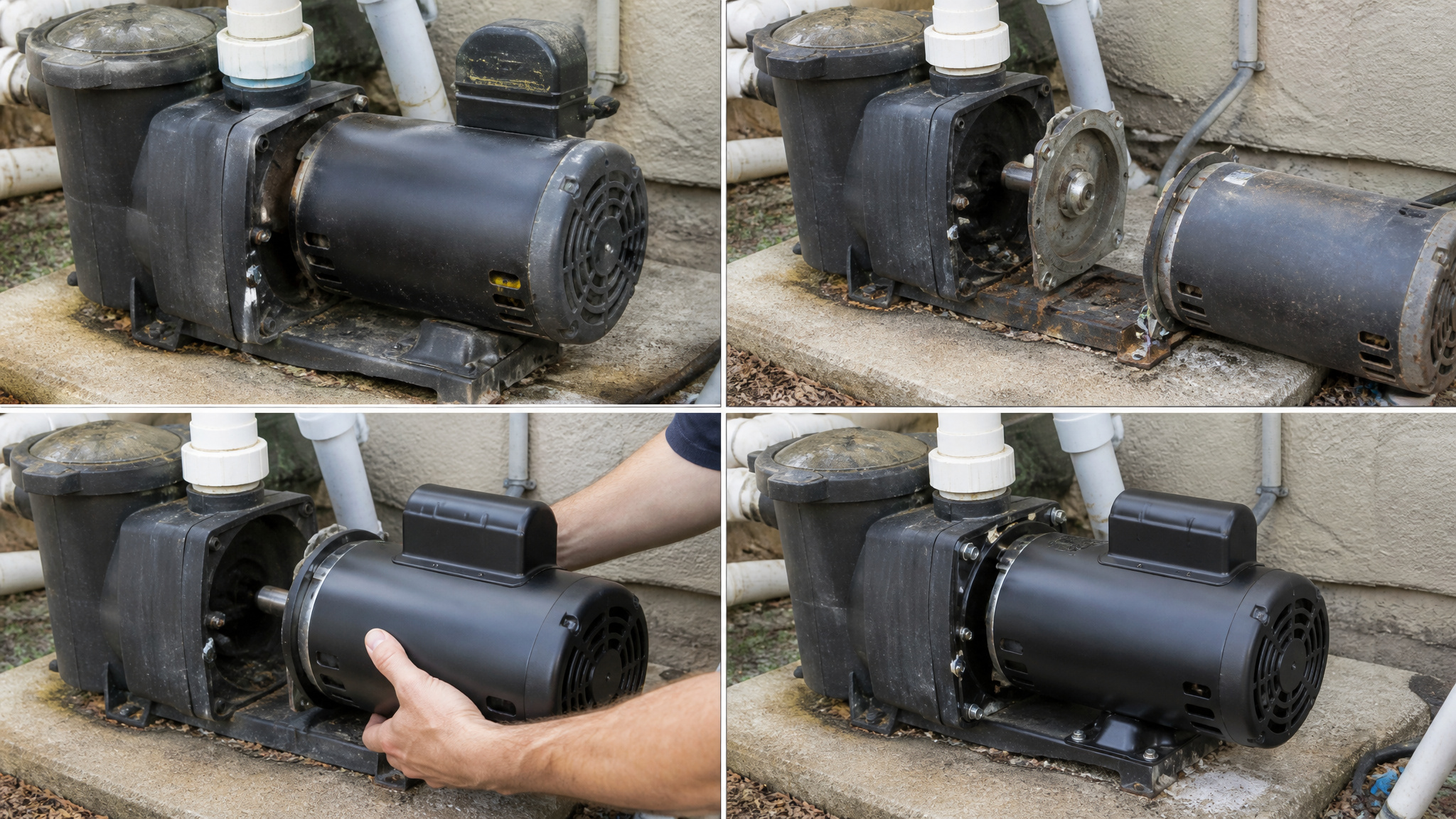
Pool pump motor replacement is the right fix when the pump’s housing, impeller and strainer are still in good shape and only the motor has failed. To choose the right replacement, match your old motor’s total horsepower (horsepower multiplied by service factor), voltage, flange or frame type and shaft type. Replacement pool pump motors at Prime Pool Market range from $198.88 for a 3/4 HP up-rate motor to $617 for the Century V-Green 1.65 HP variable speed motor.
One rule now shapes what you can buy. Under the US Department of Energy’s pool pump motor standard, motors from 1.15 to 5 total horsepower manufactured on or after September 29, 2025 must be variable speed. Below, you’ll see how to read your motor’s label, how the rule affects your options and how the swap is done.
Key Takeaways
- You can usually replace just the motor on a pool pump if the wet end is still sound.
- Match the replacement by total horsepower (THP = HP x service factor), voltage, flange or frame, shaft type and rotation, not by horsepower alone.
- Full-rated motors have a high service factor, while up-rated motors have a low one, so two “1.5 HP” motors can deliver different total horsepower.
- Since September 29, 2025, new motors from 1.15 to 5 THP must be variable speed. Single-speed motors built before that date can still be sold from existing stock.
- Always fit a new shaft seal when you replace the motor, and reconnect the #8 AWG bonding wire.
- Electrical work on a pool pump should be done or checked by a qualified electrician.
Can You Replace Just the Motor on a Pool Pump?
Yes. A pool pump has two main parts: the motor, which spins the shaft, and the wet end, which includes the pump housing, impeller, diffuser and strainer pot. If the wet end isn’t cracked or worn, you can bolt a new motor onto it instead of buying a complete pump.
Replacing the whole pump makes more sense if the housing is cracked, the strainer pot leaks, or you want to move to a different pump size. It’s also worth comparing costs when your pump is older and a correctly sized pool pump would better match your pool.
How Do You Know Your Pool Pump Motor Is Failing?
A failing motor usually gives you warning signs before it stops completely. These are the most common symptoms and what they usually point to.
| Symptom | What It Often Means |
|---|---|
| Hums but won’t start | Failed start capacitor, low voltage or an impeller jammed with debris |
| Grinding, screeching or rattling | Worn motor bearings |
| Runs hot, smokes or shuts off and restarts | Overheating that trips the thermal overload |
| Shaft feels stiff when turned by hand | Bad bearing |
| Water dripping under the motor | Worn shaft seal letting water reach the motor |
Some of these problems don’t require a new motor. A humming pump may only need a capacitor, which you can learn about in our guides on fixing a humming pool pump and replacing a pool pump capacitor. For noise and heat issues, see why a pool pump makes a loud grinding noise and why a pool pump motor overheats. If water is the problem, start with our guide to a pool pump leaking from the bottom.
How Do You Read a Pool Pump Motor Nameplate?
The nameplate on the side of your motor holds every detail you need to order the correct replacement. Take a clear photo of it before you remove anything.
| Nameplate Field | What It Tells You |
|---|---|
| HP | Rated horsepower |
| SF (service factor) | How far the motor can safely work above its rated horsepower |
| THP or SFHP | Total horsepower, which equals HP multiplied by SF |
| Volts | 115V, 230V or dual voltage. Your supply must match |
| Amps | Current draw at full load |
| RPM | Speed, commonly 3450 for single-speed pool motors |
| Frame | Mounting style, such as square flange or round flange (C-face) |
| Shaft | Threaded or keyed |
| Rotation | Usually counterclockwise when viewed from the end opposite the shaft |
| Enclosure | Open drip-proof or a rain-resistant design |
Horsepower alone isn’t enough to identify a replacement. Two motors labeled 1.5 HP can have different service factors, flanges and shafts, and only one of them will fit your pump.
How Do You Match Horsepower and Service Factor?
Century’s replacement guidance is simple: the new motor’s total horsepower should be equal to or greater than the old motor’s maximum rated horsepower, and you should match the pump manufacturer, horsepower and service factor where you can.
Full-rated motors have a high service factor, so they deliver more total horsepower than the label suggests. Up-rated motors have a low service factor, so their total horsepower sits close to the label. Here’s how some of the motors we stock compare, based on Century’s published ratings.
| Motor | HP | Service Factor | Total HP |
|---|---|---|---|
| B2846, 1/2 HP full rate | 0.5 | 1.95 | 0.98 |
| B2847, 3/4 HP full rate | 0.75 | 1.65 | 1.24 |
| UST1072, 3/4 HP up-rate | 0.75 | 1.0 | 0.75 |
| B2848, 1 HP full rate | 1.0 | 1.65 | 1.65 |
| UCT1102, 1 HP energy efficient | 1.0 | 1.0 | 1.0 |
| B2858, 1.5 HP full rate | 1.5 | 1.5 | 2.25 |
| UCT1152, 1.5 HP energy efficient | 1.5 | 1.0 | 1.5 |
| B2748, 2 HP full rate | 2.0 | 1.3 | 2.6 |
Notice that a 1 HP full-rate motor (1.65 THP) delivers more total horsepower than a 1.5 HP energy-efficient motor (1.5 THP). That’s why matching THP matters more than matching the number on the label. The impeller inside your pump is sized to a specific total horsepower, so a mismatch can reduce flow or overload the motor.
How Does the DOE Variable Speed Rule Affect Motor Replacement?
The Department of Energy’s standard for dedicated-purpose pool pump motors changes which new motors manufacturers can build.
| Motor Size | Requirement | Compliance Date |
|---|---|---|
| 1.15 to 5 THP | Must be variable speed | September 29, 2025 |
| 0.5 to under 1.15 THP | Must be variable speed | September 28, 2027 |
| Under 0.5 THP | Must meet a minimum efficiency | September 29, 2025 |
The rule covers replacement motors as well as motors sold inside complete pumps. It’s tied to the date a motor is manufactured, so single-speed motors built before the deadline can still be sold from existing stock. In April 2026, DOE also announced it will not seek civil penalties for small-size motors (0.5 to under 1.15 THP) manufactured before March 26, 2029.
What this means for you: if your old motor is between 1.15 and 5 THP, single-speed replacements are limited to remaining inventory. A variable speed motor such as the Century V-Green 1.65 HP round flange motor is the long-term option, and running a pump at lower speeds generally uses less energy. Our guide to how much it costs to run a pool pump explains how speed affects your bill.
How Do You Replace a Pool Pump Motor Step by Step?
The steps below give you an overview of the job so you know what’s involved. Hayward advises that only qualified personnel replace the rotary shaft seal, and all wiring must follow the National Electrical Code, so have a qualified electrician do or check the electrical work.
- Turn off power at the breaker. Confirm the power is off before you touch any wiring. A motor that isn’t running may still be live.
- Photograph the nameplate and wiring. Note the voltage setting, wire positions and bonding lug.
- Disconnect the supply wires and the bonding wire. The bonding wire is a solid copper conductor, at least #8 AWG, attached to the motor’s bonding lug.
- Separate the motor from the wet end. Remove the bolts or clamp that hold the motor and seal plate to the pump housing, then slide the motor assembly out.
- Remove the diffuser and impeller. Hold the motor shaft steady and unscrew the impeller.
- Remove the old shaft seal. Take out both halves: the ceramic seat in the seal plate and the spring half on the impeller.
- Install a new shaft seal on the new motor. Fit the new ceramic seat into the seal plate and the new spring half onto the impeller, then mount the seal plate and impeller on the new motor.
- Replace worn gaskets and O-rings. Fit a new housing gasket and diffuser O-ring if the old ones are damaged.
- Reassemble and reconnect. Slide the motor assembly back into the housing, reconnect the supply wires to match the nameplate’s wiring diagram and voltage, and reattach the bonding wire.
- Prime and test. Fill the strainer pot, restore power and check for leaks, unusual noise and normal flow.
Is Pool Pump Motor Replacement the Right Fix for Your Pump?
If your pump’s wet end is in good condition, pool pump motor replacement is usually the most direct repair. Read the nameplate, match total horsepower, voltage, flange and shaft, and fit a new shaft seal during the swap. If your motor falls between 1.15 and 5 THP, factor in the DOE variable speed rule and consider whether a variable speed motor suits your pool better than a single-speed one.
If the housing is damaged or you’re changing pump size, a full pump replacement may be the better choice. Either way, have the electrical connections handled by a qualified electrician.
Need Help Matching a Replacement Pool Pump Motor?
The fastest way to order the right motor is to send us a clear photo of your current motor’s nameplate. Prime Pool Market stocks Century, A.O. Smith and Hayward replacement motors, including variable speed options, and our team can match one to your pump.
Shop our replacement pool pump motors and pool pumps, browse everything at Prime Pool Market, or send us your motor details.
Call us at (877) 650-7665 with a photo of your motor’s nameplate, and we will help you match the right replacement pool pump motor.
Frequently Asked Questions
How often should I replace my pool pump motor?
There’s no fixed schedule. Nidec, a motor manufacturer, says pool pump motors usually last 4 to 5 years before they need to be rebuilt or replaced, and ENERGY STAR flags a pump that’s seven to ten years old as a sign it may be time to replace it. Heat, voltage problems and water reaching the motor through a worn seal can shorten that.
Can I replace a 1 HP pool pump motor with a 1.5 HP?
Not without other changes. The impeller is matched to the motor’s total horsepower, so moving to a bigger motor usually means replacing the impeller too. A larger motor also draws more current, and the new flow rate must stay within your filter’s gallon-per-minute rating and what your pipe size can carry.
How much does it cost to replace a pool pump motor?
At Prime Pool Market, replacement motors range from $198.88 for a 3/4 HP up-rate motor to $617 for the Century V-Green 1.65 HP variable speed motor. Most 1 HP to 2 HP single-speed motors we carry fall between about $280 and $530. Add a new shaft seal kit and, if you hire the job out, a technician’s labor.
How do you test a pool pump motor?
With the power off, turn the motor shaft by hand. A stiff or noisy shaft points to a bad bearing. With the motor running, a qualified technician can measure current draw. If the amps run more than 10% above the nameplate rating, the motor is overloaded. A start capacitor with a burnt spot between its terminals has failed.
Can a pool pump motor be repaired?
Some problems can be repaired. A failed capacitor can be replaced with one of the same voltage and microfarad rating, and worn bearings can be replaced when a motor is rebuilt. If the shaft is bent or the windings have failed, replacing the motor is the practical fix.