
Cyanuric acid (CYA) bonds with your pool’s free chlorine to shield it from UV degradation, letting it last 3 5 times longer in sunlight. You’ll want to maintain CYA between 30 50 ppm for residential pools, as levels above 70 ppm slow chlorine’s disinfection speed and can trigger persistent algae and cloudy water. Since CYA doesn’t naturally dissipate, buildup from stabilized chlorine products often goes unnoticed until problems emerge and knowing how to correct it makes all the difference.
What Cyanuric Acid Does in Your Pool
Cyanuric acid (CYA) functions as a chlorine stabilizer that forms a weak bond with free chlorine, shielding it from ultraviolet degradation. Without this protection, sunlight rapidly breaks down chlorine in outdoor pools, considerably reducing sanitizer persistence. CYA doesn’t disinfect on its own it supports chlorine’s ability to remain active longer between treatments. With adequate CYA levels, chlorine can last 3-5 times longer than it would in an unstabilized pool.
You should think of CYA as sunscreen for your chlorine. By buffering free chlorine against UV loss, it helps you maintain more consistent residuals and improves sanitation efficiency. However, maintaining proper cyanuric acid levels is critical. Excessive accumulation diminishes chlorine’s disinfecting power, even when free chlorine registers as present. Since stabilized products like dichlor and trichlor add CYA with each application, you’ll need to monitor levels regularly to prevent buildup that compromises water treatment effectiveness.
The Ideal Cyanuric Acid Range for Your Pool Type
Commercial pools must comply with stricter standards. The CDC’s Model Aquatic Health Code sets the cyanuric acid pool threshold at 15 ppm or less, since higher levels slow chlorine’s disinfection speed.
Indoor pools require little to no CYA typically 20 30 ppm at most because minimal UV exposure eliminates the need for stabilizer protection. For residential pools, the recommended range is 30 50 ppm, and free chlorine should maintain 7.5% of CYA level to ensure effective sanitation. Regardless of pool type, you should test CYA weekly when using stabilized chlorine products to prevent uncontrolled accumulation.
Why CYA Levels Above 70 PPM Hurt Chlorine
While cyanuric acid protects chlorine from UV degradation, CYA levels above 70 ppm actually undermine the very disinfection they’re meant to support. As this pool stabilizer accumulates, it binds more free chlorine into a slow-releasing equilibrium, increasing the contact time needed to kill pathogens. This relationship is nonlinear each CYA increase slows chlorine disproportionately. To maintain adequate sanitization, the free chlorine to CYA ratio should be a minimum of 7.5%.
When chlorine protection becomes excessive, you’ll encounter:
- Reduced sanitization speed, requiring higher CT values to inactivate bacteria and intestinal pathogens
- Cloudy water and algae growth, even when chlorine readings appear adequate
- A “chlorine lock” effect, where chlorine is present but can’t respond quickly enough to organic load
Most pool references cap the ideal range at 30 50 ppm, treating 70 ppm as the practical ceiling where disinfection reliability declines markedly.
How Cyanuric Acid Builds Up Without You Noticing
Because stabilized chlorine products like trichlor tablets and dichlor granules contain cyanuric acid as a byproduct, every routine dose of chlorine simultaneously raises your pool’s CYA concentration whether you’re tracking it or not. Unlike chlorine, which sunlight and sanitation consume rapidly, CYA doesn’t decompose or dissipate under normal conditions. This means each addition compounds the last.
CYA buildup accelerates when you rely exclusively on stabilized chlorine through tablet feeders or floating dispensers over an entire season. Your water may look clear, but clarity doesn’t reflect stabilizer concentration. Without consistent testing, the upward trend remains invisible until symptoms emerge persistent algae, cloudy water, or chlorine that won’t hold despite repeated shocking. By that point, corrective measures like partial draining become necessary to restore effective sanitization levels.
How to Lower Cyanuric Acid That’s Too High
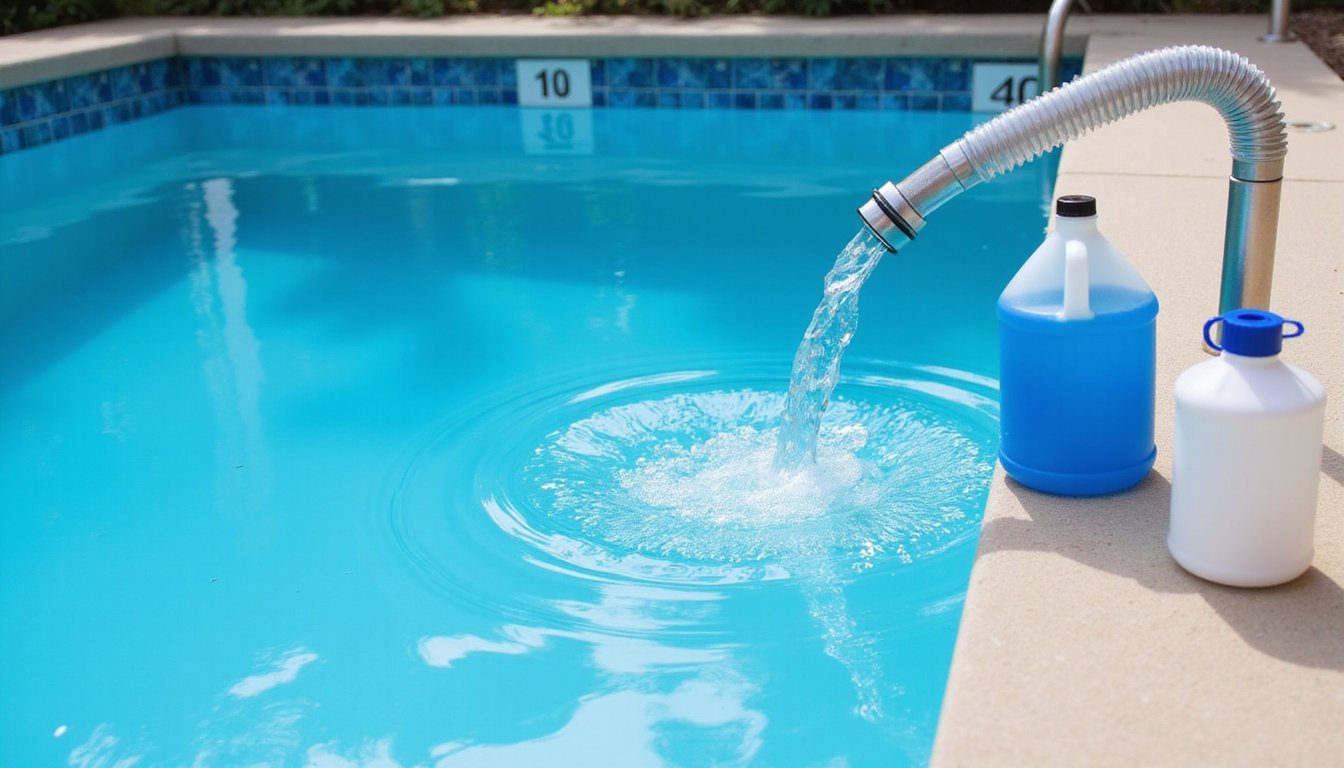
Once CYA climbs past the 50 ppm threshold, the most reliable correction is a partial drain-and-refill. You’ll remove water using a submersible pump, hose siphon, or your filter’s waste setting, then replace it with fresh water. Keep the water level above the skimmer to protect your pool sanitation system from running dry.
Before draining, take these steps:
Preparation is everything test your CYA, ditch stabilized chlorine, and plan your drain-and-refill before jumping in.
- Test CYA accurately if readings are off the chart, get a professional pool-store test for a usable number.
- Stop using stabilized chlorine (trichlor and dichlor), which adds CYA with every dose.
- Retest after refilling and repeat the process until you reach the 30 50 ppm target range.
Chemical CYA reducers remain limited in effectiveness. Maintaining balanced pool water chemistry through regular testing prevents future buildup.
Shop Pool Chemicals & Water Care Supplies
If you need reliable pool chemicals for opening season, water balance, or routine maintenance, Prime Pool Market has the products your pool needs. We carry a full range of Pool & Spa Chemicals at discount pricing, sourced from trusted brands and shipped fast. Browse our full catalog or contact us for expert product recommendations today.
Frequently Asked Questions
Can Cyanuric Acid Affect Pool pH or Alkalinity Readings?
Yes, cyanuric acid can lower your pool’s pH because it’s inherently acidic a 0.1% solution registers around pH 4.5. The pH drop you’ll see depends on your existing total alkalinity, which buffers the acid impact. Higher TA absorbs more of that acidity. You should always test and balance your pH and total alkalinity before adding cyanuric acid or stabilized chlorine products to avoid unexpected chemical imbalances.
Is Cyanuric Acid Safe for Children and Pets Using the Pool?
Yes, cyanuric acid is generally safe for children and pets when you maintain proper water balance. Keep levels between 30 50 ppm and free chlorine at 2 10 ppm to guarantee effective sanitation. High cyanuric acid can weaken chlorine’s disinfection power, increasing bacterial risk. You should test water at least monthly, supervise children and pets during swimming, and store all pool chemicals securely to prevent accidental ingestion or mixing.
Does Cyanuric Acid Expire or Lose Effectiveness During Storage?
Cyanuric acid doesn’t expire under proper storage conditions. You’ll maintain its potency indefinitely by keeping it in a tightly sealed container in a cool, dry, well-ventilated area away from moisture, acids, and oxidizers. Per SDS guidelines, it’s chemically stable under normal temperatures and pressures. If you notice clumping from moisture exposure or container damage, you should replace it. It’s one of the most storage-stable pool chemicals you’ll use.
Can You Use Cyanuric Acid in Hot Tubs or Spas?
You can use cyanuric acid in hot tubs, but many industry and CDC-referenced guidelines recommend against it. CYA slows chlorine’s pathogen kill time rising from roughly 20 seconds at 0 ppm to nearly 2 minutes at 100 ppm. If you do use it, keep levels between 30 and 50 ppm. However, since covers already limit UV exposure, you’re often better off using unstabilized chlorine and skipping CYA entirely.
How Long After Adding Cyanuric Acid Can You Swim Safely?
You can swim safely about 30 minutes after adding cyanuric acid, provided you’ve followed the product label’s directions. Run your pump during that time so the stabilizer disperses evenly and no concentrated pockets remain. If you’ve added CYA through a sock or skimmer, wait until all solids have fully dissolved. Always apply the most restrictive wait time when you’ve added multiple chemicals simultaneously, and retest levels within seven days.