
A safety pool cover is an anchored, tensioned barrier that’s tested to support at least 485 pounds under ASTM F1346 standards it’s not just a cover, it’s a certified safety system. You’ll find three main types: mesh covers that drain water automatically, solid covers that block sunlight and debris entirely, and automatic covers with motorized operation. Choosing the right one depends on your pool shape, anchoring surface, and maintenance preferences factors you’ll want to understand before making a decision.
What Makes a Safety Pool Cover Different?
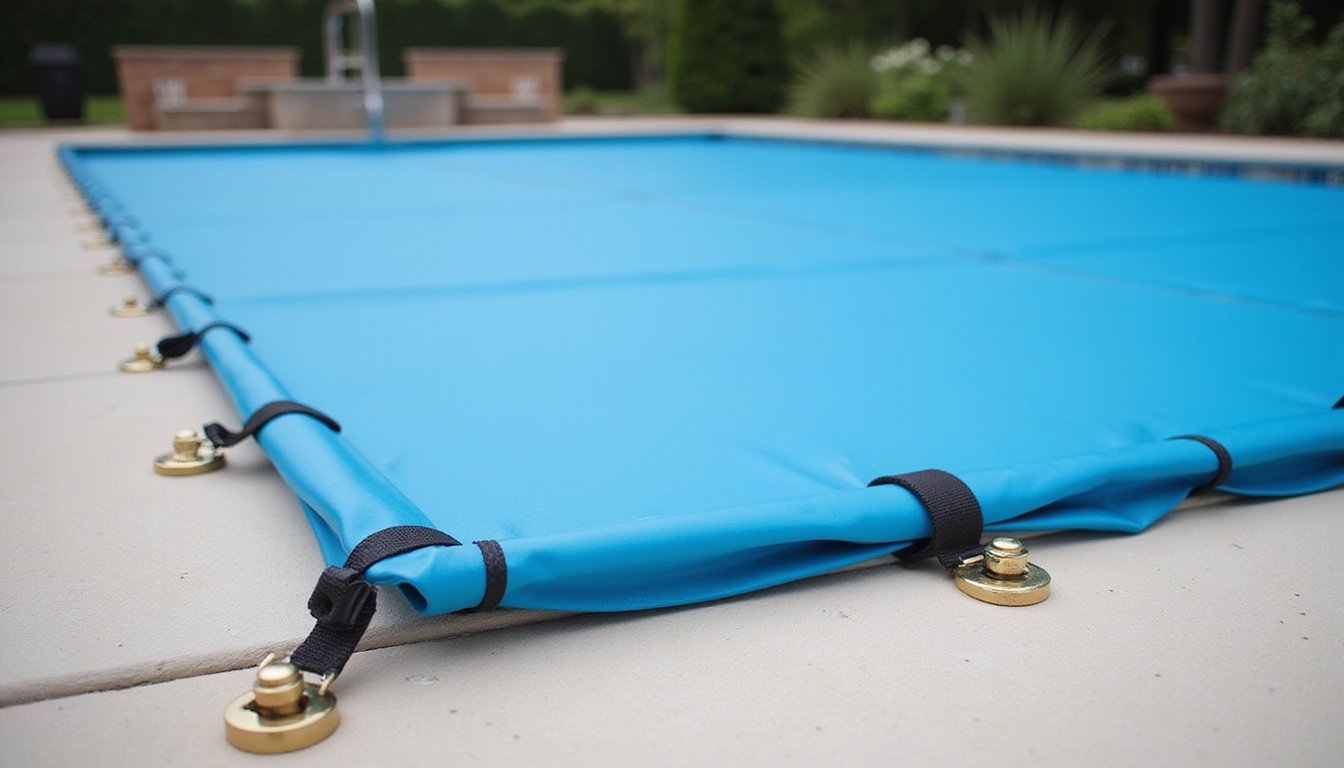
This means the cover must demonstrate verified material strength, load capacity, and durability not simply drape over the opening. Whether you’re considering a mesh safety cover that allows water drainage or a solid variant that blocks sunlight and debris completely, the defining factor is engineered performance. Solid covers offer the added advantage of blocking 100% of sunlight, which prevents algae growth and helps maintain chemical levels throughout the off-season. If a cover isn’t anchored, tensioned, and tested to ASTM criteria, it doesn’t qualify as a safety cover regardless of marketing claims.
How Safety Pool Covers Prevent Drowning
You’ll also need to manage water accumulation children can drown in less than two inches of standing water on the cover’s surface. Routine drainage maintenance and proper tensioning aren’t optional; they’re essential safety requirements. It’s worth noting that floating solar and winter covers are not classified as safety covers and can actually increase drowning risk.
What ASTM F1346 Means for Safety Pool Covers
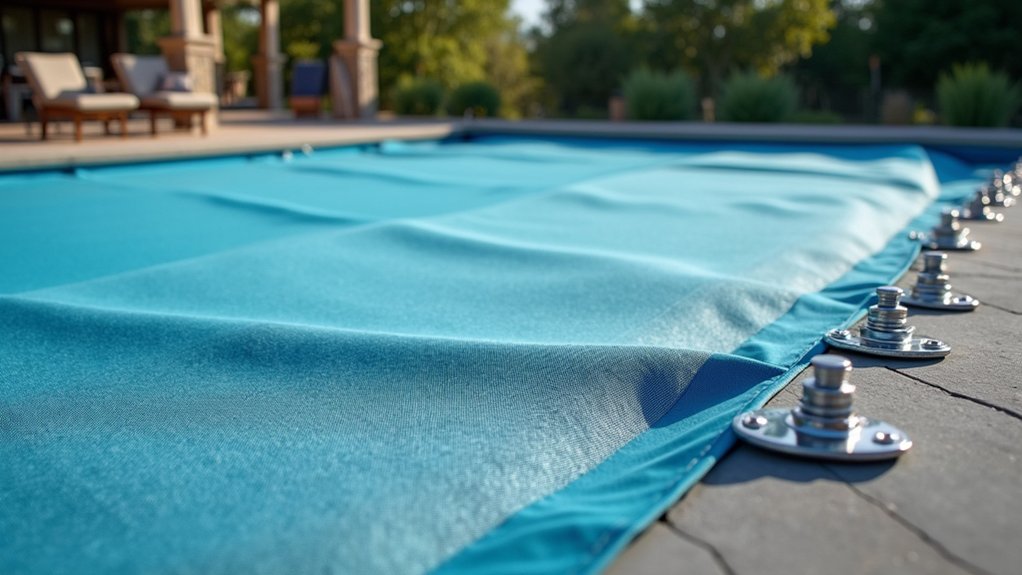
When you’re evaluating a safety pool cover, ASTM F1346 is the performance standard you need to verify, as it establishes the specific tests a cover must pass to qualify as a true safety barrier. Under this standard, a compliant cover must support at least 485 pounds of static load roughly the combined weight of two adults and a child ensuring it won’t collapse under unexpected weight. Certification matters because without verified ASTM F1346 compliance, a cover labeled “safety” may not actually meet the weight support, perimeter deflection, and drainage requirements that reduce drowning risk. Independent testing laboratories confirm that a cover meets these specifications, since ASTM International itself has no role in approving or enforcing compliance.
ASTM F1346 Compliance Basics
Because a pool cover’s appearance alone can’t confirm its protective capability, ASTM F1346 exists as the definitive performance specification for manual safety covers on pools, spas, and hot tubs. Whether you’re evaluating a mesh or solid safety cover, ASTM F1346 compliance requires passing specific performance tests not simply covering the water’s surface.
The standard mandates static load testing to 485 lbs, perimeter deflection evaluation, surface drainage assessment, and openings verification to prevent child head access. Proper pool cover installation and anchoring directly affect whether a cover maintains compliance under real-world conditions.
You should verify compliance through manufacturer documentation, independent lab test results, and the required ASTM-compliance label on the cover itself. If a product doesn’t explicitly reference ASTM F1346, don’t assume it qualifies as a safety cover.
Weight Support Requirements
| Pool Width from Periphery | Minimum Static Load | Application |
|---|---|---|
| Greater than 8 feet | 485 lb | Standard residential pools |
| Less than 8 feet | 275 lb | Smaller spans |
| Manufacturer-rated break strength | 1,500 2,500 lb | Varies by cover type and installation surface |
Don’t confuse break strength with ASTM compliance. Effective pool safety systems require certified static-load performance verified through the standard’s specific test framework.
Why Certification Matters
Not every cover labeled “safety” actually meets the standard that defines one. ASTM F1346 is the U.S. benchmark that separates verified safety performance from marketing language. If your inground pool cover hasn’t been tested and certified to this standard, it’s a debris cover not a barrier.
Certification confirms your cover supports 485 pounds, limits water accumulation to one inch, and resists perimeter intrusion. It also requires proper installation using manufacturer-specified pool cover anchors; without correct anchoring, certification doesn’t hold.
For residential pool protection, this distinction carries regulatory weight. Some jurisdictions accept ASTM F1346-certified covers as an alternative barrier layer, replacing or supplementing fencing requirements. You can’t substitute a non-certified winter cover for this purpose. Always verify compliance through product labeling and manufacturer documentation before purchasing.
Mesh Safety Covers: Drainage Without the Hassle
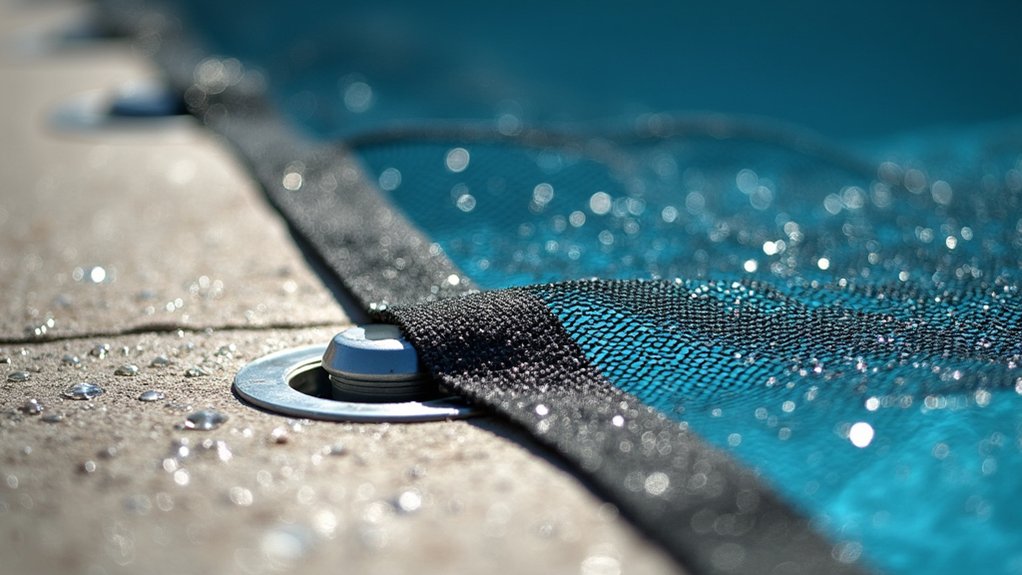
Mesh safety covers drain rain, snowmelt, and ice through their woven material rather than letting water accumulate on the surface eliminating the need for manual pumping and reducing the risk of standing water, a recognized drowning hazard on pool covers. Some models drain standing water up to 10 times faster than standard alternatives, functioning fundamentally as a large strainer over your pool.
You should evaluate weave density carefully. Standard mesh blocks leaves, insects, and twigs but permits fine particles to pass through. Super mesh variants filter dirt as small as talcum powder while maintaining drainage. Higher-density weaves also block up to 95% of sunlight, directly limiting algae growth and reducing your chemical demand. Verify ASTM F1346 certification and confirm UV-resistant material construction before purchasing.
Solid Safety Covers: Total Sunlight and Debris Protection
Where mesh covers let water pass through while filtering debris, solid safety covers take the opposite approach they block everything. Made from impermeable vinyl or reinforced PVC, they eliminate 100% of sunlight penetration, cutting off the UV exposure algae need to grow. You’ll also keep out leaves, pollen, dust, and fine particulates.
| Specification | Requirement | Purpose |
|---|---|---|
| ASTM F1346 weight support | ~485 lbs | Prevent accidental entry |
| Maximum gap allowance | 4 inches | Child/pet safety |
| Drainage/pump requirement | Mandatory | Eliminate standing water hazard |
A solid cover only qualifies as a safety cover if it includes a drain or pump standing water on the surface creates a drowning risk. You’ll need to monitor drainage and remove accumulated water throughout the off-season.
Automatic Safety Covers: Push-Button Protection
Although mesh and solid covers require manual installation and removal each season, automatic safety covers eliminate that effort entirely a motorized drive system opens and closes a reinforced vinyl barrier across your pool at the push of a button. Built-in tracks guide the cover along both sides of the pool, maintaining consistent tension and alignment during operation.
You’ll control the system via a keyed switch, keypad, or remote, with locking mechanisms preventing unauthorized access. When closed, the cover creates a physical barrier against accidental entry by children and pets. Beyond safety, automatic covers reduce evaporation, lower chemical loss, and can increase water temperature by 10 to 15°F. Installed costs typically run $15,000 to $20,000, with vinyl cover replacement expected every 5 to 8 years.
Mesh vs. Solid vs. Automatic Safety Covers Compared
Each cover type mesh, solid, and automatic delivers fall-protection safety when properly anchored, but they diverge sharply in material behavior, maintenance demands, and cost. Mesh covers drain precipitation passively, eliminating pump requirements. Solid covers block sunlight more completely, reducing algae growth but demanding active water removal to prevent standing-water hazards. Automatic covers offer push-button deployment with integrated tracks.
You’ll find mesh covers lighter, more economical upfront, and easier to handle solo with typical lifespans of 10 15 years. Solid covers require more labor during installation and seasonal changes but minimize chemical adjustments through superior light blockage. Automatic systems carry the highest cost but deliver unmatched convenience.
Your decision hinges on three variables: drainage management tolerance, spring cleanup expectations, and budget constraints. No single type is universally superior.
Anchoring Hardware That Keeps Safety Covers Secure
Because a safety cover is only as reliable as the hardware holding it down, anchoring systems deserve close attention during installation and inspection. Brass concrete anchors are the most common type, installed by drilling a 3/4-inch hole to approximately 2-1/4 inches deep, then tamping the anchor flush with the deck surface. For wood decks, you’ll need a counter-sink hole so the flange sits flush, reducing trip hazards.
On paver surfaces, you can place anchors in the joint between three pavers rather than drilling through the face. Lawn installations require a buried tube or PVC pipe set in concrete with a 48-hour cure time. Anchors must extend at least 1/2 inch above the deck for springs and installation bars to engage properly under snow loads.
How to Match a Safety Cover to Your Pool Shape
When your pool follows a standard rectangle, matching a safety cover is straightforward manufacturers produce covers with consistent anchor spacing that aligns with straight edges and uniform dimensions. Oval pools typically require shape-specific fabrication from manufacturers offering custom templates.
Kidney-shaped, freeform, and irregular pools demand custom covers built to your pool’s exact measurements. You’ll need to measure length, width, curves, and angles at waterline level so the manufacturer can map your full perimeter accurately. Radius sections require multiple measurements across each curve rather than a single dimension.
Professional measurement reduces sizing errors on complex outlines. Submitting photos helps manufacturers identify overlooked shape details. If you’re replacing an existing cover, your current anchor positions can serve as a fabrication template, provided the pool shape remains unchanged.
Why Winter Covers and Solar Covers Aren’t Safety Covers
Winter covers and solar covers lack the anchored strap-and-spring system that defines a true safety cover, so they can’t create the tensioned, load-bearing surface you need to prevent accidental entry. A winter cover typically rests on the water’s surface held down by water bags or cables, while a solar cover simply floats neither is engineered to support weight. These products manage debris or heat retention, not drowning prevention, and you shouldn’t treat them as substitutes for a deck-anchored safety cover.
No Anchored Support System
Not every pool cover qualifies as a safety cover, even if it stretches across the full pool opening. The defining feature is an anchored support system deck-mounted anchors, straps, and spring-loaded hooks that create a tensioned, load-bearing barrier across your pool. Without this system, a cover can’t reliably prevent entry into the water.
Winter covers use water bags, blocks, or cable-and-winch setups that don’t produce the snug, secured fit required for safety performance. Solar covers are lightweight bubble blankets designed for heat retention and evaporation control they’re not engineered to bear weight. Neither type meets the structural requirements of a safety-rated cover. If your cover lacks embedded anchors and a tension-based attachment system, it’s not functioning as a safety barrier, regardless of how it looks installed.
Debris Covers, Not Barriers
Although winter covers and solar covers physically sit over your pool opening, they’re debris management tools not safety barriers. Winter covers are tarp-style products designed for seasonal leaf and dirt control. Solar covers retain heat and reduce evaporation. Neither provides the tensioned, anchored support system required to prevent accidental pool entry.
| Feature | Safety Cover |
|---|---|
| Primary Function | Drowning prevention |
| Anchoring System | Springs, straps, deck-mounted hardware |
| Weight Support | Supports children, pets, adults |
| Structural Design | Tensioned barrier stretched across pool |
If your primary concern is protecting children, pets, or guests from falling in, you need a mesh or solid safety cover not a winter tarp or solar blanket. The product categories aren’t interchangeable.
Shop Premium Pool Covers Today
If you are looking for quality pool covers that protect your investment and keep your water clean year-round, Prime Pool Market has you covered. We offer a complete range of pool supplies and outdoor living products with discount pricing from real pool guys you can trust. Browse our full catalog or contact us to find the right cover for your pool today.
Frequently Asked Questions
How Long Does a Safety Pool Cover Typically Last Before Needing Replacement?
Your safety pool cover‘s lifespan depends on its type. Mesh covers typically last 10 15 years, solid covers around 6 10 years, and automatic cover fabrics roughly 5 7 years. UV exposure, poor water chemistry, debris load, and improper storage will shorten these timelines. You’ll want to inspect your cover regularly for fraying, cracking, torn seams, and hardware wear these signs indicate you should replace it before it compromises pool safety.
Can You Walk on a Safety Pool Cover Without Damaging It?
You can step on a true anchored safety cover without damaging it it’s engineered to support accidental weight but you shouldn’t treat it as a walking surface. Routine foot traffic accelerates wear on springs, straps, and stitching. Only step on it during an emergency if the cover is properly tensioned, all anchors are secure, and no standing water, ice, or snow is present. A sagging or damaged cover should never be walked on.
How Much Does Professional Installation of a Safety Pool Cover Cost?
You’ll typically pay $400 to $1,500 for manual safety cover installation labor, separate from the cover itself. Total installed costs including materials commonly range from $1,200 to $4,500+, depending on cover type, pool size, and shape complexity. Mesh covers generally cost less than solid designs. You should confirm your quote includes anchors, hardware, and fitting adjustments, and verify whether it reflects standard or custom sizing to guarantee accurate budgeting.
Do Safety Pool Covers Affect Homeowners Insurance Rates or Liability Coverage?
Safety pool covers can influence your homeowners insurance, though there’s no universal rate reduction. Insurers may require safety controls including covers, four-foot fencing, and self-closing gates before binding coverage. You should maintain liability limits of at least $300,000 $500,000 and consider an umbrella policy, since injury claims remain possible even with a cover installed. Contact your carrier directly, as underwriting rules and premium impacts vary greatly by insurer, state, and pool configuration.
How Long Does It Take to Remove a Safety Cover for Swimming?
Removal time varies based on your pool size, cover type, and debris load there’s no single standard estimate. You’ll speed up the process by hosing off debris and draining standing water before detaching anchors. Mesh covers typically come off faster than solid models. With a helper, you can accordion-fold sections efficiently as you release each attachment point. Prioritize careful handling over speed to prevent debris contamination and cover damage.