
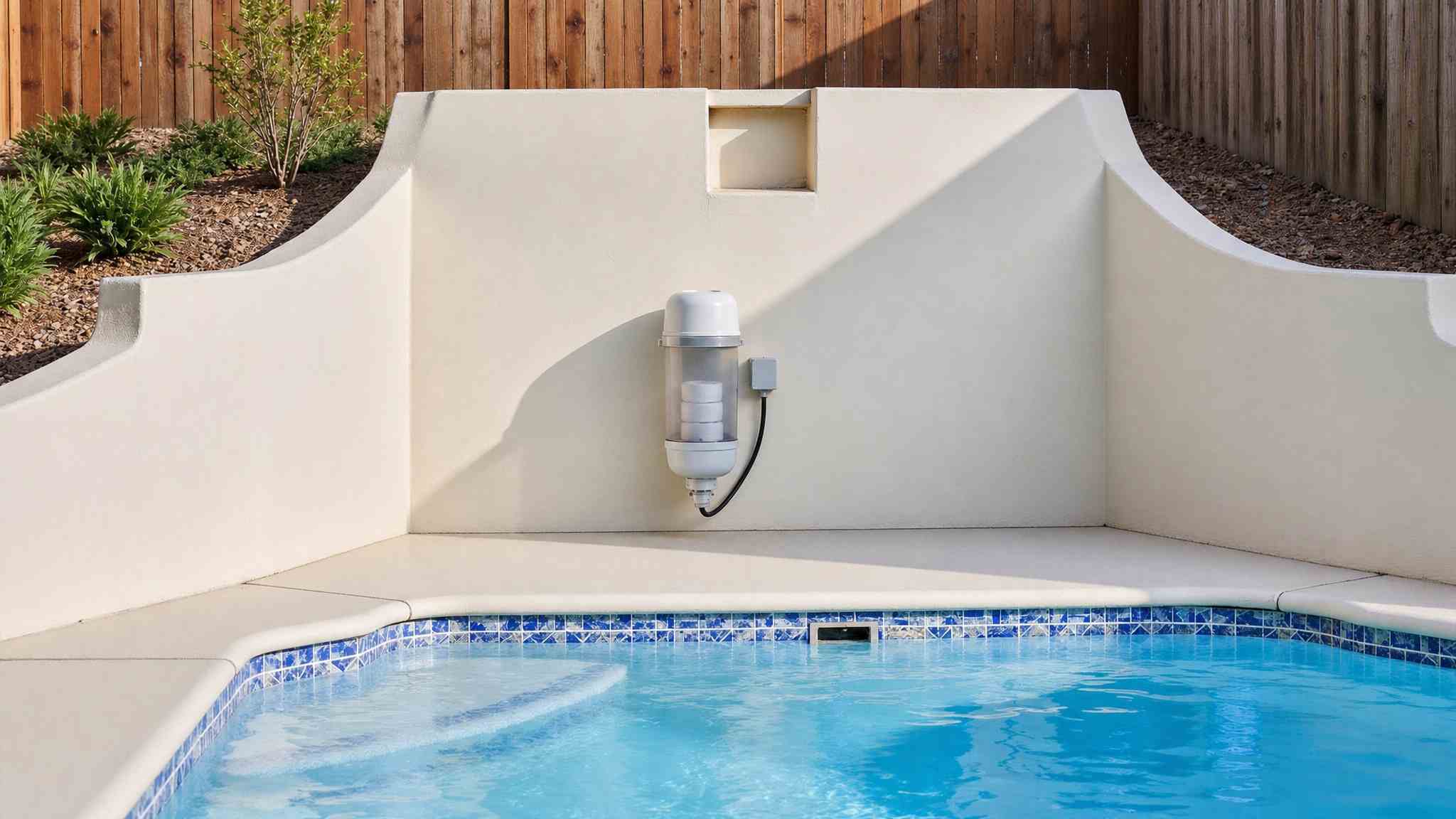
For a clear, clean pool, you’ll use 1 pound of shock per 10,000 gallons. With cal-hypo, that raises free chlorine by roughly 5 to 7 ppm. But first, measure your pool’s real volume, length × width × average depth × 7.5 for rectangular pools, since accurate dosing depends on it. If algae shows up, double or triple that baseline. Always defer to your product’s label. The specifics below sharpen every calculation you’ll make.
Key Takeaways
- The standard opening dose is 1 lb of shock per 10,000 gallons for clear, clean water, though some brands specify 2 lbs.
- Calculate your pool’s real volume first: length × width × average depth × 7.5 for rectangular pools.
- Cloudy or light green water needs double the dose (2 lbs), while dark green or algae requires 3 to 5+ lbs per 10,000 gallons.
- With cal-hypo, 1 lb per 10,000 gallons raises free chlorine by roughly 5 to 7 ppm.
- Always defer to the manufacturer’s label, since product strength and active ingredient affect the correct dose.
The Standard Shock Dose for Opening Your Pool

For clear, clean water, you’ll typically add 1 lb of shock per 10,000 gallons, though some products and brands call for 2 lbs per 10,000 gallons as their standard opening dose. Your correct pool shock amount depends on product strength, so a granular product might cover 10,000 to 13,500 gallons per pound. With cal-hypo, 1 lb per 10,000 gallons raises free chlorine roughly 5 to 7 ppm. Always base the dose on your actual pool volume, not guesswork. For a 20,000-gallon pool, you’ll use 2 lbs; for 30,000 gallons, 3 lbs. Since opening pool chemicals vary, treat the manufacturer’s label as the controlling instruction whenever dosage guidance conflicts.
How to Measure Your Pool’s Real Volume
Every accurate dose starts with your pool’s real volume, so calculate it using the right formula: length × width × average depth × 7.5 for rectangular pools, or diameter² × average depth × 5.9 for round ones. Don’t guess, a 20,000-gallon pool needs 2 lbs of standard shock, but underestimate by 5,000 gallons and you’ll fall short of your target free chlorine. Once you’ve got that number, you can dose from actual volume instead of a rough estimate, which is the difference between a clear opening and a wasted treatment.
Volume Calculation Formulas
Volume calculation formulas convert your pool’s dimensions into gallons. For rectangular pools, multiply length × width × average depth × 7.5. For round pools, use diameter × diameter × average depth × 5.9. Oval pools require length × width × average depth × 6.7.
Average depth means adding the shallow and deep end depths, then dividing by two. These multipliers convert cubic feet into gallons, giving you the precise figure your pool opening shock calculation requires.
Run these numbers carefully. An accurate volume ensures you dose correctly, avoiding both under-treatment that leaves algae and overdosing that wastes product and delays swimming.
Dosing From Actual Volume
Anchor your dose to actual pool volume, not a rounded estimate or the number printed on a decade-old installation invoice. Translate that gallon figure directly into product weight. For clean, clear water, apply 1 lb per 10,000 gallons as your baseline, then scale linearly with your measured volume.
| Actual Volume | Clean Water Dose | Light Algae Dose |
|---|---|---|
| 10,000 gallons | 1 lb | 2 lbs |
| 20,000 gallons | 2 lbs | 4 lbs |
| 30,000 gallons | 3 lbs | 6 lbs |
Multiply proportionally for volumes between these marks. A 15,000-gallon pool needs 1.5 lbs for clean water. Always cross-check against your product’s label, since strength varies by brand and formulation, overriding any general chart.
What to Test Before You Shock
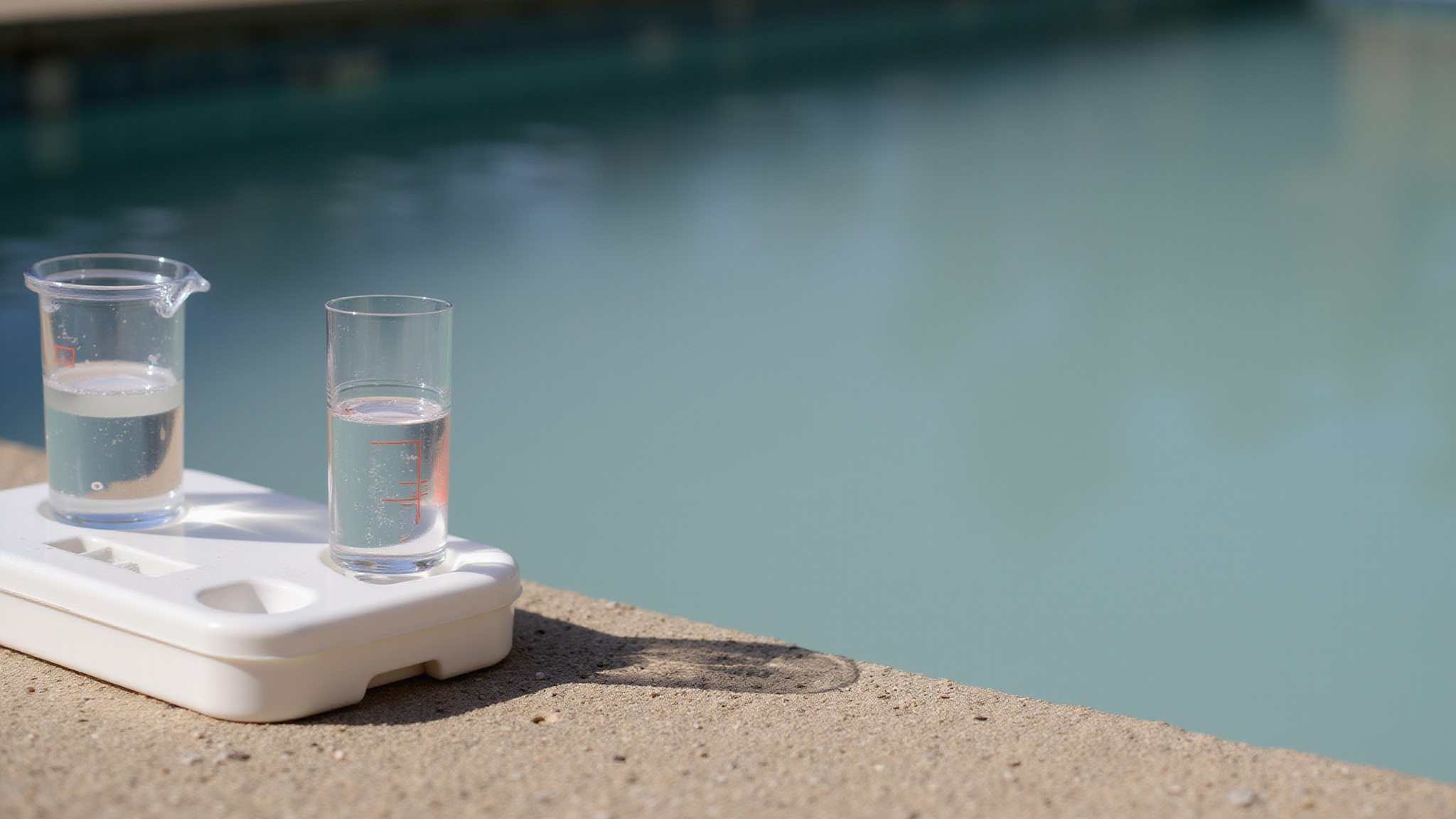
Test four core parameters before you shock: free chlorine (FAC), total chlorine, pH, and total alkalinity. These readings drive both your product choice and your dose. If FAC sits below 2.0 ppm, choose a chlorine-based shock. When FAC lands between 2.0 and 4.0 ppm, a non-chlorine shock will do the job. Check pH next; adjust it into the 7.2 to 7.6 range so your chlorine works efficiently rather than burning off ineffectively. Total alkalinity stabilizes pH, so confirm it’s in spec before dosing. Don’t guess any of these numbers, use a reliable test kit and read against known standards. Accurate results, paired with your actual pool volume, let you calculate a precise dose instead of over- or under-treating the water.
Shock Dose by Pool Size Chart
Shock dose by pool size starts with a standard baseline of 1 lb per 10,000 gallons for clean, clear water, though some products call for 2 lbs, so verify your label first. Scale linearly with your gallonage:
Start with 1 lb per 10,000 gallons for clean water, but always check your product’s label first.
- 10,000 gallons: 1 lb for clean water
- 20,000 gallons: 2 lbs for clean water
- 30,000 gallons: 3 lbs for clean water
- Light green or cloudy water: double the dose to roughly 2 lbs per 10,000 gallons
These figures assume clear conditions and a routine free-chlorine bump of about 5 to 7 ppm with cal-hypo. Always defer to manufacturer directions when a product’s strength shifts these numbers, and base every calculation on measured volume.
How Much Shock for Cloudy or Light Green Water
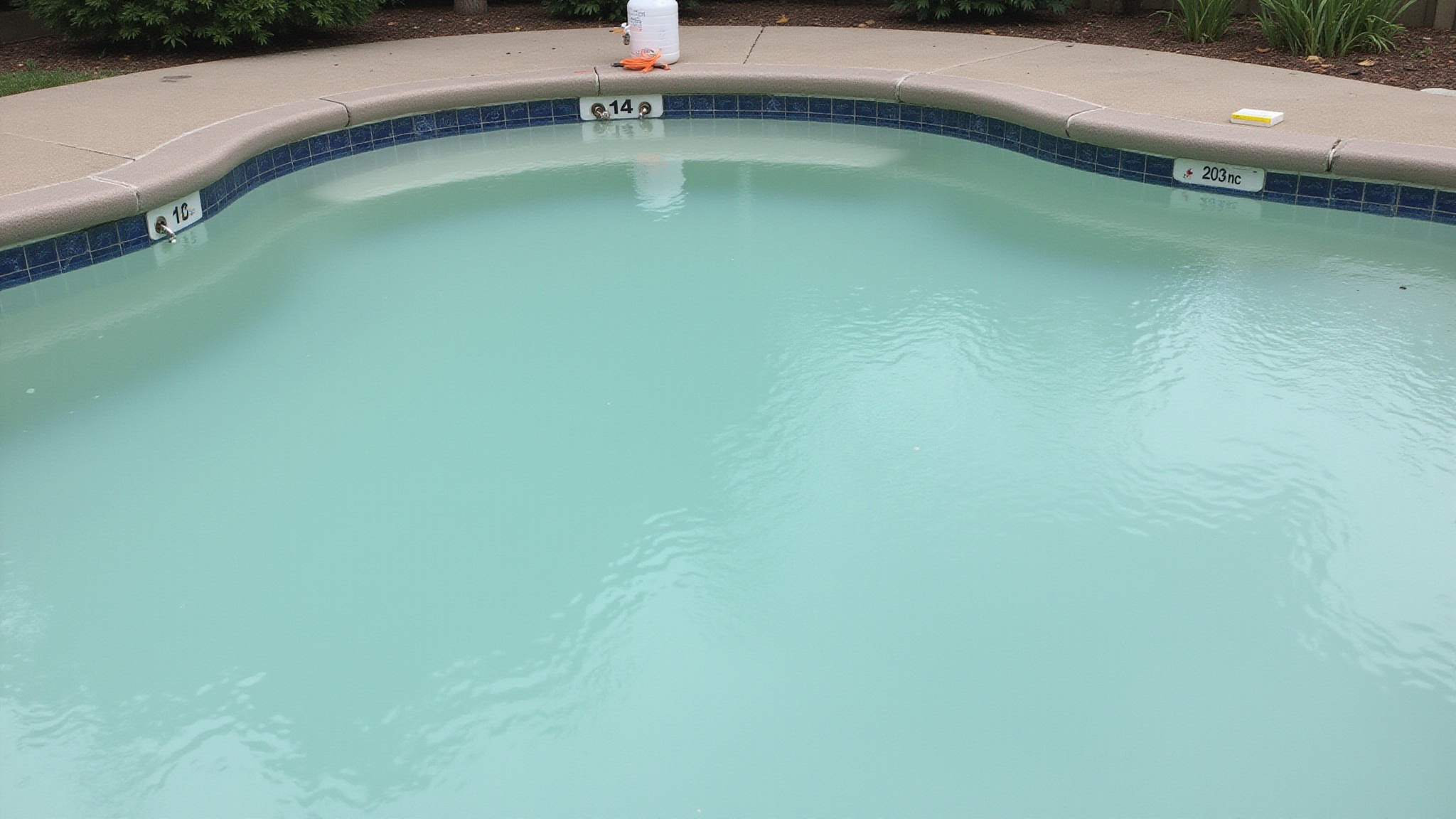
For cloudy or light green water, double the standard baseline to roughly 2 lbs per 10,000 gallons. This heavier dose overwhelms the organic load driving early algae growth and restores enough free chlorine to clear the water. Test your free chlorine, pH, and total alkalinity, and adjust pH into the 7.2 to 7.6 range so the added chlorine works efficiently. Pre-dissolve the shock if your product label requires it, then pour it slowly around the perimeter with the pump running. For a 20,000-gallon pool, that’s 4 lbs; for 30,000 gallons, 6 lbs. Keep circulation going at least 8 hours or overnight, and watch for the water to shift toward a clear blue-gray tone.
Dosing Dark Green and Algae-Filled Pools
Dark green water needs roughly 3 lbs per 10,000 gallons, triple the baseline, because it carries a far heavier algae load. Severe neglect pushes higher. Some guidance recommends 3 to 5 lbs per 10,000 gallons for visible algae, and 6+ lbs per 10,000 gallons when conditions are extreme. Keep adding shock until the water shifts from green to blue-gray with no green tint remaining.
Keep shocking until every green tint vanishes and the water turns blue-gray, that’s your signal the algae’s fully oxidized.
- Dark green water: apply about 3 lbs per 10,000 gallons (triple dose).
- Visible algae: increase to 3 to 5 lbs per 10,000 gallons based on severity.
- Severe neglect: use 4x the baseline, or 6+ lbs per 10,000 gallons.
- Color check: dose until water turns blue-gray, confirming the algae’s oxidized.
Run circulation continuously to distribute the treatment thoroughly.
How Much Shock Does Severe Neglect Need?
| Water Condition | Dose per 10,000 Gallons |
|---|---|
| Clean/clear | 1 lb |
| Light algae | 2 lbs |
| Dark green | 3 lbs |
| Visible algae | 3 to 5 lbs |
| Severe neglect | 6+ lbs |
Severe neglect needs 6+ lbs of shock per 10,000 gallons. Don’t underdose here. Insufficient chlorine won’t break the demand, wasting product and time. Add shock at dusk, pre-dissolve when the label requires it, and circulate overnight before retesting.
Why Your Product Label Beats Every Chart
Your product label beats every chart because it reflects the exact active chemistry you’re pouring in. Although the charts above give you solid starting points, your product label overrides every one of them. Manufacturers formulate shock at varying concentrations, so a chart’s “1 lb per 10,000 gallons” won’t match every product’s actual strength.
Check the label for these specifics:
- Dosage rate, some products treat 10,000 gallons, others stretch to 13,500
- Pre-dissolving requirements, certain granular formulas demand a bucket first
- Target FAC increase, verify the ppm boost per dose
- Swim-readiness timing, confirmed wait intervals before reentry
When a chart and label conflict, follow the label. It’s the controlling instruction, calibrated to your specific product’s concentration and safety profile.
Cal-Hypo vs Other Shock Types and Dosing
Cal-hypo differs from other shock types primarily in how its active chemistry determines both your dose and its effect on water balance. With cal-hypo, one pound per 10,000 gallons typically raises free chlorine by roughly 5 to 7 ppm, making it a reliable baseline for routine maintenance shocking. Product strength shifts that math, though. Some granular shocks cover 10,000 to 13,500 gallons per pound, so you’ll adjust based on concentration rather than assuming a fixed rate.
That’s why you can’t treat all shock types identically. A dose that works for one formulation may overshoot or fall short with another. Always confirm the active ingredient and its ppm impact before you calculate. Then verify against the label, since that instruction controls whenever guides and charts disagree with each other.
Should You Pre-Dissolve Your Pool Shock?
Whether you should pre-dissolve your pool shock depends on your product, but the label is the controlling instruction. Cal-hypo and many granular shocks benefit from pre-dissolving to prevent undissolved granules from settling and bleaching your liner or plaster.
When your label requires pre-dissolving, follow these steps:
- Fill a clean bucket with water first, then add the shock, never the reverse, to reduce reaction risk.
- Stir slowly until the granules dissolve completely.
- Pour the solution slowly around the pool’s perimeter for even distribution.
- Run the pump and filter during and after application to circulate the treatment thoroughly.
This ensures uniform chlorination without damaging surfaces.
The Right Way to Pour Shock Around the Pool
Once you’ve pre-dissolved your shock (when the label requires it), pour it slowly around the pool’s perimeter rather than dumping it in one spot. This even distribution keeps chlorine from concentrating in a single area, where it can bleach liner surfaces or settle before circulating. Take your time and keep the flow steady as you work your way around the edge.
Pour Slowly Around Perimeter
Pour the solution slowly around the pool’s perimeter rather than dumping it in one spot. This distributes the treatment evenly and prevents concentrated pockets that can damage liners or bleach surfaces. Keep the circulation running so the chemical disperses throughout the entire water volume as you work. After applying the treatment, you may need to adjust the pool’s pH levels to ensure the water is safe for swimming. Regular brushing and vacuuming will help remove any debris and prevent algae growth. Following these tips for clearing green pool water will keep your pool looking crystal clear and inviting.
Follow these practices during application:
- Walk the perimeter steadily, pouring a thin, continuous stream near the water’s edge
- Keep the pump and filter running to circulate treatment as you pour
- Avoid stagnant corners by directing flow toward return jets
- Maintain a well-ventilated stance, staying upwind of fumes
Even distribution ensures uniform chlorine levels, maximizing sanitizing effectiveness across your entire pool.
Pre-Dissolve When Required
Pre-dissolve shock products in a clean bucket whenever the label requires it, because some react violently or settle undissolved on your pool floor. Fill the bucket with pool water first, then add the chemical to the water, never the reverse, to reduce the risk of a dangerous reaction. Stir until the granules fully dissolve, leaving no undissolved residue that could bleach or stain your liner. Always defer to the manufacturer’s label directions, since they’re the controlling instruction whenever guidance conflicts across sources. Some cal-hypo products may demand pre-dissolving, others don’t, so check before you measure. Once dissolved, pour the solution slowly around the perimeter for even distribution. This step protects your surfaces, ensures accurate dosing, and delivers consistent free chlorine throughout the water.
How Long to Run the Pump After Shocking
Run the pump and filter for at least 8 hours, or overnight, after you’ve added shock to circulate the treatment fully. Continuous circulation distributes chlorine evenly, prevents localized concentration, and accelerates the breakdown of contaminants and algae. Skipping this step leaves dead zones where shock can’t reach, undermining your dosing effort.
Monitor these factors while the pump runs:
- Runtime: Maintain circulation for a minimum of 8 hours after application.
- Timing: Add shock at dusk, then run overnight to minimize UV loss.
- Filtration: Keep the filter engaged to capture dead algae and debris.
- Verification: Retest free chlorine before you consider swimming.
Once chlorine drops back to a safe range, typically 1 to 3 ppm, you’re clear to resume normal use.
When Is It Safe to Swim Again?
You can safely return to the water once your free chlorine drops back into a safe range. After shocking, don’t swim immediately, because chlorine levels run too high and can irritate skin, eyes, and swimwear. Test your free chlorine before reentry and confirm it’s fallen to a swim-safe target. Different guides cite slightly different thresholds, so match your readings to the ranges below.
| Free Chlorine Level | Swim Status |
|---|---|
| 1 to 3 ppm | Safe (commonly cited) |
| 2 to 4 ppm | Safe (alternate guide) |
| 3 mg/L or below | Safe |
| Below 5 mg/L | Acceptable for additional use |
Retest after your pump runs its full circulation cycle. Confirm pH sits near 7.2 to 7.6 for comfort and chlorine effectiveness before anyone enters the water.
Conclusion: Shocking at Opening
Opening a pool calls for a heavier dose of shock than routine maintenance, usually two to three times the normal amount, to clear out everything that built up over the closed season. Test first, dose to your pool’s volume, and run the filter to circulate it. Get the opening shock right and the water clears fast, setting up an easy start to the season.
Get Everything You Need for Pool Opening
From shock treatments to clarifiers and starter kits, expert-selected pool chemicals make spring opening easy. Browse Prime Pool Market for premium Pool & Spa Chemicals with real value from real pool experts. Call (877) 650-7665 today and get your pool crystal clear.
Frequently Asked Questions
Can I Shock My Pool During the Day Instead of Evening?
Evening is better. Sunlight burns off unstabilized chlorine quickly, so shocking during the day wastes much of the dose before it can work. Adding shock after sundown lets it circulate overnight and do its job fully. In daylight, a stabilized product holds up better, but evening remains the reliable choice.
Does Shock Expire or Lose Strength While Sitting in Storage?
Yes. Pool shock loses potency over time, especially if stored in heat, humidity, or sunlight, and granular cal-hypo degrades faster once the container is opened. Old shock may not clear the water as expected. Buying fresh shock for opening and storing it sealed in a cool, dry spot keeps it effective.
Can I Use Liquid Chlorine Instead of Granular Shock?
Yes, liquid chlorine works well for shocking and dissolves instantly, which avoids the undissolved granules that can bleach a liner. It is often cheaper by volume too. The main trade-off is that it is bulkier to store and store-bought strength varies. Either one clears an opening pool as long as you dose to your pool’s size.
Will Shocking My Pool Damage My Liner or Equipment?
Properly dosed and circulated shock is safe. Problems come from adding granular shock directly onto a vinyl liner, where undissolved crystals can bleach or weaken it. Pre-dissolving granular shock in a bucket of water first, or using liquid chlorine, prevents that. Running the pump while you dose keeps the chemical from concentrating in one spot.
Can I Mix Different Brands or Types of Shock Together?
Do not mix shock types, and never combine them in the same container. Different chemistries, such as cal-hypo and dichlor, can react dangerously when combined dry. Add one product at a time, letting it circulate before adding anything else. Sticking to a single type per treatment keeps the process both safe and predictable.