
Run your pool pump 8 to 12 hours a day during summer to hit at least one complete turnover. Your turnover rate sets the floor: pool volume ÷ flow rate ÷ 60 gives hours per turnover. Add 2 hours during peak heat to offset faster chlorine breakdown and rising algae pressure. Extend to 12 to 16 hours for heavy use, and run continuously if water turns cloudy. There’s more you’ll want to know below.
Key Takeaways
- Run your pool pump 8 to 12 hours per day during summer to maintain proper circulation and water quality.
- Ensure at least one complete water turnover daily, which typically takes 8 to 10 hours to filter the entire pool volume.
- Apply the temperature rule of one hour per 10°F, adding 2 extra hours during peak summer heat.
- Extend runtime to 12 to 16 hours during extreme heat or heavy use, and run continuously until cloudy or algae-affected water clears.
- Operate the pump during the hottest, sunniest part of the day, using split cycles for consistent circulation and chemical distribution.
How Many Hours to Run a Pool Pump in Summer
Run your pool pump 8 to 12 hours per day during summer to maintain proper circulation and water quality. To determine how long to run pool pump systems, calculate your turnover rate: pool volume ÷ pump flow rate ÷ 60 = hours for one full turnover, which typically takes 8 to 10 hours. Aim for at least one complete turnover daily.
Adjust your pool pump run time using the temperature rule: run one hour for every 10°F. At 90°F, that’s roughly 9 hours, plus 2 extra hours for higher chlorine demand.
In extreme heat or heavy-use periods, extend your pool pump schedule to 12 to 16 hours. If water turns cloudy or algae appears, run continuously until it clears.
Why Summer Heat Demands a Longer Pump Runtime
Summer heat demands a longer pump runtime because higher temperatures accelerate chlorine breakdown and increase algae pressure, forcing your pump to work longer to keep water safe. Higher temperatures degrade your free chlorine faster, leaving less residual sanitizer to control bacteria and algae. A useful rule ties runtime to air temperature: roughly one hour per 10°F, so 80°F suggests about 8 hours, while 90°F pushes you toward 9 or more. Add 2 extra hours during peak summer to offset heightened chlorine demand and heavier debris load. Deciding how often to run a pool pump depends on heat, bather load, and turnover, but hotter conditions consistently justify longer cycles. Match your schedule to temperature, and you’ll maintain safe, clear water reliably.
The Temperature Rule for Setting Pump Runtime
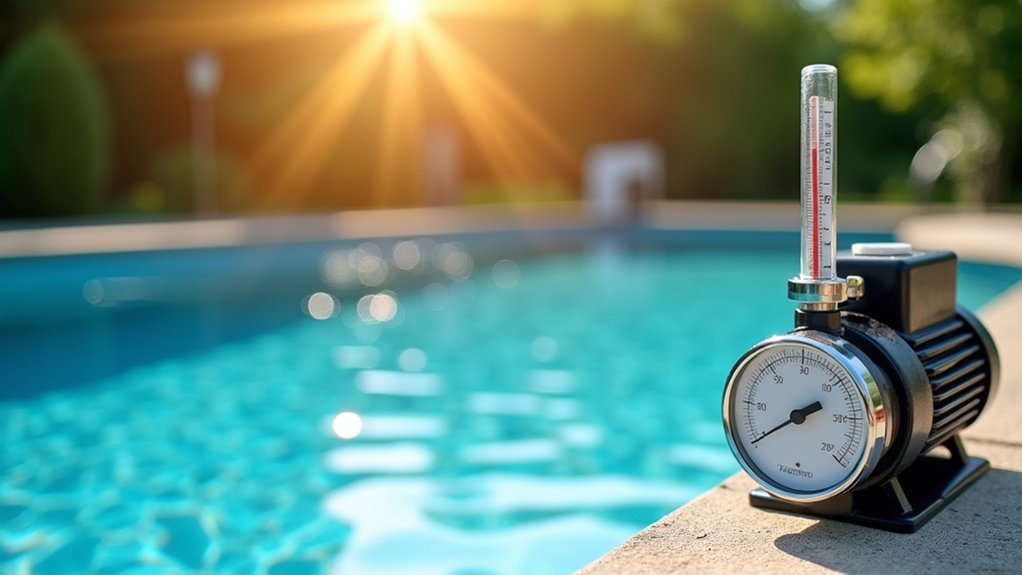
The temperature rule sets your pump runtime at one hour for every 10°F of air temperature. At 80°F, that means roughly 8 hours; at 90°F, plan for about 9 hours or more. This calculation scales your runtime to actual conditions rather than a fixed guess.
Summer heat accelerates chlorine breakdown and raises algae pressure, so add 2 extra hours above your temperature-based baseline. That adjustment offsets higher chemical demand and increased debris load during peak season.
Track your daily high temperature and recalculate as conditions shift. When heat spikes, extend runtime accordingly. This method keeps your water safely circulated and sanitized without overrunning the pump, giving you an efficient, defensible schedule tied directly to measurable temperature data.
How Turnover Rate Sets Your Minimum Runtime
Your turnover rate, the time it takes to filter your pool’s entire volume once, sets the hard floor for daily runtime, and one full turnover is the minimum you should target for safe summer maintenance. To calculate it, use the formula: pool volume ÷ pump flow rate ÷ 60 = hours per turnover, which typically lands between 8 and 10 hours. Once you know that number, treat it as your minimum daily runtime and add more when heat, bather load, or debris increases circulation demand.
Understanding One Turnover
One turnover is the time your pump needs to cycle your pool’s entire water volume through the filter once. You calculate it with a straightforward formula: pool volume ÷ pump flow rate ÷ 60 = hours for one turnover. Most residential pools complete one turnover in 8 to 10 hours, depending on your pump’s flow rate and total gallons.
| Variable | Function |
|---|---|
| Pool volume | Total gallons requiring filtration |
| Flow rate | Gallons per minute your pump moves |
Treat one full turnover as your daily minimum circulation target. Filtering all water once removes contaminants, distributes chlorine evenly, and limits algae growth. When you know your turnover time, you establish a safe baseline runtime and adjust upward as summer conditions demand more filtration.
Calculating Your Turnover
Calculate your turnover by running the numbers on your specific pool. Use the turnover formula: pool volume ÷ pump flow rate ÷ 60 = hours for one turnover. Divide your total gallons by your pump’s gallons-per-minute rating, then divide by 60 to convert minutes into hours. Most pools land at 8 to 10 hours for a single complete turnover, which sets your minimum daily runtime target.
Treat that figure as a floor, not a ceiling. One turnover circulates every gallon through your filter once, the baseline for adequate daily maintenance. If you don’t know your flow rate, check the pump’s specifications or measure it directly. Summer heat, heavy bather load, and debris all push you above this minimum, so calculate first, then adjust upward.
Setting Minimum Runtime
Your minimum runtime equals your turnover time, the number you get after calculating how long your pool takes to complete one full turnover. If your pool completes one full turnover in 8 hours, you shouldn’t run the pump less than that during summer. One turnover circulates your entire water volume through the filter once, which is the minimum needed to distribute chlorine, remove debris, and prevent stagnation.
Treat this floor as non-negotiable. Running below it leaves untreated zones where algae establishes and contaminants accumulate. In summer, you’ll often need more than one turnover because heat accelerates chlorine loss and increases algae pressure.
Set your minimum first, then adjust upward for temperature, bather load, and water clarity. Never schedule below your turnover time. It’s the baseline that keeps your water safe and properly filtered.
How to Calculate One Full Pool Turnover
One full pool turnover equals your pool volume ÷ pump flow rate ÷ 60, which gives you the hours for one turnover. You’ll need two figures: your pool’s total volume in gallons and your pump’s flow rate in gallons per minute (GPM).
Start with volume. If you don’t know it, calculate it from your pool’s dimensions and average depth. Next, confirm your pump’s actual flow rate, which you’ll find on the pump’s specification label or performance curve.
Divide volume by flow rate, then divide by 60 to convert minutes into hours. For example, a 20,000-gallon pool with a 40 GPM pump needs about 8.3 hours per turnover.
Treat one turnover as your minimum daily circulation target, adding runtime when conditions worsen.
How Long to Run a Single-Speed Pump
For a single-speed pump in summer, you should run it 8 to 12 hours per day to maintain proper circulation and chlorine distribution. Adjust for heat by applying the rule of one hour per 10°F of air temperature, then add about 2 hours during peak summer conditions to offset faster chlorine loss and higher algae risk. In extreme heat or heavy-use periods, push runtime toward 12 to 16 hours to protect water quality.
Recommended Daily Hours
Run a single-speed pump 8 to 12 hours per day during summer, with 8 hours serving as the minimum for adequate circulation during normal swim season. Heat accelerates chlorine breakdown and raises algae risk, so lean toward the higher end during hot stretches. Aim for at least one full pool turnover daily, adjusting hours to your pump’s flow rate and water conditions.
- 8 hours, minimum for normal swim season circulation.
- 10 to 12 hours, recommended during summer heat and higher chlorine demand.
- 12 to 16 hours, appropriate in extreme heat or heavy bather load.
- 24 hours, temporary operation when water’s cloudy or algae is present.
Match runtime to temperature and use, verifying you achieve complete daily turnover for safe, sanitary water.
Adjusting For Heat
Adjust your pump runtime for heat by applying the common rule of thumb: run your pump one hour for every 10°F of air temperature. At 80°F, that means roughly 8 hours; at 90°F, plan for 9 or more. Because heat accelerates chlorine breakdown and increases algae pressure, add 2 extra hours above this baseline during peak summer to offset higher chemical demand and debris load. During extreme heat waves, push runtime toward 12 to 16 hours to maintain adequate circulation and sanitizer distribution. Monitor your water clarity and chlorine levels as you adjust. If either slips, extend runtime immediately. Don’t treat one fixed number as safe across the season; scale hours directly with rising temperatures to protect water quality.
How Long to Run a Variable-Speed Pump
Run a variable-speed pump 16 to 24 hours a day or even continuously at low RPM. Unlike single-speed pumps, variable-speed pumps run best over longer periods at low RPM. Low-speed operation moves water efficiently while cutting energy use, so you don’t need to limit runtime the way you would with a single-speed unit. Build your schedule around circulation quality, not short high-power bursts.
- Run 16 to 24 hours daily at low RPM for steady filtration and chemical mixing.
- Add brief high-speed periods for skimming, vacuuming, and thorough chemical distribution.
- Increase runtime toward 24/7 when water turns cloudy or algae appears.
- Confirm one full turnover using pool volume ÷ flow rate ÷ 60.
Match speed and duration to temperature, bather load, and turnover for safe, efficient operation.
How to Schedule a Two-Speed Pump
Schedule a two-speed pump by combining short high-speed blocks with longer low-speed filtration to balance circulation, skimming, and energy use. Run high speed for a few hours during peak sun to improve chlorine mixing and skimming, then shift to low speed for extended filtration. Target at least one full turnover daily, adding runtime when heat, bather load, or debris rise.
| Mode | Runtime | Purpose |
|---|---|---|
| High speed | 2 to 3 hours | Skimming, chemical mixing |
| Low speed | 6 to 10 hours | Continuous filtration |
| High speed (later) | 1 to 2 hours | Evening circulation |
| Total | 8 to 12 hours | One turnover minimum |
For safety, verify flow before adding chemicals, and extend low-speed blocks if water turns cloudy or algae appears until conditions clear.
Best Time of Day to Run Your Pump
The best time of day to run your pump is during the hottest, sunniest part of the day, because heat drives chlorine loss and algae growth. Peak sun accelerates chlorine breakdown, so circulating and skimming during those hours improves chemical mixing and removes floating debris before it sinks.
- Peak sun block: Run several hours midday to counter maximum chlorine demand and UV loss.
- Split cycles: Schedule a morning run plus a shorter evening cycle for consistent turnover.
- Off-peak shift: Move part of your runtime to off-peak evening or overnight hours if you’re on a time-of-use plan.
- Continuous mode: Run 24/7 temporarily when water’s cloudy or algae’s present.
Match timing to your temperature, bather load, and turnover target for efficient, safe operation.
Should You Split Pump Runtime Into Two Cycles?
Yes, splitting your pump runtime into two cycles improves circulation by preventing water from sitting stagnant between filtration blocks. When you run one continuous block, water quality can degrade during the long off period, letting chlorine dissipate and algae gain a foothold. By dividing your total daily runtime, say, 8 to 12 hours, into a morning and evening cycle, you maintain more consistent circulation and chemical distribution.
Schedule your longer cycle during peak sun to maximize chlorine mixing and skimming, then add a shorter later cycle to refresh circulation overnight. This approach suits time-of-use electricity plans, letting you shift part of your runtime into cheaper off-peak hours. Just confirm your combined cycles still deliver at least one full turnover daily to protect water quality.
When to Run Your Pool Pump 24/7
Run your pool pump 24/7 when certain conditions demand continuous operation until water quality recovers. Continuous filtration maximizes turnover and chemical distribution, clearing contaminants faster than intermittent schedules. Run your pump 24/7 when you encounter:
When water quality demands it, run your pump 24/7, continuous filtration clears contaminants faster than any intermittent schedule can.
- Active algae blooms, circulate continuously until the water clears and chlorine holds a stable residual.
- Cloudy or murky water, nonstop filtration removes suspended particles that intermittent cycles leave behind.
- Post-storm debris loads, heavy organic matter increases chlorine demand and clogging risk, requiring sustained flow.
- Difficult water conditions, variable-speed pumps handle 24/7 low-RPM operation efficiently during recovery.
Once your water clears and chemistry stabilizes, return to your standard 8 to 12 hour summer schedule to conserve energy and reduce equipment wear.
Adjusting Pump Runtime for Heavy Swimmer Load
When your pool sees heavy swimmer traffic, you’ll need to add runtime beyond your temperature-based baseline to handle the increased chlorine demand and debris load. Tack on a few extra hours during and after peak use to maintain proper circulation and sanitizer distribution. If the water turns cloudy, run the pump continuously until it clears, since inadequate filtration under heavy load creates conditions where algae and contaminants can take hold.
Extra Hours for Bathers
Add extra runtime whenever swimmer traffic climbs, because bather load directly increases your pool’s circulation demand. Each swimmer introduces contaminants, sweat, oils, sunscreen, organic debris, that raise chlorine demand and burden your filter. Heavy use accelerates chlorine breakdown, so extend runtime beyond your temperature-based baseline to maintain safe sanitizer levels and clear water.
Add extra hours according to swimmer intensity:
- Light use (1 to 2 swimmers): Add 1 hour above your baseline runtime.
- Moderate use (3 to 5 swimmers): Add 2 hours to compensate for increased chlorine demand.
- Heavy use (6+ swimmers): Add 3 to 4 hours to clear heightened contaminant load.
- Pool parties or all-day traffic: Run continuously until water clarity and sanitizer levels stabilize.
Monitor chlorine after heavy sessions to confirm adequate circulation.
Continuous Cycles When Cloudy
Run the pump continuously until clarity returns when your water turns cloudy. Cloudy water almost always signals that your circulation and sanitation can’t keep pace with the contaminant load. Don’t revert to your standard 8 to 12 hour schedule while the water stays hazy, 24/7 operation maximizes filtration passes and keeps sanitizer evenly distributed. Continuous cycling also prevents dead zones where algae can establish. While the pump runs, verify your chlorine level and adjust as needed, since cloudy conditions typically indicate higher demand. Backwash or clean your filter as pressure rises, because trapped debris quickly reduces flow and turnover efficiency. Once clarity returns and readings stabilize, scale back gradually rather than stopping abruptly. Monitor for 24 to 48 hours afterward to confirm the water holds, then resume your normal summer runtime.
Conclusion: Summer Pump Runtime
In peak summer most pools need the pump running about eight to twelve hours a day to turn the water over fully and keep it clear. Heat, heavy swimming, and storms all push that number up, while a cover and a variable-speed pump bring it down. Aim for one full turnover a day and adjust with the conditions, and the water stays clean without needless energy waste.
Shop Reliable Pool Pumps at Discount Prices
Whether you’re replacing an old pump or upgrading to a more energy-efficient model, quality matters for lasting performance. Shop Prime Pool Market for reliable Pool Pumps at discount prices delivered right to your door. Call (877) 650-7665 today or browse our shop and save on every purchase.
Frequently Asked Questions
Does Running the Pool Pump Longer Increase My Electricity Bill Significantly?
It adds to the bill, and on an older single-speed pump the cost can be noticeable. A variable-speed pump running longer at a low setting uses far less power and often costs less overall. Running the pump during off-peak utility hours also trims the expense while still giving the water its full turnover.
Can I Run My Pool Pump Too Much and Damage It?
Running it continuously will not usually damage a healthy pump, but it does add wear and raise the power bill for no real benefit. Once the water has turned over and stays clear, extra hours mostly waste energy. Match the runtime to what the pool needs rather than leaving it on around the clock.
Should I Reduce Pump Runtime on Rainy or Cloudy Summer Days?
Cloudy days alone are not a reason to cut runtime, since the water still needs filtering. After heavy rain you may actually want to run it longer to clear the debris and rebalanced water the storm brought in. Cooler, unused days with a cover on are the times you can safely trim an hour or two.
Does Adding a Pool Cover Reduce How Long I Run the Pump?
It can help. A cover keeps out leaves, dust, and debris, so the filter has less to remove and the water stays cleaner between runs. It also slows evaporation and chemical loss. You may be able to shave some runtime with a cover on, though the pool still needs its daily turnover to stay healthy.
Is It Safe to Run the Pump While Swimming?
Yes, and it is usually the better choice. Running the pump while people swim keeps the water circulating and filtering out the oils and debris that swimmers add. Modern pumps and drain covers are built for this. The main thing is that all drain covers are intact and properly fitted, which any pool should have anyway.